
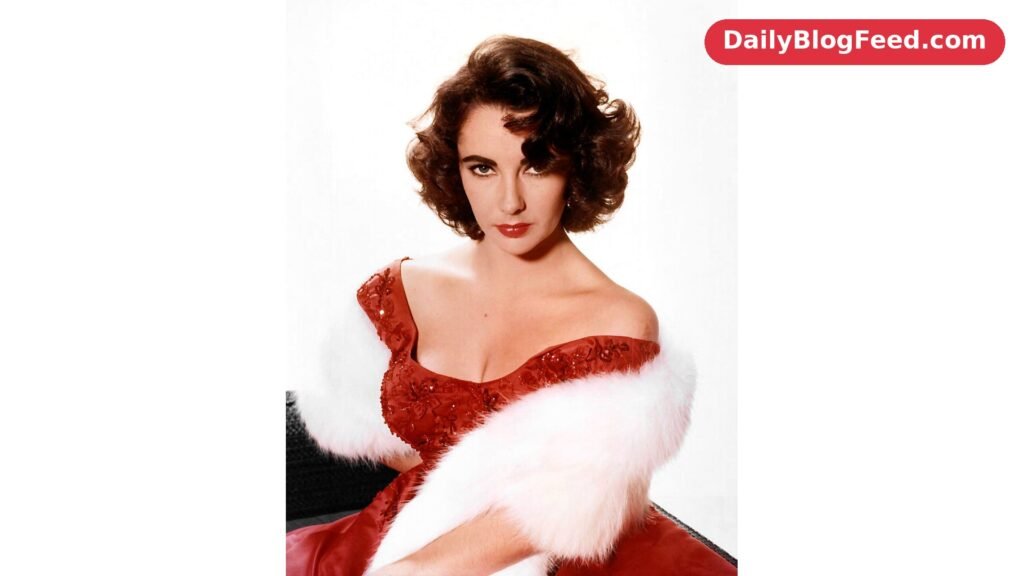

Some stars are famous. Elizabeth Taylor was something rarer: a person whose name alone could stop a room. For nearly seventy years, she was in the public eye, first as a child with unforgettable violet eyes, then as the most glamorous movie star of her generation, and finally as a tireless campaigner who changed how the world talked about AIDS.
People still search for her for the same reasons they always did. They want to know how old she was when she died, how many times she married, who her children are, how much money she left behind, and which films are worth watching first. The answers are remarkable, but they only make sense when you see the whole life behind them.
Quick Facts
| Fact | Detail |
|---|---|
| Full Name | Dame Elizabeth Rosemond Taylor |
| Born | February 27, 1932, London, England |
| Died | March 23, 2011, Los Angeles, California, USA (aged 79) |
| Nationality | British-American |
| Height | About 5 feet 2 inches (reported) |
| Occupation | Actress, businesswoman, humanitarian |
| Years Active | 1941–2007 |
| Marriages | 8 marriages to 7 husbands |
| Children | 4 — Michael Wilding Jr., Christopher Wilding, Liza Todd, Maria Burton |
| Best Known For | National Velvet, A Place in the Sun, Giant, Cat on a Hot Tin Roof, Cleopatra, Who’s Afraid of Virginia Woolf? |
| Major Awards | 2 Academy Awards for Best Actress; Dame Commander of the Order of the British Empire (2000) |
| Net Worth | Estimated $600 million–$1 billion at death (see Net Worth section) |
The London Girl Who Arrived in Hollywood Just in Time
Taylor was born in London to American parents. Her father, Francis Lenn Taylor, was an art dealer, and her mother, Sara Sothern, had been a stage actress. The family lived comfortably in Hampstead Garden Suburb, and Elizabeth grew up surrounded by art, horses, and the kind of polish that would later look effortless on screen.
In 1939, as war gathered over Europe, the family moved to Los Angeles. Taylor was seven. Within a few years she had a contract with Universal Pictures, but it was short-lived: after her small debut in There’s One Born Every Minute (1942), Universal dropped her. MGM picked her up, and that decision shaped the rest of her life.
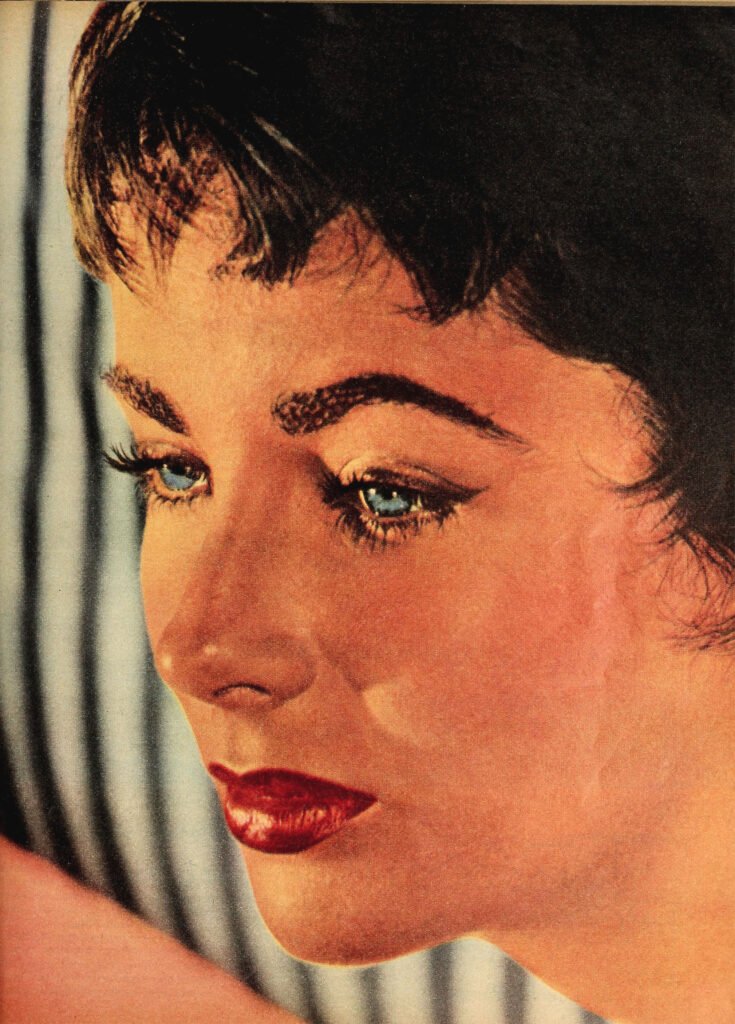
She was not the only child star MGM was molding, but she was the one with the face the camera could not leave alone. The dark hair, the double row of eyelashes, and those famously violet eyes made her instantly recognizable. What the camera could not show was how little control she had over her own childhood.
National Velvet Made Her a Star at Twelve
Her breakthrough came with National Velvet (1944), in which she played Velvet Brown, a girl who disguises herself as a boy to ride her horse to victory in the Grand National. Taylor was twelve, and she did much of her own riding. The film was a huge success and made her one of MGM’s most popular young stars.
The studio years that followed were a mix of glossy pictures and growing pains. Lassie Come Home (1943) had already shown her appeal, and films like Little Women (1949) and Father of the Bride (1950) carried her into young adulthood on screen. Off screen, MGM controlled nearly everything: her roles, her image, and much of her schedule.
She later spoke about resenting that control. She had wanted to stop acting in the early 1950s and disliked many of the films assigned to her. The roles she enjoyed came later, in the mid-1950s, when she finally began to choose work that matched her talent rather than just her face.
Growing Up in Public: From A Place in the Sun to Giant
The turning point was A Place in the Sun (1951), opposite Montgomery Clift. Taylor played Angela Vickers, a wealthy young woman at the center of a tragic love story, and critics praised a performance of real depth. She was no longer just a beautiful child star. She was an actress.
Giant (1956), opposite Rock Hudson and James Dean, confirmed it. Spanning decades, the film asked her to age from a young bride to a grandmother, and she carried it with a maturity that surprised even her admirers. Around the same time, she starred in two adaptations of Tennessee Williams plays: Cat on a Hot Tin Roof (1958) and Suddenly, Last Summer (1959), the latter earning her a Golden Globe for Best Actress.
That run of serious work sits in the same golden era that made Clark Gable the King of Hollywood a generation earlier. Gable had ruled MGM in the 1930s; Taylor inherited his studio, its machinery, and its expectations, and then pushed against all three to become something more than a studio product.
Two Oscars, and the Roles That Earned Them
Taylor won the Academy Award for Best Actress twice. The first came for Butterfield 8 (1960), in which she played Gloria Wandrous, a call girl caught between love and self-destruction. Taylor herself disliked the role, and the win is often remembered as much for her recent illness and public sympathy as for the performance. She accepted it anyway, and it remains part of her record.
The second Oscar was beyond dispute. In the 1966 film Who’s Afraid of Virginia Woolf, opposite Richard Burton, she played Martha, a middle-aged professor’s wife whose marriage has curdled into nightly warfare. Taylor gained weight for the role, let her glamour go, and delivered a ferocious, funny, heartbreaking performance. It is widely considered the finest work of her career, and it won her the Oscar outright.
Between those two wins came the film that nearly swallowed her whole: Cleopatra (1963). The production was famously troubled, wildly over budget, and endlessly covered in the press. Taylor’s reported $1 million salary made her the first actor to command that figure for a single film. The movie itself disappointed at the box office, but the scandal around it, and her affair with co-star Richard Burton, made her the most talked-about woman in the world.
Eight Marriages and the Burton Story
Taylor married eight times, to seven husbands. Her first marriage, at eighteen, was to hotel heir Conrad “Nicky” Hilton Jr. in 1950. It lasted barely a year.
She then married British actor Michael Wilding in 1952, with whom she had two sons, and producer Mike Todd in 1957, with whom she had a daughter.
Todd’s death in a plane crash in 1958 devastated her. She later married his friend, singer Eddie Fisher, in 1959, a union that drew enormous press attention because Fisher had left his own wife, Debbie Reynolds, for Taylor. That marriage ended in 1964.
Then came Richard Burton. They married in 1964, divorced in 1974, remarried in 1975, and divorced again in 1976. Together they made eleven films, and their tempestuous relationship became a global obsession.
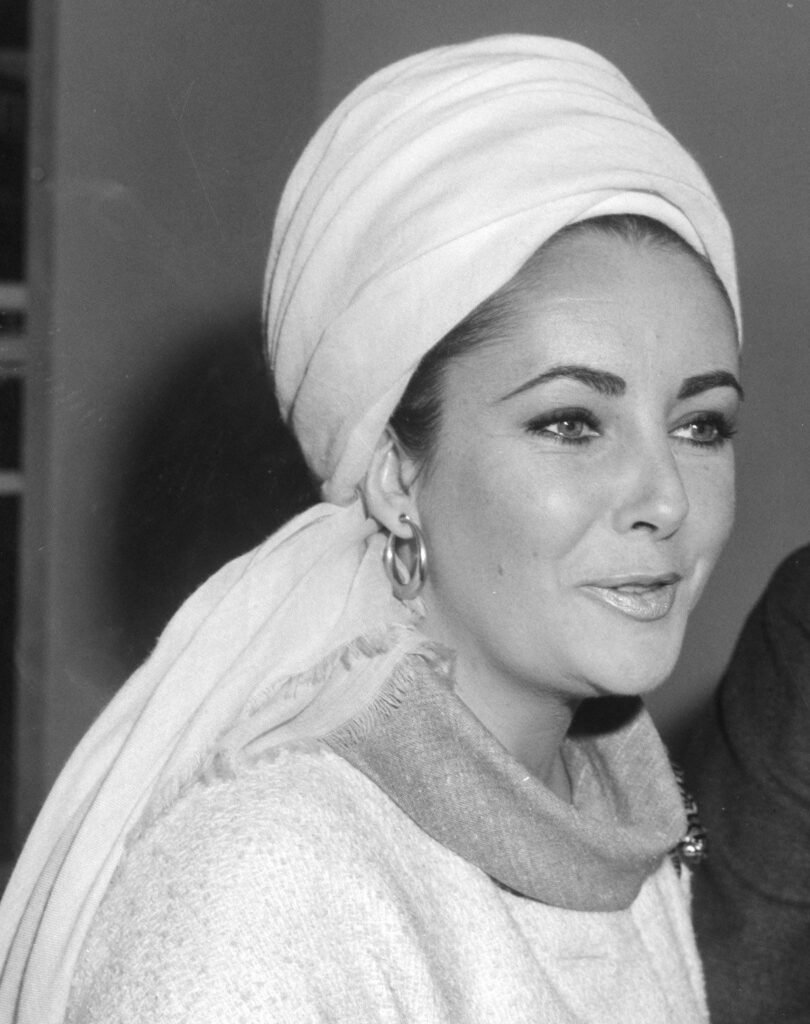
Taylor later described Burton as the great love of her life, even though both marriages ended. She went on to marry Senator John Warner in 1976, divorcing in 1982, and construction worker Larry Fortensky in 1991, divorcing in 1996.
Her four children are Michael Wilding Jr. (born 1953) and Christopher Wilding (born 1955), from her marriage to Michael Wilding; Liza Todd (born 1957), from her marriage to Mike Todd; and Maria Burton, adopted during her marriage to Richard Burton. At her death she was also survived by ten grandchildren and four great-grandchildren, according to contemporary reports.
The Activist Who Changed the Conversation on AIDS
If Taylor’s film career made her famous, her activism made her heroic to a new generation. After her close friend Rock Hudson died of AIDS in 1985, she became one of the first major celebrities to speak out about the disease at a time when stigma and fear kept many public figures silent.
She co-founded the American Foundation for AIDS Research (amfAR) in 1985 and later established the Elizabeth Taylor AIDS Foundation in 1991. She raised millions of dollars, lobbied politicians, and used her fame to insist that people with AIDS deserved compassion and care, not shame. In 2000, she was named a Dame Commander of the Order of the British Empire, an honor that recognized both her acting and her humanitarian work.
This is the part of her legacy that has aged best. Her children singled out this advocacy when they announced her death, praising her brave and relentless fight against HIV/AIDS.
The Businesswoman Behind the Perfume Counter
Taylor was also one of the first stars to build a genuine business empire from her name. Working with Elizabeth Arden, she launched her first fragrance, Passion, in 1987, followed by White Diamonds in 1991. White Diamonds became one of the best-selling celebrity perfumes ever, and she personally supervised the creation of each of the eleven fragrances marketed under her name.
According to her biographers, she earned more from fragrances than from her entire acting career. In 2005 she also founded a jewelry company, House of Taylor.
What Was Elizabeth Taylor’s Net Worth?
Here, honesty requires a range, because the published estimates disagree. Celebrity Net Worth puts her net worth at $600 million at the time of her death in 2011. The Guardian, reporting after her death, estimated her estate at $600 million to $1 billion, with the majority of it consisting of fragrance revenue.
Other outlets have published lower figures, around $300 million, usually by counting only part of the estate. No official valuation of the full estate was ever made public, so the honest answer is that her fortune at death was at least several hundred million dollars, and most likely in the $600 million to $1 billion range cited by the Guardian.
The money came from three sources: a long film career at the top of Hollywood, the fragrance business that out-earned her acting, and a jewelry and art collection of extraordinary value. Unlike many stars of her era, she kept earning long after she stopped making films regularly, because her name itself had become a brand.
Her wealth also puts her in a different league from most of her contemporaries. Cary Grant, another giant of classic Hollywood, died in 1986 with an estimated $60 million, a fortune built on salaries and profit participation. Taylor’s fragrance empire took her far beyond what any acting salary of her era could have produced.
The Final Years and a Fitting Farewell
Taylor’s later years were marked by serious health problems, including heart trouble, back surgeries, and a diagnosis of congestive heart failure in 2004. She made fewer public appearances but remained active in her AIDS foundation work and close to her family.
She died on March 23, 2011, at Cedars-Sinai Medical Center in Los Angeles, of congestive heart failure. She was 79. Her children were with her, and her son Michael Wilding’s statement called her “an extraordinary woman who lived life to the fullest, with great passion, humor, and love.”
She was buried at Forest Lawn Memorial Park in Glendale, California. In 1999, the American Film Institute had already named her the seventh-greatest female screen legend, a ranking that now looks conservative.
There is a useful contrast with the generation that followed her. Marlon Brando reshaped acting itself in the 1950s, bringing a raw, Method-driven realism that made the old studio style look polished and distant. Taylor never tried to be Brando. She stayed a star in the older sense, larger than life, and proved that the old kind of stardom could still carry real weight when it was pointed at something that mattered.
Things You Might Not Know About Elizabeth Taylor
- She was born with a rare genetic condition, distichiasis, which gave her a double row of eyelashes and deepened the famous violet color of her eyes.
- She was the first actor ever paid $1 million for a single film role, for Cleopatra.
- She won her first Oscar for a role she openly disliked, in Butterfield 8.
- She was made a Dame by Queen Elizabeth II in 2000, becoming Dame Elizabeth Taylor.
- Her jewelry collection sold at auction for $156.8 million, a record for a private jewelry collection.
- She turned down the chance to play the lead in several major films in the 1950s because she disliked the scripts, even while under contract to MGM.
Frequently Asked Questions
How old was Elizabeth Taylor when she died?
Elizabeth Taylor was 79 when she died on March 23, 2011, in Los Angeles. She was born on February 27, 1932, in London, England.
How many times was Elizabeth Taylor married?
She married eight times, to seven husbands: Conrad Hilton Jr., Michael Wilding, Mike Todd, Eddie Fisher, Richard Burton (twice), John Warner, and Larry Fortensky.
Who are Elizabeth Taylor’s children?
Her four children are Michael Wilding Jr. and Christopher Wilding (with Michael Wilding), Liza Todd (with Mike Todd), and Maria Burton, whom she adopted during her marriage to Richard Burton.
What was Elizabeth Taylor’s net worth?
Celebrity Net Worth estimates $600 million at her death, while The Guardian estimated her estate at $600 million to $1 billion, mostly from fragrance revenue. No official total was ever published, so the range itself is the honest answer.
What are Elizabeth Taylor’s best movies?
Start with National Velvet (1944) for the child star, A Place in the Sun (1951) and Giant (1956) for her dramatic peak, Cat on a Hot Tin Roof (1958) for Tennessee Williams, and Who’s Afraid of Virginia Woolf? (1966) for her Oscar-winning masterpiece.
What did Elizabeth Taylor do for AIDS research?
After Rock Hudson’s death in 1985, she co-founded amfAR and later founded the Elizabeth Taylor AIDS Foundation in 1991, raising millions and campaigning publicly at a time when few celebrities would speak about AIDS.
Conclusion
Elizabeth Taylor lived several lives in one: child star, studio property, Oscar winner, scandal queen, wife eight times over, businesswoman, and finally humanitarian. Any one of those lives would have been enough for fame. Together, they made her one of the defining figures of the twentieth century.
What endures is not just the beauty or the jewelry or even the films, though the best of them still hold up. It is the way she used the fame she never asked for, first to survive Hollywood, and then to help others survive something far worse. That is why, more than a decade after her death, people are still searching for her name.