
Everyone wanted to be Cary Grant. Even Cary Grant wanted to be Cary Grant — or so the famous line goes, and he was cheerful enough to repeat it himself. It was a joke, but it was also the plain truth about how he lived.
Because Cary Grant did not really exist, at least not at first. He was invented, piece by piece, by a poor boy from Bristol named Archie Leach, who decided that the life he had been handed was not the one he intended to keep.
What Archie built became the most copied act in Hollywood history. The suits, the voice, the timing, the ease — all of it was learned and perfected by a man who understood, earlier than almost anyone, that a star could be a creation.
Quick Facts
| Detail | Information |
|---|---|
| Full Name | Cary Grant (born Archibald Alec Leach) |
| Born | January 18, 1904, in Horfield, Bristol, England |
| Died | November 29, 1986, in Davenport, Iowa, aged 82 |
| Birthplace | Horfield, Bristol, England |
| Nationality | British-born, American (citizen from 1942) |
| Occupation | Actor, businessman |
| Spouse | Virginia Cherrill, Barbara Hutton, Betsy Drake, Dyan Cannon, Barbara Harris |
| Children | Jennifer Grant |
| Net Worth | About $60 million at his death in 1986 (estimated) |
What Was Cary Grant’s Real Name?
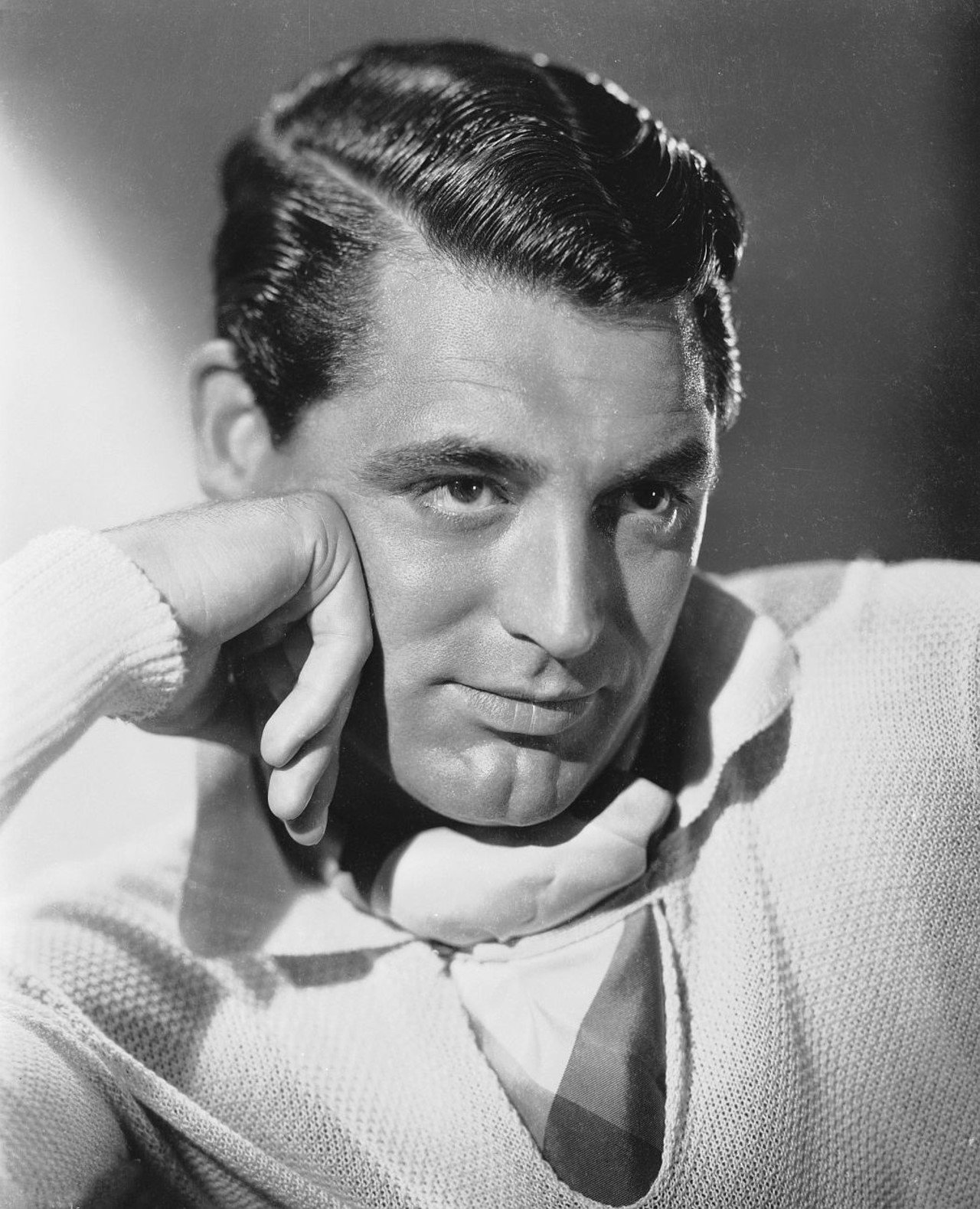
He was born Archibald Alec Leach on January 18, 1904, in Horfield, a working-class suburb of Bristol, England. Archie was fine for Bristol. It was never going to do for Hollywood.
His father, Elias Leach, pressed clothes for a living and drank too much. His mother, Elsie, was the warmer presence in the house, and young Archie adored her. His older brother, John, had died young, and loss hung over the family long before Archie understood it.
Then, when he was about nine years old, his mother vanished. He came home and she was simply gone.
The Mother He Was Told Had Died
His father told him that his mother had gone away. Later, the story changed, and Archie was led to believe that she had died. Neither version was true.
Elias had in fact had Elsie committed to a mental institution. She was alive, locked away, while her son grew up believing she was dead. Grant later traced much of his guardedness with women back to that loss.
He was 31, and already a film star, before he learned the truth. He settled his mother in a home in Bristol and visited her for the rest of her life. The visits were devoted, even if the lost years could never be given back.
How Did Archie Leach Escape Bristol?
The escape route was not school. It was the stage. As a boy, Archie had fallen for the theatre — the lights, the laughter, the sense that people up there got to be somebody else.
At about 13 or 14, he ran away to join Bob Pender’s troupe of acrobats and stilt walkers. He learned to tumble, to walk on stilts, to fall down on cue and make an audience love him for it.
That training never left him. Decades later, the grace critics praised in his films — the way he moved through a room, the comic falls timed to the second — had been learned as a teenager in music halls.
Crossing to America
In 1920, Pender’s troupe sailed to America to tour. Archie was 16, in a country that seemed to reward exactly the reinvention he had in mind. When the tour ended, he stayed.
The years that followed were lean. He worked in Broadway musicals, light operas and revues, building the accent, the walk and the polish as he went.
By the time Hollywood came calling, the raw material was ready. In 1932, Paramount signed him, and Archie Leach began the final stage of becoming someone else.
How Was “Cary Grant” Invented?
The studio wanted a new name, as studios usually did. “Cary” came from a character he had played on stage. “Grant” was picked from a list the studio offered him. It was practical, unglamorous and completely decisive — from then on, he answered to it everywhere.
What followed was a few years of forgettable films while he learned the camera. Then Mae West chose him for two pictures in 1933, She Done Him Wrong and I’m No Angel, and audiences noticed the dark, dimpled fellow standing next to her.
Still, the real breakthrough was comedy. Screwball let him use everything the music halls had taught him — the falls, the panic, the dignity punctured at exactly the right moment.
The Screwball Years
The Awful Truth in 1937 showed what he could do, and it showed it to everyone. Playing a husband in a divorce comedy opposite Irene Dunne, he was light, quick and completely modern. The film made him a major star.
Bringing Up Baby followed in 1938, with Katharine Hepburn, a leopard and Grant as a flustered palaeontologist losing control of everything. It was not a big hit on release. It is now considered one of the greatest comedies ever made.
Holiday, also in 1938, gave him a gentler role opposite Hepburn again. Then came His Girl Friday in 1940, where, as newspaper editor Walter Burns, he delivered some of the fastest dialogue in film history without ever seeming to hurry.
The Philadelphia Story, also in 1940, put him alongside Hepburn and James Stewart, and he held his own in exalted company. Arsenic and Old Lace, released in 1944, let him mug shamelessly as a man discovering his sweet aunts are murderers. He thought he overacted. Audiences adored it anyway.
A Different Kind of Leading Man
Grant’s rise is more striking when you set it beside the other great leading men of the 1930s. Clark Gable, for instance, represented a rougher, more bluntly masculine appeal — the king of Hollywood, all swagger and certainty. Grant offered something else entirely.
He made elegance funny. He could wear a suit better than anyone in pictures, then trip over a chair in it, and somehow the suit looked even better afterwards. Women wanted him, and men wanted to be him rather than fight him.
He could do serious work too. Gunga Din in 1939 was a rousing adventure. Penny Serenade in 1941 earned him his first Academy Award nomination, and None but the Lonely Heart in 1944 brought his second — remarkably, the only competitive ones of his career.
How Did Hitchcock Use Cary Grant?
Alfred Hitchcock understood something about Grant that other directors missed. Beneath the charm, there was a shadow — a watchfulness, even a hint of menace. Hitchcock built four films around that double quality, and all four are classics.
Suspicion, in 1941, cast him as a charming husband who may or may not be planning to murder his wife. The studio softened the ending, but the unease Hitchcock drew out of Grant’s smile stayed with viewers.
Notorious, in 1946, is the masterpiece of the partnership, and perhaps of Grant’s whole career. Opposite Ingrid Bergman, he played an agent who lets the woman he loves marry another man for the sake of a mission. He is cold, wounded and magnetic, sometimes in the same shot.
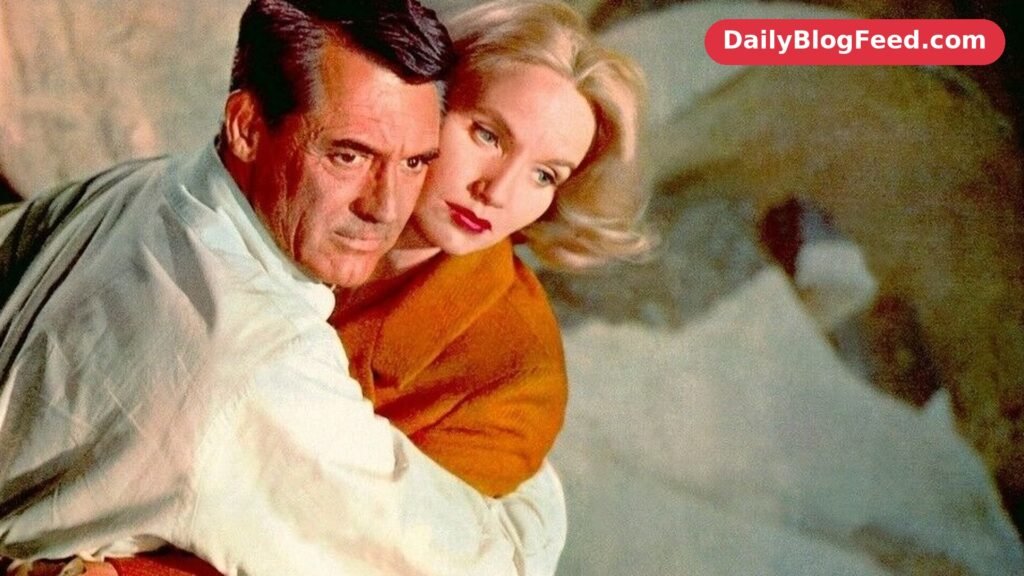
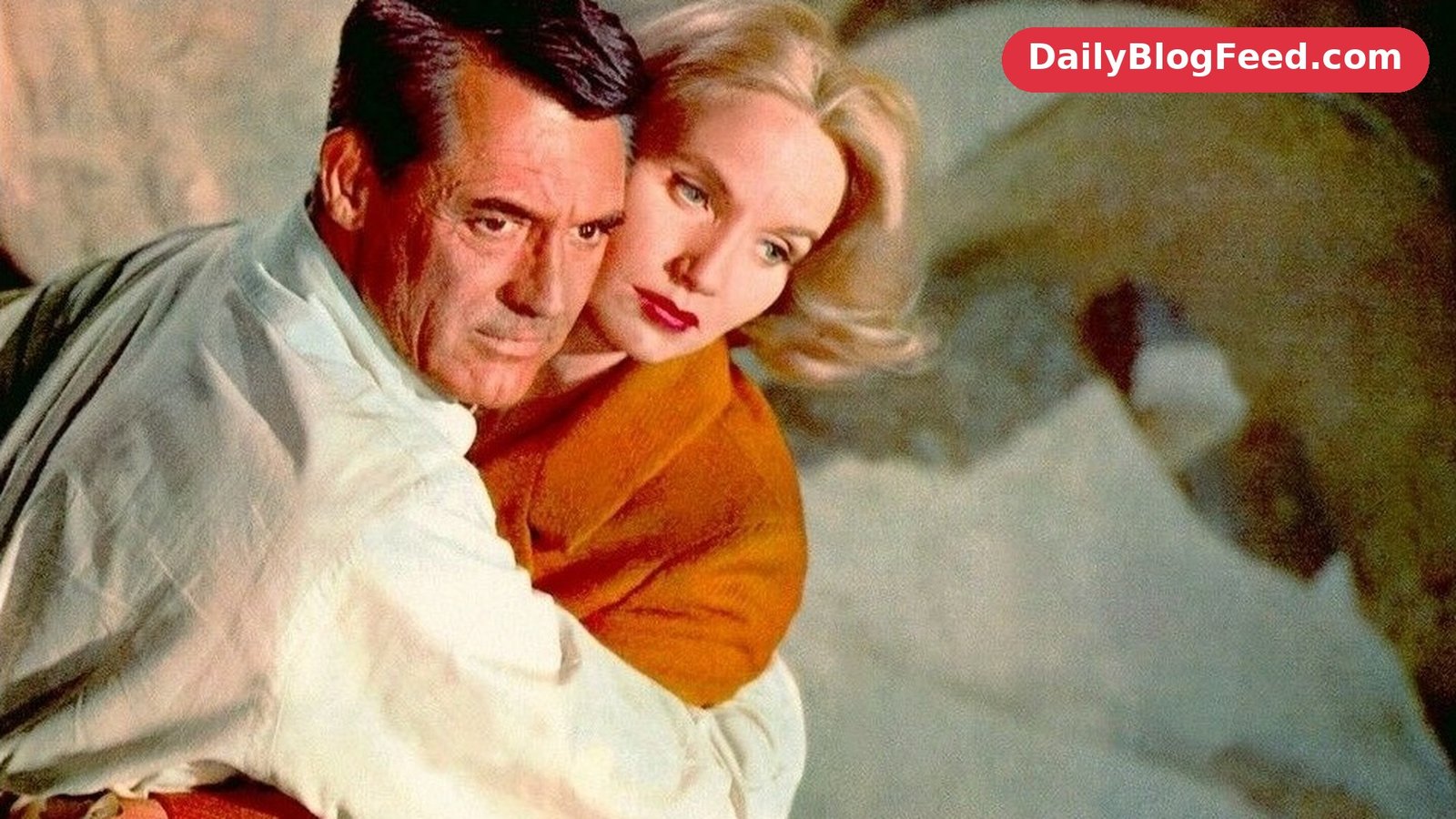
To Catch a Thief, in 1955, went the other way — Riviera sunlight, wit and romance opposite Grace Kelly. Then came North by Northwest in 1959, the perfect summing-up. Chased across America in that famous grey suit, mistaken for a man who does not exist, Grant essentially played “Cary Grant” under maximum pressure.
Going Independent
Off screen, Grant was quietly rewriting the rules of the business. He became one of the first major stars to walk away from the studio contract system and work independently, picture by picture. Instead of a salary, he negotiated a share of the profits.
It was a gamble that paid off handsomely, and other stars took note. The modern deal — the star as partner rather than employee — owes a great deal to the man from Bristol who had learned early what it meant to have no security at all.
His later years in pictures mixed hits with that freedom. An Affair to Remember in 1957 made generations weep. Indiscreet in 1958 and Operation Petticoat in 1959 were popular successes. Charade in 1963, opposite Audrey Hepburn, showed the old machinery working beautifully, and Father Goose in 1964 was another hit.
His final film was Walk, Don’t Run in 1966. He was 62, still bankable, still in demand. He simply stopped, and the reason was waiting at home.
What Was Cary Grant’s Net Worth?
Grant died a very wealthy man, earned the modern way — not just from salaries, but from holding a stake in his own success. Decades of profit participation, careful investing and cautious spending added up.
Celebrity Net Worth estimates that he was worth about $60 million at his death in 1986, roughly $130 million or more in today’s money. As with many estates of that era, the exact total was never laid out neatly for the public.
His will was deliberately vague about the overall sum. The estate was split mainly between his widow, Barbara Harris, and a trust for his daughter, Jennifer. He also served on corporate boards that included Fabergé and MGM Grand — a long way from Horfield.
Who Was Cary Grant’s Wife?
There were five Mrs. Grants, and the list spans half a century of Hollywood history. His first marriage, to actress Virginia Cherrill, lasted from 1934 to 1935, when he was still a rising contract player finding his feet.
The second marriage drew the most headlines. In 1942 he married Barbara Hutton, the Woolworth heiress and one of the richest women in the world. The press, unable to resist, dubbed them “Cash and Cary.” The marriage ended in 1945, but the two stayed friends, and Grant always refused to speak badly of her.
His third marriage, to actress and writer Betsy Drake, lasted from 1949 to 1962. Drake influenced him deeply — she encouraged his interest in therapy and self-examination, a thread that runs through his later life.
The Later Marriages
In 1965 he married actress Dyan Cannon, more than three decades his junior. Their marriage was brief and, by most accounts, difficult, ending in 1968. But it gave him the thing he had wanted for years and almost stopped expecting.
His fifth marriage came in 1981, when he was 77. Barbara Harris was decades younger, and by every account this late marriage was a happy one. She travelled with him on his speaking tours, and he credited her with a settled contentment he had not known before.
Five marriages suggest a restless man, and Grant would not have argued much. He admitted his early marriages suffered from his own guardedness — that old wound from Bristol again. Late in life, he finally seemed at peace with Archie Leach too.
Did Cary Grant Have Children?
Yes — one child, and she changed everything. His daughter, Jennifer Grant, was born on February 26, 1966, to Grant and Dyan Cannon. He was 62 years old, an age when most stars are polishing their legends.
Instead, he retired. Grant walked away from films that same year to raise his daughter, and he never went back, despite offers that would have tempted anyone else. He called being Jennifer’s father his favourite role, and for once there was no performance in it at all.
He was a devoted, hands-on father through her childhood and teens. Jennifer later acted herself, including a role in Beverly Hills, 90210, and in 2011 she published a memoir, Good Stuff, a warm portrait of growing up as Cary Grant’s daughter.
How Old Was Cary Grant When He Died?
Grant was 82 when he died on November 29, 1986, in Davenport, Iowa. He had become a United States citizen back on June 26, 1942, legally changing his name to Cary Grant on the very same day — Archie Leach formally retired, even on paper.
In retirement he toured with a one-man show called A Conversation with Cary Grant, answering questions from audiences who simply wanted an evening in his company. He was in Davenport preparing for one of those appearances when he suffered a cerebral hemorrhage — a stroke — and died that day.
The honours had arrived, belatedly, while he lived. He received an Honorary Academy Award in 1970, presented by Frank Sinatra, and the Kennedy Center Honors in 1981. The American Film Institute later ranked him the second greatest male star of classic cinema, behind only Humphrey Bogart — a ranking most film lovers would call exactly right.
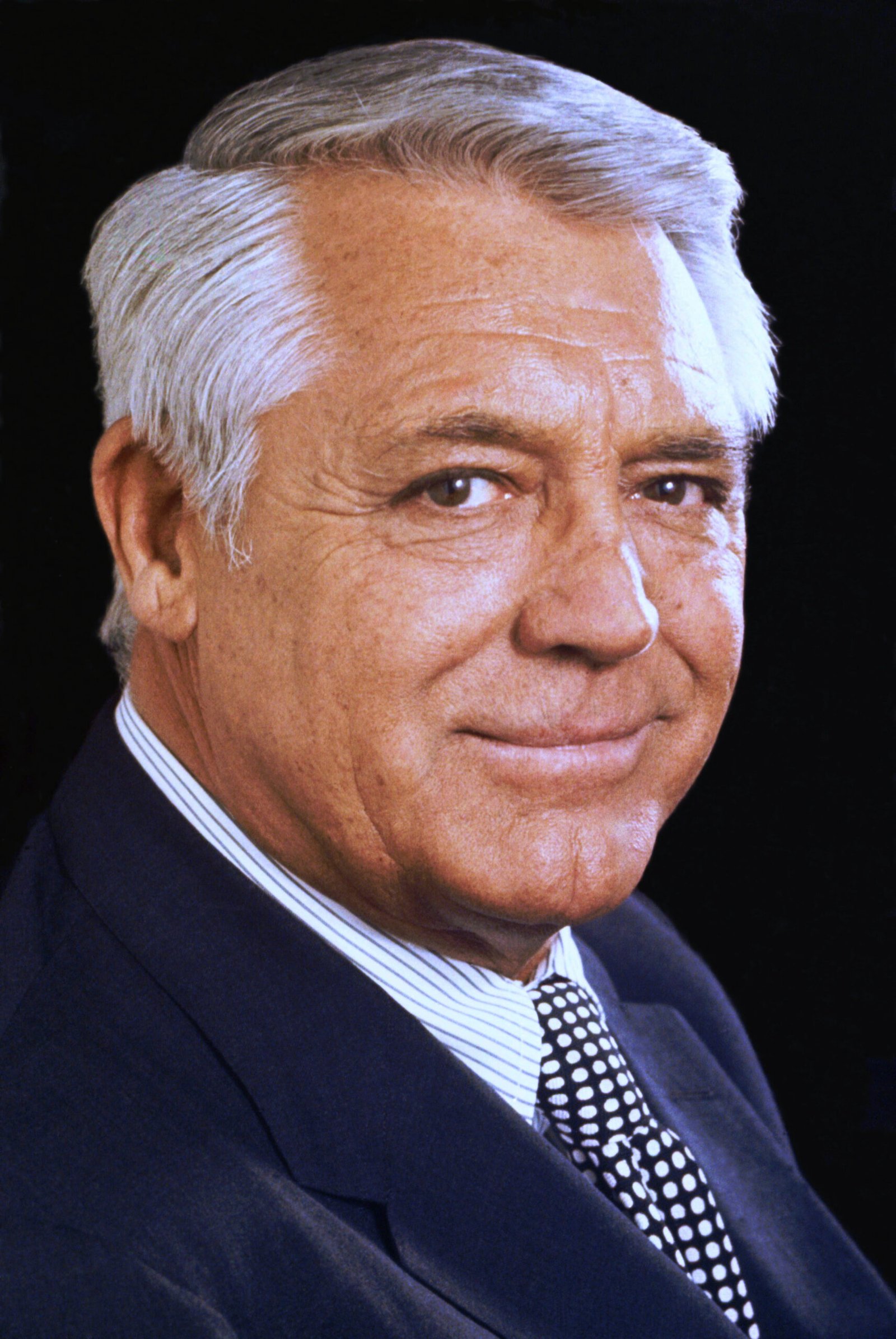
Lesser-Known Facts About Cary Grant
- He was famously careful with money, a habit friends linked to his poor childhood. One well-worn story says he cut the buttons off old shirts before throwing them away — and when interviewers teased him about it, he defended the practice as common sense.
- In the late 1950s and early 1960s, encouraged by Betsy Drake, he underwent LSD therapy roughly 100 times under Dr. Mortimer Hartman, when the drug was legal in clinical settings. He spoke openly about how the sessions helped him confront his childhood.
- His stilt-walking days never left him. Directors knew he could do his own comic falls better than most stunt performers, a skill learned as a teenage acrobat.
- He felt he was too old to play James Bond when the role was discussed in the early 1960s, despite being the kind of suave leading man the part was modelled on, and let it pass.
- Despite only two competitive Oscar nominations and no wins, his Honorary Award in 1970 drew one of the warmest ovations in the ceremony’s history.
- He kept his mother’s story private for much of his career. Elsie lived into old age in Bristol, supported by her son, and he visited her regularly on trips to England.
- His dimple and mid-Atlantic accent were endlessly imitated, usually in “Cary Grant” impressions that sounded nothing like him. He found them funny, and said so.
Frequently Asked Questions
How old was Cary Grant when he died?
He was 82. Born on January 18, 1904, he died on November 29, 1986, in Davenport, Iowa, after suffering a cerebral hemorrhage while preparing for an appearance on his one-man tour.
What was Cary Grant’s real name?
He was born Archibald Alec Leach in Horfield, Bristol. He took the stage name Cary Grant after signing with Paramount in 1932, and made it his legal name when he became a US citizen in 1942.
How many times was Cary Grant married?
Five times: to Virginia Cherrill, Barbara Hutton, Betsy Drake, Dyan Cannon and Barbara Harris, who remained his wife until his death in 1986.
Did Cary Grant have any children?
Yes, one daughter, Jennifer Grant, born in 1966 to Grant and Dyan Cannon. He retired from films at 62 to raise her and called fatherhood his favourite role.
What are Cary Grant’s most famous movies?
His best-loved films include North by Northwest, Notorious, His Girl Friday, Bringing Up Baby, The Philadelphia Story, To Catch a Thief, An Affair to Remember and Charade.
Final Thoughts
Most stars are discovered. Cary Grant was manufactured — by the one person with the strongest reason to build him. Archie Leach needed Cary Grant the way some people need a lifeboat, and he spent 30 years of films letting the rest of us climb aboard too.
What is remarkable is that the invention never felt like a lie. The wit, the warmth and the elegance were real; they were just earned the hard way, by a boy who lost his mother to a lie and taught himself, fall by fall, how to land on his feet.
He stopped acting at 62 to be a father, died at 82 still working a stage, and left behind a standard no leading man has quite matched since. Everyone wanted to be Cary Grant. Archie Leach actually managed it — and the full Cary Grant filmography shows just how completely he managed it.