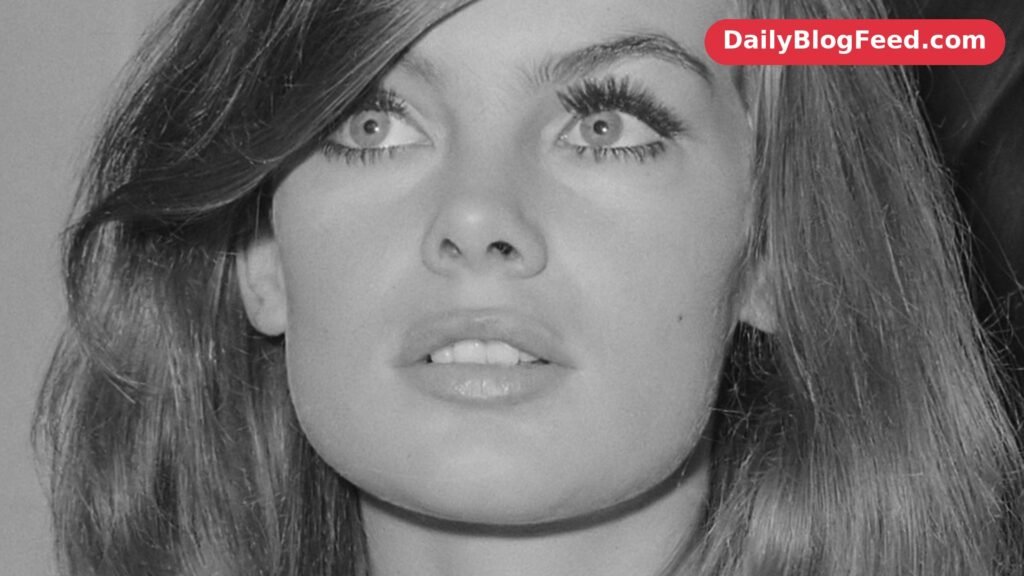

Jean Shrimpton did not set out to change fashion. She enrolled at a secretarial college in London at seventeen, a practical choice for a teenager from High Wycombe, and only drifted toward modelling after a chance meeting pointed her to a charm school course. Within a few years, however, her face was everywhere. Magazine covers, newspaper photographs, and a new kind of fame followed her, and the shy young woman became shorthand for an entire decade.
That contrast is what makes her story last. Shrimpton was called one of the world’s first supermodels, an icon of Swinging London, and, in 2012, one of the 100 most influential fashion icons since 1923 by Time. Yet she never seemed entirely comfortable with the attention. She worked hard, earned a great deal for the time, and then walked away while she was still young, choosing a quieter life in Cornwall over a permanent place in the spotlight.
This profile sticks to what reputable sources document: her early life, her rise with photographer David Bailey, the famous Melbourne dress, her brief acting career, her marriage and family, and the honest limits of what is known about her wealth. Where a figure is not reliably reported, this article says so rather than filling the gap with a guess.
Quick Facts
| Detail | Information |
|---|---|
| Full name | Jean Rosemary Shrimpton |
| Born | 7 November 1942, High Wycombe, Buckinghamshire, England |
| Age | 83 in November 2026 |
| Height | 5 ft 10 in (1.78 m) |
| Occupations | Fashion model, actress, hotelier, antique dealer |
| Nickname | The Shrimp |
| Spouse | Michael Cox (married 1979) |
| Children | 1 son, Thaddeus |
| Sister | Chrissie Shrimpton |
| Known for | Swinging London icon; one of the first supermodels; popularising the miniskirt look |
A Buckinghamshire Childhood Far From the Catwalk
Jean Rosemary Shrimpton was born on 7 November 1942 in High Wycombe, Buckinghamshire, and educated at St Bernard’s Convent School in Slough. Her upbringing was not glamorous in the way her later life would appear in photographs. She grew up in a world of school, family, and ordinary routines, and nothing about those early years suggested that she would soon be photographed by the most celebrated photographers of her generation.
At seventeen she enrolled at Langham Secretarial College in London. That decision matters because it shows how accidental her entry into modelling was. A meeting with film director Cy Endfield did not lead to a screen role, but Endfield suggested she take the model course at the Lucie Clayton Charm Academy. She did, and in 1960, still aged seventeen, she began modelling.
Early work came quickly. She appeared on the covers of magazines such as Harper’s Bazaar, Vanity Fair, and Vogue, and the bookings kept coming. Her look was different from the curvier ideal that had dominated the previous decade.
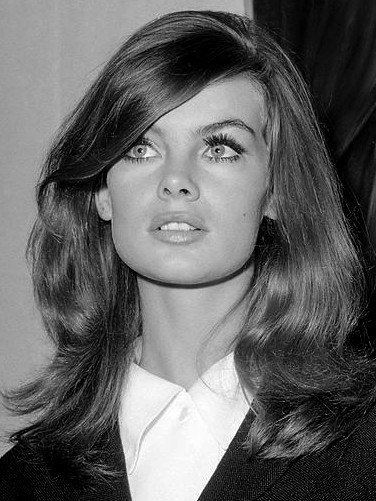
She was tall and slim, with long hair and a fringe, wide eyes, long lashes, arched brows, and a full mouth. Photographers noticed. So did readers, who began to copy what she wore.
The Bailey Years and a New Kind of Fame
Shrimpton rose to prominence through her work with photographer David Bailey. They met in 1960 at a shoot where she was working with photographer Brian Duffy on a Kellogg’s cornflakes advertisement. Duffy reportedly told Bailey she was too posh for him. Bailey was not put off, and the partnership that followed helped define both of their careers.
Bailey photographed Shrimpton in a fresh, informal way that suited the changing mood of early 1960s London. The pictures felt young and modern rather than stiff and formal. Their collaboration, including the celebrated “Young Idea Goes West” series shot in New York for British Vogue in 1962, made her a star and strengthened Bailey’s reputation as a defining photographer of the era. Like Sean Connery, who became a defining British screen figure of the same decade, Shrimpton gave the 1960s a face the public could recognise instantly.
Their personal relationship lasted about four years and ended in 1964. It was widely covered at the time, and it later became the subject of the BBC Four film We’ll Take Manhattan in 2012, with Karen Gillan playing Shrimpton. The dramatisation is a reminder of how closely her image was tied to Bailey’s camera in the public mind, even though her career extended well beyond that one partnership.
By the mid-1960s she was described as the world’s highest-paid model and the most photographed woman in the world. She appeared on the covers of Vogue, Harper’s Bazaar, Vanity Fair, Glamour, Elle, Ladies’ Home Journal, Newsweek, and Time. In 2009, Harper’s Bazaar named her one of the 26 best models of all time. Those honours came later, but they confirm what was already obvious in 1965: Shrimpton was not simply a successful model, but a cultural figure.
The Melbourne Dress That Made History
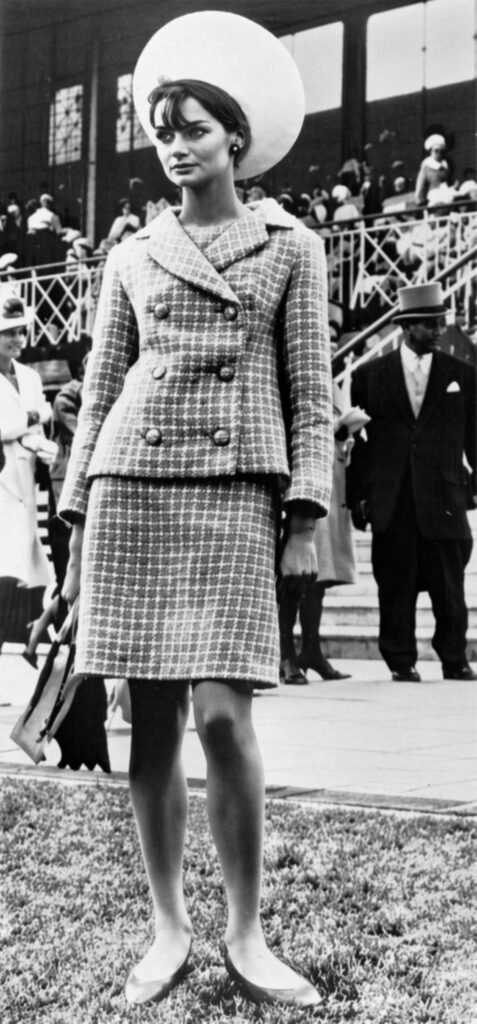
No single moment explains Shrimpton’s influence better than her visit to Australia in 1965. She travelled to Melbourne for a two-week promotional visit and attended the Victoria Derby, part of the Melbourne Cup Carnival, wearing a white shift dress made by Colin Rolfe. The dress ended several inches above her knees. She wore no hat, no stockings, and no gloves, and she wore a man’s watch.
To a modern reader, that outfit sounds unremarkable. In conservative Melbourne in 1965, it was a sensation. Newspapers reported it, condemned it, and printed photographs of it on their front pages around the world.
Shrimpton later said she had not set out to cause a scandal. She had simply worn what she thought was suitable, and the reaction took her by surprise.
Historians now point to that day as a key moment in popularising the miniskirt. Shrimpton did not invent the garment on her own, and designers such as Mary Quant were central to its rise, but her appearance gave the shorter hemline a famous, photographed moment. It captured the wider shift of the decade: younger women, shorter skirts, and a break with the formal dress codes their mothers had followed. The dress itself became part of fashion history, even though Shrimpton herself treated it as an ordinary choice at the time.
A Brief Turn to Acting
As her modelling career tapered off toward the end of the decade, Shrimpton tried acting. She starred alongside Paul Jones in the 1967 film Privilege, in which Jones played a pop star manipulated by powerful interests. The film has since gained a cult reputation, but it was not a commercial success at the time, and Shrimpton did not pursue a sustained screen career.
That short acting chapter is useful because it shows the limits of translating modelling fame into another field. She had presence in still photographs, but film demanded a different skill, and she did not enjoy the work in the same way. Like Roger Moore, another British star whose public image was carefully built in the 1960s, Shrimpton understood the power of a look, yet she chose not to chase stardom once the work stopped satisfying her.
She also published an autobiography, Jean Shrimpton: An Autobiography, in 1990. The book gave her a chance to tell her own story after decades in which other people had mostly told it for her. By then she had long since left London’s fashion world behind, and the memoir arrived as a reflection rather than an attempt at a comeback.
Leaving London for Cornwall, Marriage, and Family
Shrimpton’s most decisive choice came in the 1970s, when she stepped back from modelling and moved to Cornwall. She opened an antiques shop, and she and photographer Michael Cox later ran the Abbey Hotel in Penzance. It was a deliberate change of pace: from constant photography and travel to running a business, raising a family, and living largely out of the public eye.
She married Michael Cox in 1979, at a registry office in Penzance, when she was four months pregnant with their son Thaddeus, who was born later that year. That detail is well documented, and it corrects the simpler version of her story in which she simply disappeared. She did not vanish. She married, became a mother, and built a working life in a place far from London’s studios.
Her sister Chrissie Shrimpton was also a model and actress, which means fashion and performance ran through the family, even if Jean’s path took her away from them. Reports in later years described Thaddeus and his family as involved in managing the Abbey Hotel. Shrimpton herself gave few interviews, and that privacy has sometimes been mistaken for mystery. In truth, her later life looks less like a disappearance and more like a preference: she wanted ordinary days, and she arranged her life to have them.
Her earlier relationship with actor Terence Stamp is also part of the public record, and like her time with Bailey, it belongs to her London years. Those relationships were widely reported because she was famous, not because she courted publicity. By the time she settled in Cornwall, the tone of her life had changed completely.
What Is Jean Shrimpton’s Net Worth?
There is no reliable, publicly reported net worth figure for Jean Shrimpton, and this article does not invent one. Reputable biographical sources note that she was extremely well paid at her peak, with contemporary reports in 1965 citing earnings of around $60 per hour, an unheard-of sum for a model at the time. That hourly figure is a useful measure of her standing, but it is not a net worth, and it cannot be turned into one without guessing about decades of spending, business income, and property.
Later work as an antiques dealer and hotelier would also have affected her finances, but no authoritative outlet has published a verified estimate. Some celebrity-wealth websites publish numbers for almost everyone, yet those figures for Shrimpton are not backed by the kind of reporting that would make them safe to repeat. The honest answer is therefore that her peak earnings are documented, her current wealth is not publicly disclosed, and any single number presented as fact should be treated with scepticism.
That gap does not diminish her importance. Shrimpton’s influence was cultural rather than purely financial. She helped change what a model could be: not an anonymous clothes hanger, but a named personality whose face sold magazines and whose choices shifted fashion. That legacy is easier to measure in covers, honours, and influence than in a bank balance.
Lesser-Known Facts About Jean Shrimpton
- She began modelling in 1960 after a secretarial college course and a charm school course, not after years of planning a fashion career.
- Her nickname, “The Shrimp,” referred to her slim, leggy build, and she reportedly disliked it.
- Photographer Cecil Beaton once described her features in memorable terms, calling attention to her distinctive face rather than a conventional prettiness.
- She was photographed by Richard Avedon, Irving Penn, and Cecil Beaton, among the leading photographers of her era.
- Her 1965 Melbourne outfit is often cited as a turning point for the miniskirt, even though she did not design the dress herself.
- She starred in only one major film, Privilege (1967), before leaving acting behind.
- She later ran an antiques business and a hotel in Cornwall, a complete change from her London career.
- In 2012, Time named her one of the 100 most influential fashion icons since 1923.
Frequently Asked Questions
How old is Jean Shrimpton?
Jean Shrimpton was born on 7 November 1942, which made her 83 years old in November 2026. She was 17 when she began modelling in 1960 and in her early twenties at the height of her fame in the mid-1960s.
Who is Jean Shrimpton’s husband?
Jean Shrimpton’s husband is photographer Michael Cox, whom she married in 1979 in Penzance, Cornwall. The couple went on to run the Abbey Hotel in Penzance together, and they have one son, Thaddeus.
Does Jean Shrimpton have children?
Yes. Jean Shrimpton has one child, a son named Thaddeus, who was born in 1979. Later reports have described Thaddeus and his family as involved in managing the Abbey Hotel in Penzance.
Why is Jean Shrimpton famous?
Jean Shrimpton is famous as an icon of Swinging London and one of the world’s first supermodels. She appeared on numerous major magazine covers, worked with David Bailey and other leading photographers, and helped popularise the miniskirt look after her famous 1965 appearance in Melbourne.
What film did Jean Shrimpton act in?
Jean Shrimpton starred alongside Paul Jones in the 1967 film Privilege. It was her main acting role, and she did not build a long film career afterwards, choosing instead to step back from public life and later run businesses in Cornwall.
What is Jean Shrimpton’s net worth?
No reliable, publicly reported net worth figure exists for Jean Shrimpton. She was very highly paid at her peak in the mid-1960s, but her later business income and personal finances have not been disclosed in authoritative reporting, so this profile does not publish an estimated total.
Conclusion
Jean Shrimpton’s career was short by modern standards, but its impact was unusually long. She arrived as a teenager, became the face of a decade, helped shift fashion toward youth and freedom, and then chose a different life before fame could define her completely. That choice is part of her appeal. She did not cling to the spotlight, and she did not spend her later years trading on old photographs.
Today she is remembered not for a single campaign, but for a mood: the confidence, informality, and youthfulness of 1960s London. Like Michael Caine, another figure who came to embody Swinging London, Shrimpton showed that British style in that decade was not about formality. It was about a new generation deciding how it wanted to look, and she was, for a few brilliant years, its most recognisable face.