

European Central Bank President Christine Lagarde has resigned and will step down from her post on February 7, 2027, the central bank announced on Thursday, October 29, 2026. The decision ends months of speculation about her future and sets in motion one of the most consequential leadership contests in European economic policy in years.
In a statement, the ECB said Lagarde had informed its Governing Council and European Council President Antonio Costa that she would leave the position on that date. Her eight-year term had been scheduled to run until the end of October 2027, meaning she will depart roughly nine months early.

Lagarde herself said she was leaving because she wanted greater freedom to speak on matters beyond monetary policy. In a video message shared on social media, she said she wanted “the freedom of speech, the freedom of expression, and the freedom to engage on matters that are not monetary policy matters.” She added that she left the institution “with a sense of good work done, and an ECB that is fit for the future.”
The announcement came on the same day the ECB’s Governing Council met to decide interest rates for the eurozone. The bank left its key rates unchanged, a widely expected move, but the resignation overshadowed the policy decision. Markets reacted modestly at first: the euro slipped to its lowest level since last May, trading around $1.11, while European shares held higher on the day.
Why Lagarde is leaving early
Lagarde, 70, took charge of the ECB in November 2019, succeeding Mario Draghi. She had previously led the International Monetary Fund and served as France’s finance minister. Her tenure at the ECB covered an extraordinary run of shocks: the Covid-19 pandemic, Russia’s full-scale invasion of Ukraine, a European energy crisis, and the sharpest surge in inflation in a generation.
Speculation about an early departure had been building for months. According to Reuters, the World Economic Forum had been seen as a likely destination for Lagarde after the ECB. A source with direct knowledge of the matter told Reuters that Lagarde had resigned so she could weigh in on political matters in France and globally. Lagarde herself has ruled out standing for the French presidency, telling French newspaper La Croix last month that it would “not be a good idea.”
The timing matters politically. By stepping down in February 2027, Lagarde gives current European leaders time to choose her successor before France’s presidential election, which is scheduled for April 2027. Opinion polls cited by several outlets suggest far-right candidate Marine Le Pen is favoured to win that race, and analysts say the current leadership would prefer to settle the ECB succession before a new French government takes office.
European Council President Antonio Costa praised Lagarde’s leadership and said the process to name her successor would begin immediately. “To ensure a smooth transition to the next leadership of the ECB, the process for the appointment of her successor will be initiated today and will proceed without delay, with a view to a timely decision,” Costa said in a statement.
A tenure shaped by crisis
When Lagarde arrived in Frankfurt, few expected the scale of the crises that would follow. Within months, the pandemic shut down much of Europe’s economy, and the ECB responded with large-scale emergency bond purchases and ultra-low interest rates. Later, as inflation surged following the Ukraine war and the energy shock, the bank reversed course sharply, raising rates at a pace not seen in its history.

More recently, the ECB has faced a different set of pressures. Inflation risks have risen again, linked in part to higher energy prices amid the ongoing war involving the United States and Israel against Iran, according to Reuters reporting. At the same time, bond yields have climbed sharply, especially in France, where political uncertainty over budget plans has unsettled investors. The bank’s October meeting acknowledged that inflation risks were on the rise from surging energy costs, a signal that markets read as keeping a December rate rise on the table.
Lagarde also pushed the ECB into new territory, including a greater emphasis on climate-related risks in its work. That agenda was quickly overtaken by the pandemic and the wars that followed, but it remains part of how her tenure is assessed by economists and policymakers.
Analysts quoted by Reuters on Thursday said the resignation was a bigger story than the rate decision itself. Felix Feather, an economist at Aberdeen Investments in London, said: “Lagarde’s resignation is the bigger story than today’s widely expected decision to leave rates on hold. By stepping down before the French presidential election, her departure means its winner will have no role in choosing the next ECB president.”
Who could succeed Lagarde?
The race to replace Lagarde is already taking shape. The former central bank governors of the Netherlands and Spain, Klaas Knot and Pablo Hernandez de Cos, are widely seen as front-runners, according to Reuters and Bloomberg reporting. Both have deep experience inside the eurozone’s central banking system and are familiar figures in Frankfurt policy circles.
The appointment is likely to form part of a broader package of top ECB jobs. Executive board member Isabel Schnabel is due to leave in early January, and chief economist Philip Lane is due to depart in May. European leaders must therefore fill several senior positions at the bank in quick succession, each with its own political bargaining.
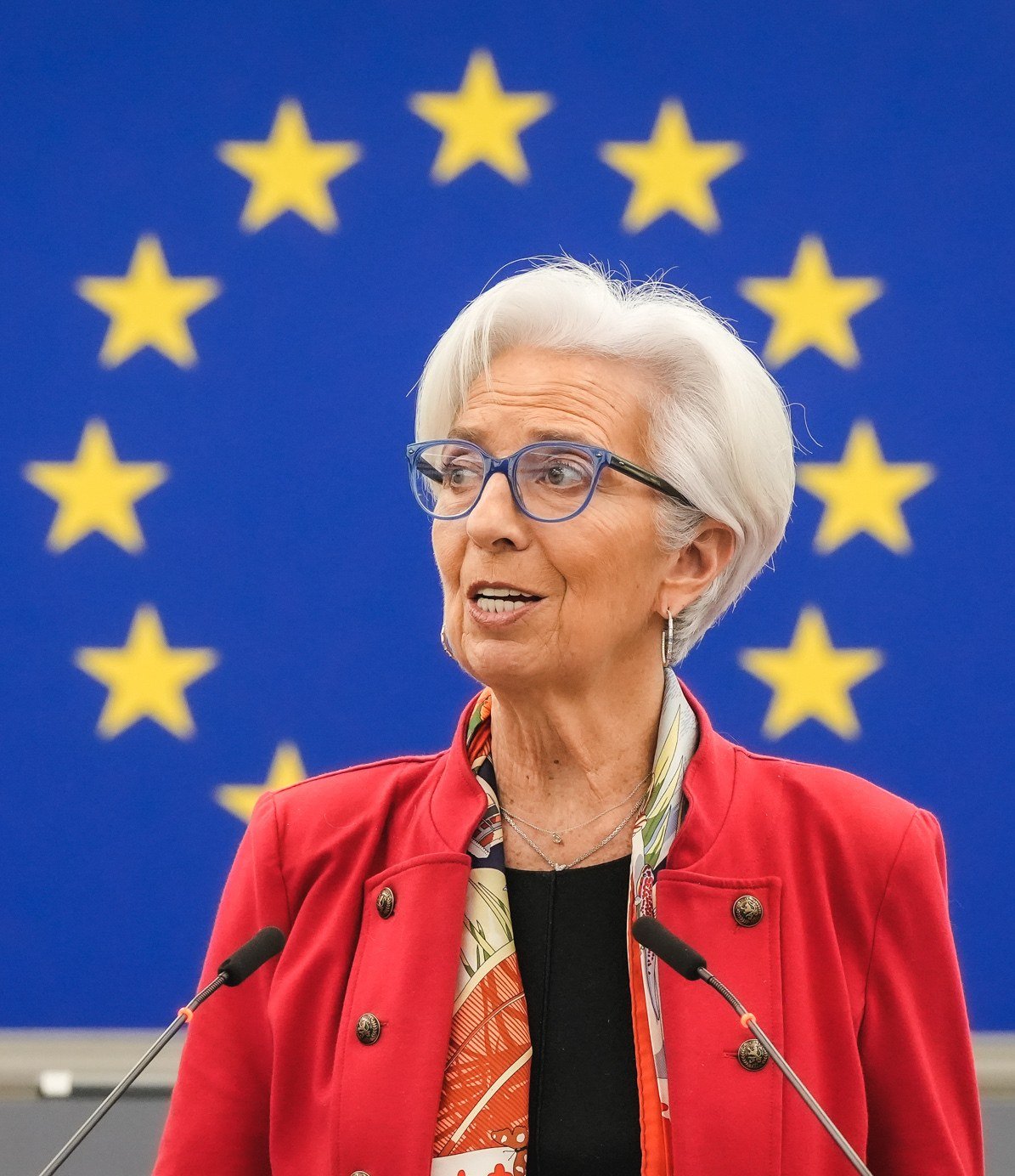
The ECB president leads monetary policy for the eurozone’s 21 member states and more than 350 million people. The choice will shape how the bank responds to weak growth, high energy prices, and political divisions over public debt, particularly in France. Different candidates hold different views on tools such as the transmission protection instrument, which the ECB can use to keep bond markets orderly, and analysts say markets will watch the succession closely for signals about future policy.
French President Emmanuel Macron is among the leaders involved in choosing the ECB president, alongside other European Union leaders. The decision ultimately rests with the European Council, acting on a recommendation after consulting the European Parliament and the ECB’s Governing Council.
What happens next
The succession process begins immediately, according to Costa, with the aim of a timely decision well before Lagarde’s February departure. Until then, Lagarde remains in post and will continue to chair Governing Council meetings, including the December meeting at which markets expect debate over whether to raise rates.
For Europe’s economy, the immediate questions are unchanged: whether inflation pressures from energy prices will persist, whether growth will recover, and whether governments can agree credible budget plans. What has changed is who will steer the ECB through those questions from next spring onward, and the contest for that role now becomes one of the defining political stories of the coming months.
Sources: Reuters; Business Standard; The National.