

Some actors chase stardom. Gene Hackman never looked like he was chasing anything at all, and that was exactly why audiences trusted him. With his lined face, his flat American voice and his total lack of vanity, he could be a cop, a criminal, a coach, a crook or a king, and you believed every one of them. He did not look like a movie star, and that became his greatest strength.
For more than four decades he was one of the most respected actors in Hollywood, collecting two Academy Awards, four Golden Globes and the admiration of nearly everyone he worked with. Then, in 2004, he simply walked away. He moved to Santa Fe, New Mexico, took up painting, and became a novelist, as if the whole glittering career had just been one chapter of a much longer life.
Hackman died in February 2025 at 95, in circumstances that made headlines around the world. This is his full story: his hard childhood, his late start, his greatest films, his marriages, his children, and the fortune he left behind.
Quick Facts
| Fact | Details |
|---|---|
| Full Name | Eugene Allen Hackman |
| Born | January 30, 1930, San Bernardino, California |
| Died | February 18, 2025, aged 95, Santa Fe, New Mexico |
| Birthplace | San Bernardino, California |
| Raised in | Danville, Illinois |
| Nationality | American |
| Occupation | Actor, novelist |
| Years Active | 1956–2004 (acting) |
| First Wife | Faye Maltese (married 1956, divorced 1986) |
| Second Wife | Betsy Arakawa (married 1991) |
| Children | Christopher, Elizabeth, and Leslie |
| Net Worth | Estimated at $80 million by Celebrity Net Worth |
| Academy Awards | 2 wins from 5 nominations |
What Was Gene Hackman’s Early Life Like?
Eugene Allen Hackman was born on January 30, 1930, in San Bernardino, California. His father worked as a press operator for a newspaper, and his mother was a homemaker. The family moved around during the Depression years before settling in Danville, Illinois, where Gene spent most of his childhood.
It was not an easy home. Money was tight, his parents argued, and when Gene was thirteen, his father walked out of the house one day and never came back.
That abandonment stayed with him. Years later, Hackman would say that his father’s departure was the defining wound of his childhood, and that much of his acting came from that early sense of loss. He found escape at the local cinema, where he fell in love with the tough, fast-talking heroes of the screen, especially James Cagney. Acting, he later said, was something he had wanted to do since he was ten years old.
At sixteen, restless and desperate to get out of Danville, Hackman lied about his age and joined the United States Marine Corps. He served for more than four years, from 1946 to 1951, working as a radio operator and spending time in China, Japan and Hawaii. He left the Marines as a private first class and drifted for a while, trying journalism at the University of Illinois before admitting to himself that the stage was what he really wanted.
In his late twenties, Hackman enrolled at the Pasadena Playhouse in California, the famous acting school that had trained a generation of stars. There he met another struggling young actor named Dustin Hoffman, and the two became close friends. The Playhouse staff famously voted them the two students least likely to succeed. Both men would go on to win Academy Awards, which tells you everything you need to know about early predictions.
How Did Gene Hackman Become a Star?
Hackman moved to New York in the early 1960s and spent years doing what most actors do: small theatre roles, tiny television parts, and long stretches of nothing. His Broadway work gradually earned him respect, and in 1964 he appeared in the play Any Wednesday, which led to small film roles. His first real break came in 1967, when director Arthur Penn cast him as Buck Barrow, the dim but loyal brother of Clyde Barrow, in Bonnie and Clyde.
The film was a sensation, and Hackman’s warm, funny, doomed performance earned him his first Academy Award nomination, for Best Supporting Actor. He was thirty-seven years old, and after a decade of struggle, he had arrived. More nominations followed, for I Never Sang for My Father in 1970, but it was his next film that made him a star.
In 1971, Hackman played Jimmy “Popeye” Doyle, the hard-drinking, rule-breaking New York narcotics detective in William Friedkin’s The French Connection. Doyle was not a hero in any simple sense. He was racist, violent and obsessive, but Hackman played him with such fierce, lived-in energy that audiences could not look away.
The film won five Academy Awards, including Best Picture, and Hackman won Best Actor. The famous car chase, with Doyle racing beneath an elevated train, remains one of the great action sequences in cinema.
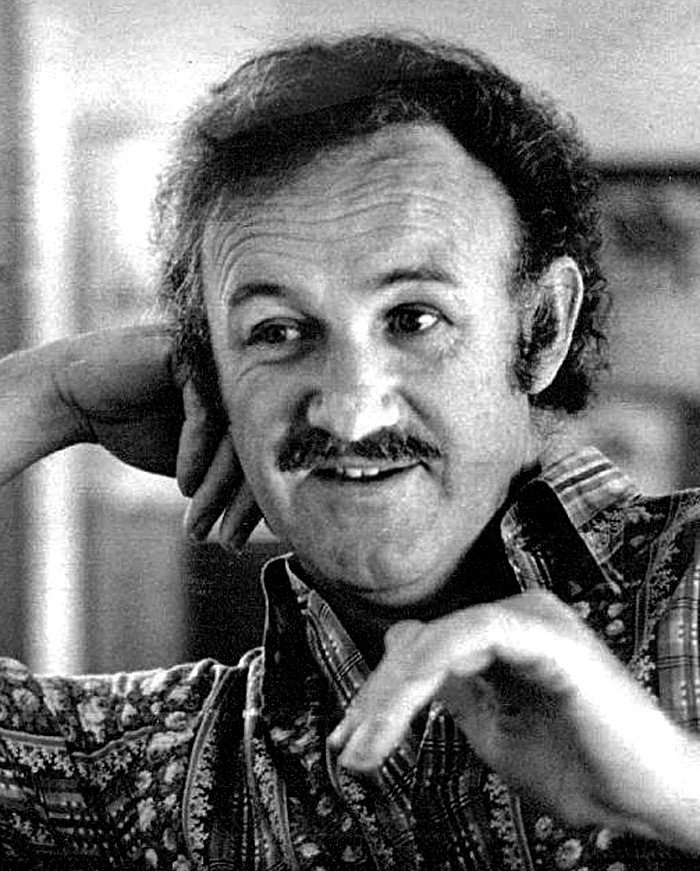
Suddenly, Hackman was in demand everywhere. Unlike many stars, he never tried to protect an image. He took the villain roles, the supporting roles, the odd roles, and he made them all feel like real people.
Fellow actors called him an actor’s actor, a compliment he valued more than fame.
What Are Gene Hackman’s Best Movies?
Trying to pick Hackman’s best films is a happy problem, because the list is so long. In 1974 alone he gave two landmark performances: as the paranoid surveillance expert Harry Caul in Francis Ford Coppola’s The Conversation, and as the blind hermit in Mel Brooks’s comedy Young Frankenstein. One was a chilling portrait of guilt and privacy, the other was pure comic delight, and both were unmistakably Hackman.
In 1978 he played Lex Luthor, Superman’s bald, brilliant enemy, in Superman, bringing wit and menace to a comic-book villain long before superhero films dominated Hollywood. He returned to the role in two sequels. In the 1980s he was superb as a small-town basketball coach chasing redemption in Hoosiers (1986), a film that still makes grown men cry, and as an FBI agent investigating a racist murder in Mississippi Burning (1988), which earned him another Best Actor nomination.
His second Oscar came in 1992, for Clint Eastwood’s western Unforgiven, in which he played Little Bill Daggett, a sheriff whose cruelty hides behind a badge and a house he is building. It is one of the great screen villains: charming one minute, terrifying the next. Hackman had actually turned the role down at first, worried about the violence, but Eastwood persuaded him, and the performance won him Best Supporting Actor.
The later years brought more gems: the submarine thriller Crimson Tide (1995), the legal thriller The Firm (1993), the paranoid thriller Enemy of the State (1998), and, in 2001, one of his most beloved performances, as the selfish, funny, heartbreaking patriarch Royal Tenenbaum in Wes Anderson’s The Royal Tenenbaums. Like the great screen legends of his generation, among them Michael Caine, Hackman kept finding new sides to himself right up to the end of his career.
Who Was Gene Hackman’s Wife?
Hackman was married twice. His first wife was Faye Maltese, whom he married in 1956, back when he was still a struggling young actor in New York. They were married for thirty years and had three children together: a son, Christopher, and two daughters, Elizabeth and Leslie. The marriage ended in divorce in 1986, a break-up that Hackman later described with regret, saying that his devotion to his career had cost him time with his family.
In 1991, Hackman married Betsy Arakawa, a classical pianist who had grown up in Hawaii. She was more than thirty years younger than him, and friends said she brought order and calm to his life. When Hackman retired from acting, it was Betsy who helped build their quiet life in Santa Fe, where they lived in a hillside home outside the city. She looked after the house, managed his affairs, and, in his final years, cared for him as his health declined.
Hackman was a private man who hated the Hollywood party circuit, and his second marriage suited that nature. He and Betsy were rarely photographed together at premieres or events. They preferred long walks, books, painting, and the company of their dogs. That privacy is part of why the news of their deaths in 2025 shocked so many people: for twenty years, the couple had lived almost entirely out of public view.
What Was Gene Hackman’s Net Worth?
According to Celebrity Net Worth, Gene Hackman’s net worth at the time of his death was estimated at $80 million. That figure is an estimate, not an official accounting of his estate, but it reflects a long and highly paid career at the top of Hollywood, plus the income from his later books.
His earnings grew enormously over the course of his career. For The French Connection, the film that won him his Oscar, he was reportedly paid around $100,000, a modest sum by later standards. By the 1970s and 1980s, his fees had risen into seven figures. Celebrity Net Worth reports that he earned $2 million for Superman and $1.3 million each for The Quick and the Dead and Lucky Lady.
In his peak years, he was one of the most reliable and bankable character actors in the business.
His money also came from a life lived carefully. Hackman was never known for lavish spending or a fleet of houses. He owned property in Santa Fe and in California, he painted, he wrote, and he lived quietly.
After his death, reports suggested his estate was worth around $80 million, and his will, written in 1995, reportedly left everything to Betsy Arakawa. Because she died before him, the question of where the estate would go became a matter for lawyers and the courts, and his son Christopher was reported to have taken legal steps over the estate in the months that followed.
Why Did Gene Hackman Retire From Acting?
Hackman’s final film role was in the 2004 comedy Welcome to Mooseport, in which he played a former president running for mayor of a small town. He was seventy-four, and after the film he quietly decided he was done. He later explained that the stress of acting had begun to affect his health. His doctor had warned him about his heart, and he did not want to spend his remaining years chasing roles.
Retirement suited him. With his friend Daniel Lenihan, a former Navy man, Hackman had already co-written a historical adventure novel, Wake of the Perdido Star, published in 1999. After leaving Hollywood he devoted himself to writing full-time.
Together they wrote two more novels, Justice for None (2004) and Escape from Andersonville (2008). Then Hackman wrote two solo novels, a western called Payback at Morning Peak (2011) and a police thriller called Pursuit (2013).
He also painted, drew, and took an interest in architecture, helping to design and restore houses in Santa Fe. Friends who visited him in those years described a contented man who loved to talk about books and history rather than movies. He gave few interviews in retirement.

How Did Gene Hackman Die?
On February 26, 2025, Hackman and his wife Betsy Arakawa were found dead at their home in Santa Fe, along with one of their dogs. The discovery was made after maintenance workers, worried because they had not seen the couple for some time, alerted the authorities. Hackman was 95 and Arakawa was 65.
At first the circumstances seemed mysterious, but the official investigation gave a clear and very sad answer.
On March 7, 2025, New Mexico’s chief medical examiner, Dr. Heather Jarrell, announced the findings at a press conference alongside Santa Fe County Sheriff Adan Mendoza. According to the medical examiner, Arakawa had died first, around February 11, from hantavirus pulmonary syndrome, a rare disease spread by infected rodents.
Hackman, who was in the advanced stages of Alzheimer’s disease, died about a week later, around February 18, the day his pacemaker last recorded activity. His official cause of death was given as hypertensive and atherosclerotic cardiovascular disease, with Alzheimer’s disease as a significant contributory factor.
Both deaths were ruled to be from natural causes, and the authorities said they did not suspect foul play. Dr. Jarrell said it was quite possible that Hackman, in his poor state of health, was not aware that his wife had died.
It was a heartbreaking end to a long life, and it prompted an outpouring of tributes from across Hollywood. At the Academy Awards a few days later, Morgan Freeman led a tribute, calling Hackman a dear friend and a giant of the profession. Francis Ford Coppola wrote that Hackman was a great actor, inspiring and magnificent in his work and complexity.
Lesser-Known Facts About Gene Hackman
- Hackman and Dustin Hoffman were voted “least likely to succeed” at the Pasadena Playhouse. Both went on to win multiple Academy Awards.
- He lied about his age to join the Marines at sixteen, and served for more than four years as a radio operator in China, Japan and Hawaii.
- He was a keen racing driver in his spare time and competed in amateur races, including the famous Daytona endurance race.
- He turned down the role of Little Bill Daggett in Unforgiven at first, because he disliked the violence, and only accepted after Clint Eastwood talked him into it.
- He painted seriously in retirement and exhibited his art, preferring to be known as a painter and writer rather than a former movie star.
- He played Lex Luthor in three Superman films, and his bald head for the role became one of the most famous looks in comic-book cinema.
- He was offered the role of Hannibal Lecter in The Silence of the Lambs but turned it down. The part went to Anthony Hopkins, who won an Oscar for it.
- Hackman wrote five novels after the age of sixty-five, three with Daniel Lenihan and two on his own, and he said he enjoyed writing more than he had expected.
- He appeared in more than eighty films across five decades, yet he almost never watched his own performances back.
- Like his fellow screen greats Richard Harris and Albert Finney, Hackman was admired as much by other actors as by audiences, a mark of true respect in the profession.
Frequently Asked Questions About Gene Hackman
How old was Gene Hackman when he died?
Gene Hackman was 95 years old when he died. He was born on January 30, 1930, and according to the New Mexico medical examiner, he died around February 18, 2025, at his home in Santa Fe. His body was discovered on February 26, 2025, along with that of his wife, Betsy Arakawa.
Who was Gene Hackman’s wife?
Gene Hackman was married twice. His first wife was Faye Maltese, to whom he was married from 1956 to 1986. His second wife was Betsy Arakawa, a classical pianist, whom he married in 1991. They remained married until their deaths together in February 2025.
How many children did Gene Hackman have?
Gene Hackman had three children, all from his first marriage to Faye Maltese: a son named Christopher and two daughters named Elizabeth and Leslie. He kept his children largely out of the spotlight, and they have rarely spoken publicly about their father.
What was Gene Hackman’s net worth?
Celebrity Net Worth estimated Gene Hackman’s net worth at $80 million at the time of his death. This is an estimate based on his long film career and book earnings, not an official figure from his estate. Reports after his death also put the value of his estate at around $80 million.
What movies was Gene Hackman famous for?
Hackman was famous for The French Connection (1971), for which he won Best Actor, and Unforgiven (1992), for which he won Best Supporting Actor. Other celebrated films include Bonnie and Clyde, The Conversation, Superman, Hoosiers, Mississippi Burning, Crimson Tide, Enemy of the State and The Royal Tenenbaums.
Why did Gene Hackman stop acting?
Hackman retired from acting after Welcome to Mooseport in 2004, at the age of seventy-four. He later said that the stress of acting was affecting his heart and his health, and he wanted to enjoy a quieter life. He spent his retirement writing novels, painting, and living in Santa Fe with his wife.
Final Thoughts on Gene Hackman
Gene Hackman never tried to be a star, and that is why he became one of the greatest actors of his time. He brought honesty to every role, whether he was a hero, a villain, or something in between, and he never once asked the audience to admire him. He just did the work, and the work was extraordinary.
His final years were quiet, and his death was terribly sad, but the films remain. From Popeye Doyle racing through Brooklyn to Little Bill Daggett building his house in Unforgiven, from the coach in Hoosiers to the father in The Royal Tenenbaums, Hackman left behind a body of work that few actors will ever match. He once said he hoped people would remember him as someone who tried to do good work. On that measure, he succeeded completely.