

How does a boy born in Peshawar in 1924 become the man Indian cinema still calls its Showman? Raj Kapoor did not just act in films. He built a studio, invented a screen character the whole world recognized, and turned Hindi cinema into something that could travel from Bombay to Moscow. His films mixed Chaplin’s tramp with Indian street life, big music with sharp social comment, and spectacle with sentiment.
Because he died in 1988, the questions people ask about him are a little different from those asked about living stars. How old was he when he died, who was his wife, who were his children, and what was he worth? The answers below are kept to the documented record. Where estimates disagree, especially on money, this article says so rather than picking one number and pretending it is settled.
Quick Facts
| Fact | Detail |
| Full Name | Ranbir Raj Kapoor |
| Born | December 14, 1924, Peshawar, British India |
| Died | June 2, 1988, All India Institute of Medical Sciences, New Delhi (aged 63) |
| Occupation | Actor, director, producer |
| Years Active | 1935–1988 |
| Studio | R. K. Films (founded 1948) |
| Best Known For | Awaara; Shree 420; Sangam; Mera Naam Joker; Bobby; Ram Teri Ganga Maili |
| Spouse | Krishna Malhotra (married May 1946) |
| Children | Randhir, Rishi, Rajiv, Ritu Nanda, Rima Jain |
| Major Honors | Padma Bhushan (1971); Dadasaheb Phalke Award (1988); 3 National Film Awards; 11 Filmfare Awards |
| Net Worth | Estimates conflict widely (see Net Worth section; no audited figure exists) |
A Peshawar Boyhood in a Theatre Family
Raj Kapoor was born Ranbir Raj Kapoor on December 14, 1924, in Peshawar, then part of British India. He was the eldest son of the celebrated stage and screen actor Prithviraj Kapoor and Ramsarni Devi Kapoor. Theatre was not a hobby in that household. It was the family trade, and the young Raj grew up around rehearsals, touring companies, and his father’s Prithvi Theatres work.
He was the eldest of six children. Two of his younger brothers, Shammi Kapoor and Shashi Kapoor, also became major film stars, and the Kapoor name would go on to dominate Hindi cinema for generations. Raj’s own start, though, was deliberately unglamorous. He began as a clapper boy and assistant, learning how a set actually ran before he ever expected to lead one.
His schooling included time at Colonel Brown Cambridge School in Dehradun, but the real education was on film sets and in his father’s theatre company. By his early twenties he was ready to stop assisting other people’s films and start making his own.
R. K. Films: A Studio of His Own at Twenty-Three
In 1948, at just twenty-three, Raj Kapoor founded his own production company, R. K. Films, and made his directorial debut with Aag. The film did not set the box office alight, but it announced his intentions. He wanted control over his stories, his music, and his image, and he was willing to build a studio to get it.
Barsaat followed in 1949 and gave him his first major success as a director and star. The film’s music, its rain-soaked romance, and its young hero established the template of the RK film: emotion worn openly, songs that carried the story, and a hero who was more dreamer than tough guy. The studio, based later at Chembur in Bombay, became the base for almost everything he made afterward.
That instinct, to build a company rather than simply wait for the next acting offer, is the same one that defined later actor-producers elsewhere. Like Robert Redford, who used acting success as a base for directing and producing work he believed in, Kapoor treated stardom as leverage for a studio and a slate, not as the whole career.
The Tramp, Awaara, and Shree 420
Kapoor’s defining creation was his screen tramp: a poor, cheerful, big-hearted drifter in a torn coat and a bowler hat, openly inspired by Charlie Chaplin. Awaara (1951), which he directed and starred in, made that character famous far beyond India. The film’s story of a good man shaped by a harsh world, and its unforgettable music, turned Kapoor into a star across Asia, the Middle East, and the Soviet Union, where his films drew enormous audiences.
Shree 420 (1955) pushed the character further. Its hero arrives in Bombay with nothing and must choose between honest poverty and easy corruption, and its song “Mera Joota Hai Japani” became a kind of anthem: Japanese shoes, English trousers, a Russian cap, and still an Indian heart. The film won a National Film Award, and Awaara and Boot Polish (1954) both earned nominations for the Palme d’Or at Cannes. Time magazine later ranked his performance in Awaara among the greatest screen performances of all time.
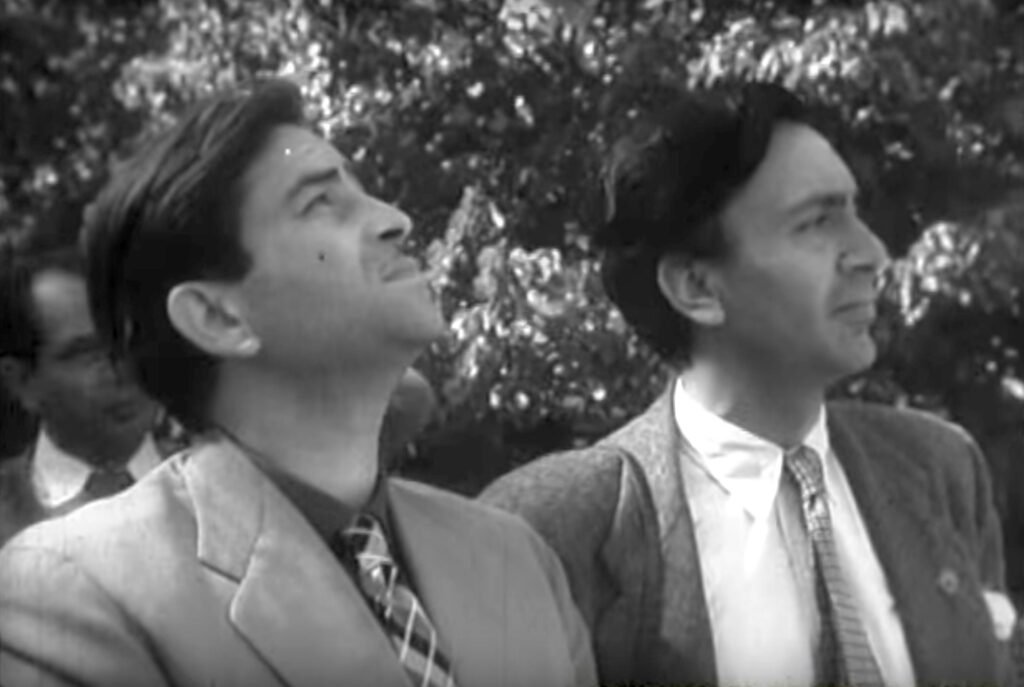
The comparison that followed him everywhere was flattering and limiting at once. He was called the Clark Gable of Indian cinema, a shorthand for a leading man whose charm could carry a whole industry. Like Clark Gable, Kapoor was a star audiences trusted to be both romantic and ordinary, larger than life and instantly recognizable. Unlike Gable, though, Kapoor was also writing, directing, and producing the films that made him famous.
His celebrated screen partnership with Nargis, across films including Barsaat, Awaara, and Shree 420, became one of Hindi cinema’s great pairings. Their off-screen relationship in those years has also been widely reported, including in his son Rishi Kapoor’s autobiography, and this article notes it as reported history rather than dwelling on private detail.
Sangam, and the Gamble of Mera Naam Joker
By the 1960s, Kapoor the director was thinking bigger. Sangam (1964), which he directed and starred in, was among the first major Hindi films shot in color and abroad, and it was a huge commercial success. It marked a shift in his cinema toward grander romance and spectacle, while keeping the music and emotion his audiences expected.
Then came the gamble that nearly broke him. Mera Naam Joker (1970) was his most personal film, a long, two-part story of a clown’s life told through the three women he loved. Kapoor poured his own money into it, and reports say he even mortgaged property to finish it.
The film took years to complete, and when it finally released it failed at the box office. It pushed him close to financial ruin.
The recovery came three years later, and it came through his own family. Bobby (1973), directed by Kapoor, launched his second son Rishi Kapoor as a romantic lead opposite Dimple Kapadia and became a thunderous hit. It rescued the studio and, in a sense, rescued the Showman’s career. Later, television and international audiences would give Mera Naam Joker the cult reputation it never found on first release, and Kapoor himself always called it his favorite film.
The Second Act: Directing From Behind the Camera
After Bobby, Kapoor acted less and directed more, shaping a second career as a maker of heroine-centered popular films. Satyam Shivam Sundaram (1978) with Zeenat Aman, Prem Rog (1982) with Padmini Kolhapure, and Ram Teri Ganga Maili (1985), which introduced Mandakini, all carried his signature mix of music, melodrama, and social comment. His later acting appearances were fewer, including a cameo in the 1984 British television film Kim.
Ram Teri Ganga Maili proved to be his last completed film as a director. At the time of his death he was working on Henna, an India-Pakistan love story, which his sons Randhir and Rishi later completed and released in 1991. His honours by then were the highest Indian cinema offers: the Padma Bhushan in 1971 and the Dadasaheb Phalke Award, India’s highest cinema honor, in 1988.
His death itself became part of the legend. On May 2, 1988, at the New Delhi ceremony where he was to receive the Dadasaheb Phalke Award, he suffered a severe asthma attack and collapsed in the auditorium. He was taken to the All India Institute of Medical Sciences, where he remained hospitalized for about a month.
He died there on June 2, 1988, aged 63, of complications related to asthma. The award had been presented to him at the ceremony even as he struggled to breathe, and the story has been retold in Indian newspapers ever since.
Wife Krishna Kapoor and Their Five Children
Raj Kapoor married Krishna Malhotra in May 1946, in a match arranged by their families. Krishna, whose brothers Prem Nath, Rajendra Nath, and Narendra Nath all became actors, remained his wife until his death in 1988. She outlived him by thirty years, dying on October 1, 2018, at the age of 87, and in her later years she was the matriarch of the Kapoor family, hosting the family’s famous gatherings at their Chembur home.
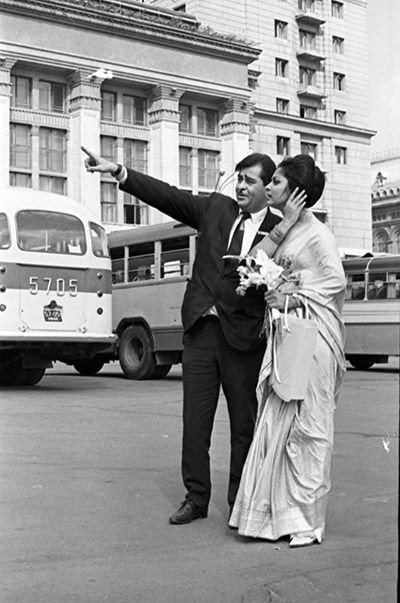
The couple had five children. Their three sons, Randhir, Rishi, and Rajiv Kapoor, all became actors, with Rishi the most successful of the three and the star his father launched in Bobby. Their daughters were Ritu Nanda, who married industrialist Rajan Nanda, and Rima Jain, who married investment banker Manoj Jain. The grandchildren who followed, including Karisma Kapoor, Kareena Kapoor, and Ranbir Kapoor, named after his grandfather, carried the family name into a third and fourth generation of stardom.
That long family line is part of why Raj Kapoor is still discussed as a person rather than only as a filmography. He was not just a star. He was the head of a film dynasty, and his children and grandchildren kept his studio, his songs, and his screen image alive long after 1988.
What Was Raj Kapoor’s Net Worth?
Raj Kapoor’s net worth cannot be stated as a single reliable number, and any article that gives you one without a warning is oversimplifying. No audited figure exists, and the estimates published after his death disagree by an enormous margin. Celebrity Net Worth puts his fortune at around $2 million, a figure repeated by other outlets, while other trackers publish figures as high as $19 million, and at least one biography site claims $30–50 million, tied largely to the value of RK Studios and family property.
The honest summary is that range, with $2 million as the most widely repeated tracker estimate and the higher figures reflecting property valuations rather than cash wealth. His income in life came from acting, directing, and producing across four decades, plus the studio and its land at Chembur, which the family later sold in part. The Mera Naam Joker losses and the Bobby recovery also mean his wealth rose and fell sharply during his lifetime, so a single “at death” number hides more than it reveals.
That uncertainty is worth stating plainly because it mirrors his career. Like Paul Newman, who treated screen fame as a base for wider work rather than simply collecting paydays, Kapoor poured his earnings back into films and a studio. His real fortune, if the word must be used, was the studio, the songs, and the family business he left behind, not a bank balance anyone can verify today.
Lesser-Known Facts About Raj Kapoor
- He was born Ranbir Raj Kapoor, and his grandson Ranbir Kapoor was named after him.
- He started in films as a clapper boy and assistant before founding R. K. Films at twenty-three.
- His performance in Awaara was ranked by Time magazine among the greatest screen performances of all time.
- Awaara and Boot Polish were both nominated for the Palme d’Or at the Cannes Film Festival.
- He mortgaged property to finish Mera Naam Joker, his favorite film, which flopped on release and later became a cult classic.
- Bobby (1973) launched his son Rishi Kapoor and rescued the studio after the Mera Naam Joker losses.
- He collapsed at the Dadasaheb Phalke Award ceremony on May 2, 1988, and died about a month later, aged 63.
- His unfinished film Henna was completed by his sons Randhir and Rishi and released in 1991.
- His family memorial at Rajbaugh, near Pune, includes a museum of his filmmaking from 1945 to 1990.
Frequently Asked Questions
How old was Raj Kapoor when he died?
Raj Kapoor was born on December 14, 1924, and died on June 2, 1988, at the All India Institute of Medical Sciences in New Delhi, aged 63, of complications related to asthma.
Who was Raj Kapoor’s wife?
He married Krishna Malhotra in May 1946, in a family-arranged match. She remained his wife until his death in 1988 and died herself on October 1, 2018, aged 87.
How many children did Raj Kapoor have?
He had five children: three sons, Randhir, Rishi, and Rajiv Kapoor, and two daughters, Ritu Nanda and Rima Jain. All three sons became actors.
What is Raj Kapoor’s net worth?
No audited figure exists. Celebrity Net Worth estimates around $2 million, while other trackers publish much higher figures, up to $19 million or more, usually tied to studio and property values. The number should be treated as an estimate, not a fact.
What are Raj Kapoor’s best movies?
His defining work includes Awaara, Shree 420, Barsaat, Sangam, Mera Naam Joker, Bobby, Satyam Shivam Sundaram, Prem Rog, and Ram Teri Ganga Maili, most of them made through his own studio, R. K. Films.
What was Raj Kapoor’s last film?
Ram Teri Ganga Maili (1985) was his last completed film as a director. At his death he was working on Henna, which his sons completed and released in 1991.
Final Thoughts
Raj Kapoor’s career is unusual because it contained several careers at once: child of a theatre family, clapper boy, matinee idol, studio boss, director of spectacles, and father of a film dynasty. He failed spectacularly with the film he loved most and recovered by launching his own son. He died, fittingly and sadly, at the very ceremony meant to honor his lifetime in cinema.
Nearly four decades after his death, his songs still play at weddings, his tramp still walks through film history books, and his grandchildren still carry his name on marquees. The Showman title was not a marketing line. It was a job description, and he held it for half a century.
Sources
Raj Kapoor | Bollywood Star, Producer, Actor-Director, Family, & Films – Britannica
Raj Kapoor 100: Mirroring India through the ages – The Week (PTI)