
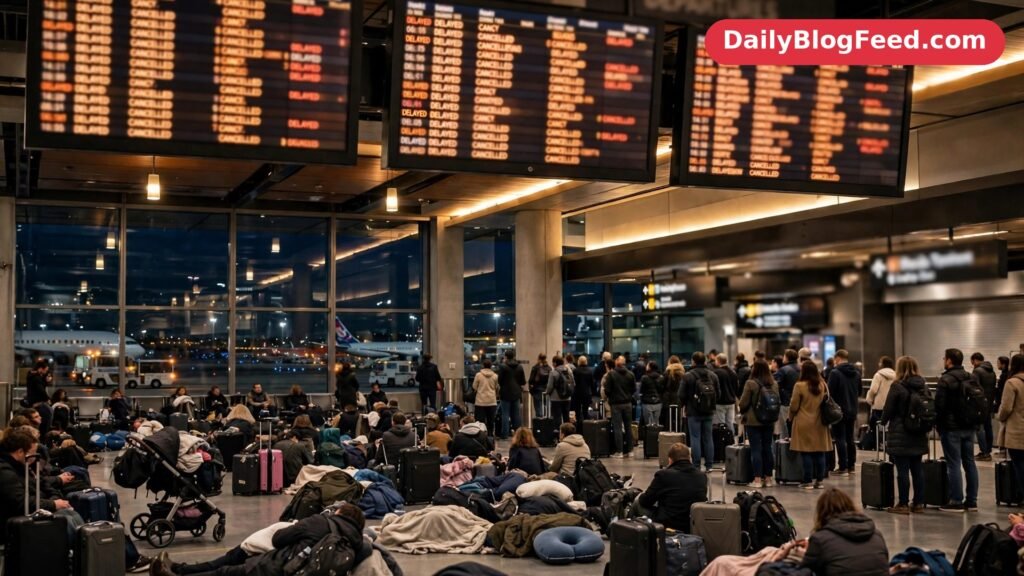

On Friday afternoon, American air travel simply stopped. No take-offs. No departures at all, anywhere in the country. The Federal Aviation Administration ordered a nationwide ground stop — every plane grounded — after a failure in the communications system that air traffic controllers rely on to talk to pilots and track aircraft. It lasted about four hours, and by the time the order was lifted on Friday night, more than 12,000 flights had been cancelled and hundreds of thousands of passengers were stranded.
Flights started moving again on Saturday, November 14, 2026. Planes pushed back from gates, taxied out and took off. But “back in the air” didn’t mean back to normal. Thousands more flights were cancelled on Saturday, and officials warned it would take days before the system fully caught up.
A routine upgrade that went wrong
The cause, according to the Trump administration, was painfully ordinary: old wiring. A contractor had been working on replacing a section of the air traffic control system’s ageing copper telephone lines with new fibre-optic cable. Somewhere in that work, something went badly wrong.
Transportation Secretary Sean Duffy put it bluntly: “Either through contractor error or a faulty piece of equipment… it started flooding other routers in our air traffic control system.”
The work was being done by L3Harris Technologies, a defence and aerospace contractor that manages the FAA’s telecommunications infrastructure. The company supports about 45,000 daily US flights and connects more than 4,400 facilities, according to its website. Duffy said the copper-to-fibre switch had been going on across the system for decades, and L3Harris says it has now completed more than 70 percent of the planned conversion.
FAA Administrator Bryan Bedford said the outdated copper wires should be completely replaced by September 2027. That date suddenly matters a lot more than it did a week ago.
The FAA lifted the ground stop at 8:15 p.m. Eastern Time on Friday, saying it had restored full functionality at its air traffic control facilities. Duffy posted on X on Saturday morning: “Operations are slowly returning to normal this morning. Planes are pushing back, taxiing, and taking off, and it is safe to fly.”
How bad was it?
The numbers tell the story. Bedford told a news conference that 12,000 flights were cancelled on Friday. On Saturday, between 4,000 and 5,000 of the 41,000 scheduled flights were likely to be cancelled as well. The FAA said the disruption would lead to more than 16,000 cancellations by Saturday in total, and by early Saturday afternoon FlightAware had already recorded at least 5,000 cancelled flights for the day.
It was only the second time a nationwide ground stop had been issued in US airspace since the September 11, 2001 attacks. That fact alone gives you a sense of how serious the FAA judged the failure to be.
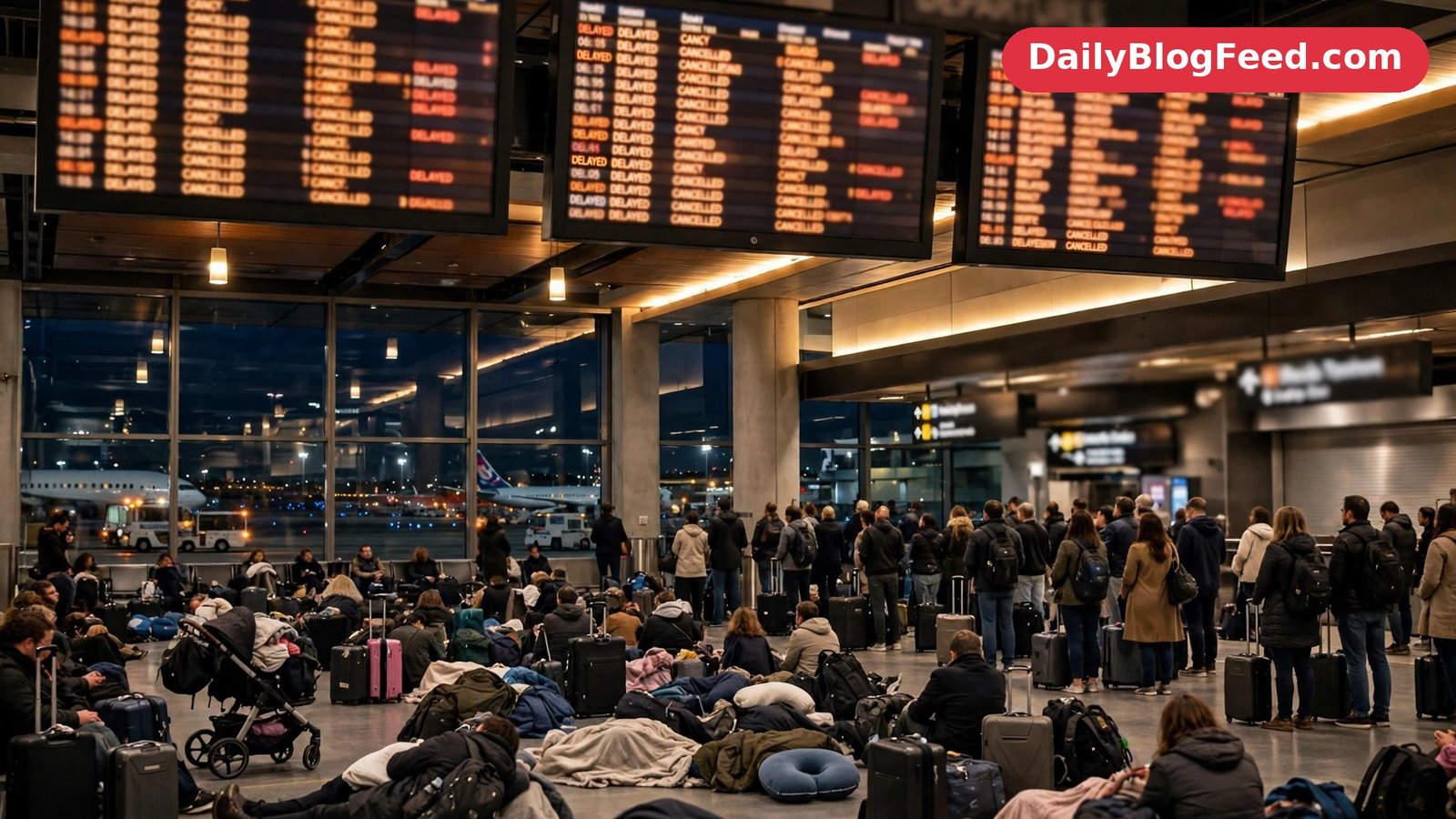
For passengers, the chaos was personal and immediate. Some travellers were pulled off planes moments before departure by airline staff who seemed to know as little about what was happening as the passengers did. Others sat in departure halls watching the boards flip to “cancelled” one flight at a time. With the system backed up, rebooking was a scramble — and with thousands of flights wiped from the schedule, there simply weren’t enough spare seats to go around.
Duffy said he expected a full resumption of flight schedules by “close of business on Sunday”. Even so, experts warned that the knock-on effects — crews and aircraft in the wrong cities, missed connections, overbooked rebookings — could linger for days after the last cancelled flight.
No sign of foul play
When a system this central to American life fails all at once, the first question is always whether someone made it fail. Officials were quick to answer that one. Homeland Security Secretary Markwayne Mullin said there was no evidence linking the outage to a cyberattack or any hostile action, and that public safety had not been compromised.
Duffy struck a similar note, blaming decades-old equipment rather than any outside interference. “We use 1980s little copper lines. It’s an old system that went down, and went down everywhere. It got overloaded,” he told reporters late on Friday.
That explanation has put the spotlight on the state of America’s air traffic control network — and on the money needed to fix it. Duffy appealed for $50 billion in funding to upgrade and modernise the system. The outage, he argued, showed exactly why the money is needed: the equipment keeping planes apart in the world’s busiest airspace still runs on technology from the 1980s.
There are still open questions about the failure itself. Officials said they were still working out whether the problem came down to an error in how the router work was done, or a faulty piece of equipment. Reuters reported that officials said there may have been problems with routers installed in both Arkansas and Texas. Duffy identified a single router as the likely culprit on Saturday, but the full investigation is still under way.
A system running on borrowed time
The ground stop has also revived a debate that has been running in Washington for years. America’s air traffic control system is one of the most complex in the world, and parts of it are genuinely old — copper lines, ageing switches, routers that predate the modern internet. The modernisation programme has been inching forward for decades, and the copper-to-fibre conversion is only now about three-quarters done.
Friday showed what happens when that slow progress meets a single point of failure. One maintenance job, in one place, rippled across the whole network in hours. Controllers lost contact with aircraft. The FAA had no safe choice but to ground the country.
What happens next
For travellers, the advice is simple and familiar: check your flight before you leave for the airport, expect delays, and give yourself far more time than usual. Airlines are still working through the backlog, and with thousands of Saturday flights cancelled, the ripple effects will reach into Sunday and possibly beyond.
For the FAA and the administration, the work is bigger. The investigation into the router failure will continue, and Duffy’s $50 billion modernisation ask will now be debated in Congress with a very fresh example of what the old system can do. Bedford’s September 2027 deadline for replacing the last of the copper wire will be watched closely.
And for everyone who spent Friday night sleeping on an airport floor or queuing at a rebooking desk, there’s a smaller lesson too. The system that moves 45,000 flights a day is more fragile than it looks — and when it breaks, it breaks everywhere, all at once.
Sources: AFP; Reuters; Dawn; The Straits Times; USA Today.