
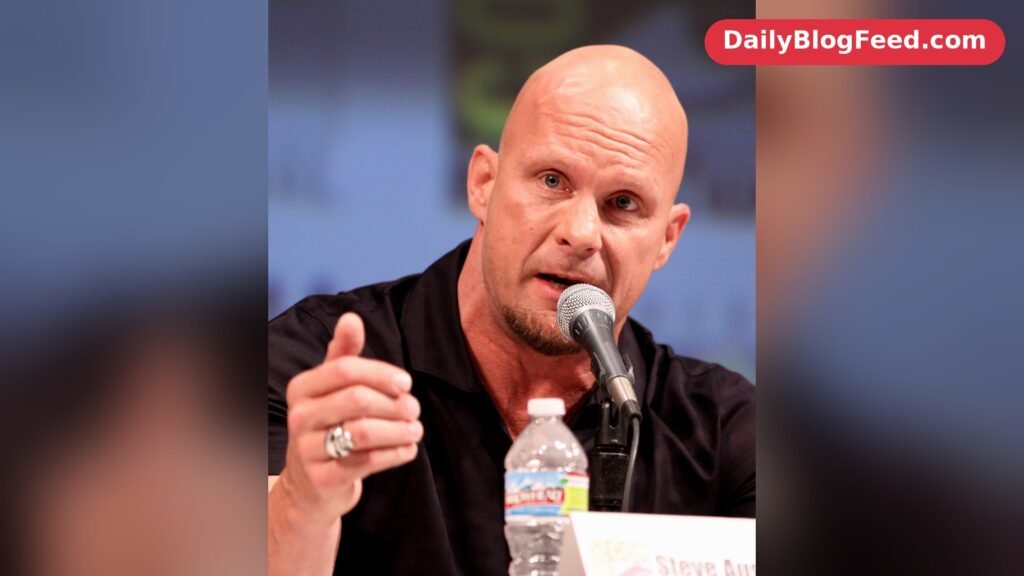

There are wrestling stars, and then there is “Stone Cold” Steve Austin. In the late 1990s, no performer in the industry was bigger. His beer-drinking, boss-defying antihero became the face of WWE’s Attitude Era, and his catchphrases entered everyday language far beyond wrestling audiences. Even fans who never watched a match have heard of Austin 3:16.
Austin’s real story is less cartoonish than his character. He spent years as a solid but unremarkable mid-card wrestler before a single promo changed everything. Then injuries cut his prime short, and he rebuilt himself as an actor, television host, podcaster, and rancher. This article covers the verified facts: his age, his marriages, his career, and the best available estimates of his net worth.
Quick Facts
| Detail | Fact |
|---|---|
| Birth name | Steven James Anderson (later Steven James Williams) |
| Ring name | “Stone Cold” Steve Austin |
| Born | December 18, 1964, Austin, Texas, USA |
| Age | 61 (as of November 2026) |
| Billed height | 6 ft 2 in (1.88 m) |
| Debut | September 1989 |
| Retired from full-time wrestling | March 2003 |
| WWE Championships | 6 |
| Royal Rumble wins | 3 (1997, 1998, 2001) |
| King of the Ring | 1996 |
| WWE Hall of Fame | 2009 (individually); 2025 (Immortal Moment, with Bret Hart) |
| Current wife | Kristin Feres (married 2009) |
| Children | Three daughters (two biological, one adopted) |
Texas Roots and a Name That Changed Twice
Austin was born Steven James Anderson on December 18, 1964, in Austin, Texas. He was raised in Victoria, Texas, after his mother remarried, and he took the surname Williams from his stepfather. That is why older records sometimes list him as Steven Williams — the name he carried when he first entered wrestling.
He was a talented football player at school and later attended the University of North Texas on a football scholarship. After college he worked on the docks in Dallas, an unglamorous job that taught him plenty about hard work and nothing about fame. A chance sighting of an advertisement for “Gentleman” Chris Adams’ wrestling school changed his direction entirely.
Adams trained him, and Austin debuted in 1989. Because another well-known wrestler was already called Steve Williams, he adopted the name Steve Austin — reportedly suggested after the television character Steve Austin of The Six Million Dollar Man. It was a practical choice at the time. Nobody could have guessed how famous that borrowed name would become.
The Long Road to Stone Cold
Austin’s early career was steady rather than spectacular. In World Championship Wrestling (WCW) in the early 1990s, he wrestled as “Stunning” Steve Austin, a technically polished performer with bleached blond hair and a strong look. He won the WCW World Television Championship and tag team gold, but the company never positioned him as its top star.
In 1995, WCW released him while he was recovering from injury — a decision that is now remembered as one of wrestling’s great misjudgments. A short stint in Extreme Championship Wrestling (ECW) followed, and it mattered more than its length suggests. There, freed from WCW’s restrictions, Austin began cutting angry, unfiltered promos that hinted at the character to come. He was no longer just a good wrestler. He was becoming a voice.
He signed with the World Wrestling Federation (WWF, now WWE) in late 1995 and debuted as “The Ringmaster,” a quiet technician managed by Ted DiBiase. The gimmick went nowhere. Then, in 1996, the company repackaged him as “Stone Cold” Steve Austin: a short-tempered, beer-drinking antihero who answered to nobody. Everything clicked.
Austin 3:16 and the Attitude Era
The moment that made Austin a star came at the 1996 King of the Ring tournament. After winning the event, he delivered a promo mocking his opponent’s religious slogan and declaring his own: Austin 3:16. The phrase exploded. T-shirts bearing it became one of the best-selling items in wrestling history, and Austin’s popularity surged.
From 1997 onward, his feud with company chairman Vince McMahon became the engine of WWE’s business. The storyline was simple and endlessly repeatable: the rebellious employee versus the tyrannical boss. Audiences who had never cared about wrestling tuned in to see what Austin would do next, whether it was driving a beer truck to the ring or stunning McMahon himself.
His rivalries with Bret Hart and The Rock were equally important. The submission match against Hart at WrestleMania 13 in 1997 is widely regarded as one of the greatest matches ever staged, and it was inducted into the WWE Hall of Fame’s Immortal Moment category in 2025, alongside Hart. His WrestleMania matches against The Rock in 1999 and 2001 headlined the biggest shows of their era.
The appeal of Austin’s character owed something to a much older American archetype: the lone, unbending tough guy. Steve McQueen embodied that figure on screen in the 1960s and 1970s, all cool defiance and few words. Austin translated the same energy into a wrestling ring, and a new generation recognized it instantly.
Championships, Injuries, and a Forced Farewell
Austin’s championship record speaks for itself. He won the WWF Championship six times, the Intercontinental Championship twice, and the Tag Team Championship four times, making him the company’s fifth Triple Crown Champion. He remains the only wrestler to win the Royal Rumble three times, doing so in 1997, 1998, and 2001.
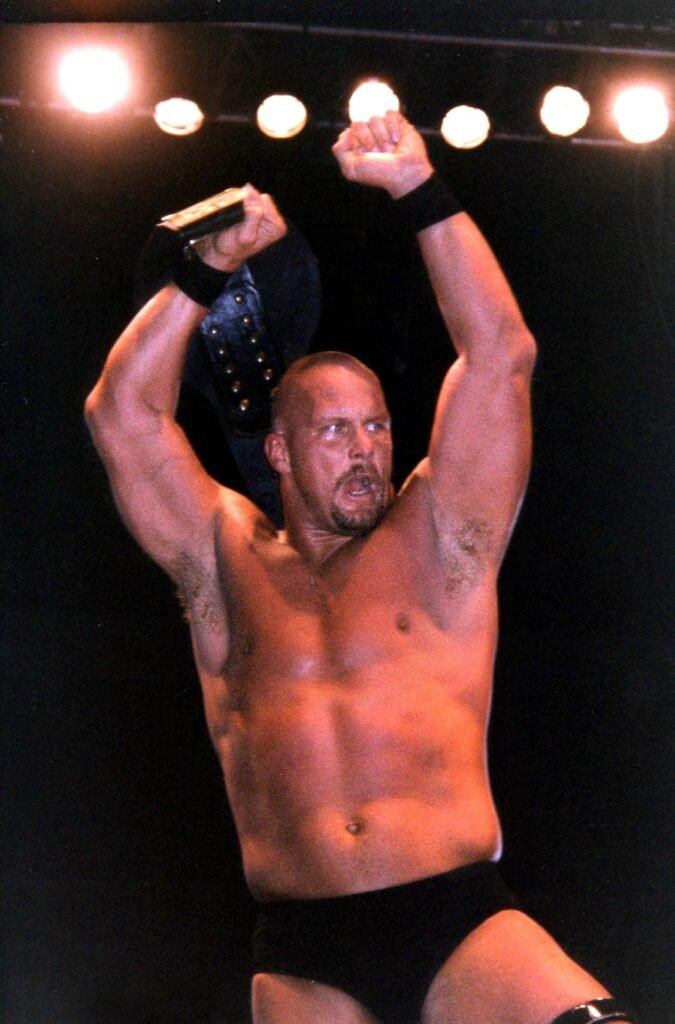
But his prime was cut short by his body. At SummerSlam in 1997, a botched piledriver from Owen Hart caused a serious neck injury that affected him for the rest of his career. Knee problems added to the toll. He wrestled on for several more years, often in visible pain, before retiring from full-time competition in March 2003 after losing to The Rock at WrestleMania XIX.
He was inducted into the WWE Hall of Fame in 2009, a recognition that surprised nobody. Even in retirement, he remained one of the company’s most popular figures, returning for guest appearances, delivering Stunners to delighted crowds, and serving as a bridge between wrestling’s past and present.
The screen’s great hard men offer a useful comparison here. Charles Bronson built a film career on the same granite-jawed, no-nonsense persona that Austin brought to the ring: a man who solved problems directly and asked permission from no one. The difference, of course, is that Austin performed his toughness live, night after night, in front of crowds that could turn on a performer in an instant.
Life After the Ring
Retirement from wrestling did not mean retirement from work. Austin moved into acting, appearing in films including The Condemned (2007), Damage (2009), and The Expendables (2010). His film career never matched his wrestling fame, but it kept him visible and added a second act to his public life.
Television hosting suited him better. He hosted the reality competition series Steve Austin’s Broken Skull Challenge on CMT from 2014 to 2017 and Straight Up Steve Austin on the USA Network from 2019 to 2021. In 2013 he launched The Steve Austin Show podcast, which became one of wrestling’s most popular audio shows, and later hosted Broken Skull Sessions interview specials for WWE.
He also built a business around his own name. His Broken Skull Ranch in Texas is both his home base and a brand, and his Broken Skull IPA and lager, brewed with El Segundo Brewing, grew out of the beer-drinking image that defined his character. Since 2023 he has also taken part in desert racing with a utility terrain vehicle, a hobby that suits a man who has never been comfortable sitting still.
Personal Life
Austin has been married four times. His first marriage, to Kathryn Burrhus, lasted from 1990 to 1992. He then married fellow wrestler Jeanie Clarke in 1992; they had two daughters, Stephanie and Cassidy, and Austin also adopted Clarke’s daughter Jade. That marriage ended in divorce in 1999.
In 2000 he married wrestler and manager Debra Marshall. That marriage ended in divorce in 2003, amid widely reported domestic-violence allegations from that period. Austin has rarely discussed the marriage in detail since, and this article does not go beyond what is publicly documented.
In 2009 he married Kristin Feres, and they remain married. The couple split their time between Marina del Rey, California, and the Broken Skull Ranch in Tilden, Texas. Unlike his wrestling character, Austin’s later public life has been notably quiet, centered on the ranch, his dogs, and his work behind a microphone rather than in front of a crowd.
That Texas identity is central to how audiences see him, and it connects him to another towering figure of American popular culture. John Wayne became synonymous with a rugged, self-reliant American hero, and while their worlds were different — film Westerns versus professional wrestling — both men built careers on an image of unshakeable toughness that audiences instantly understood.
How Much Is Stone Cold Steve Austin Worth?
As with many retired performers, there is no official, audited figure for Austin’s net worth, and estimates vary. Some outlets, including Surprise Sports, have estimated his net worth at around $30 million as of 2026, while other sources have put it closer to $45 million. The honest answer is that the true figure sits somewhere in that range and is not publicly confirmed.
What is clear is where the money came from. His WWE earnings during the Attitude Era boom were substantial, and he has continued to earn from merchandise royalties — Austin 3:16 shirts still sell decades later — along with acting roles, television hosting, podcasting, and his Broken Skull beverage brand. He built his wealth the way he built his career: steadily, over decades, rather than from a single payday.
Lesser-Known Facts About Stone Cold Steve Austin
- Before wrestling, Austin worked as a dockworker in Dallas after leaving college.
- His finishing move, the Stone Cold Stunner, remains one of the most imitated moves in wrestling, and its sudden, simple impact is part of why it worked so well.
- He devised the “What?” chant, in which crowds interrupt a speaker by shouting “What?” after every pause — a chant that outlived his own career and still echoes at wrestling shows.
- He once held the Million Dollar Championship, a title created for Ted DiBiase’s “Million Dollar Man” character, during his brief run as The Ringmaster.
- His final match, a No Holds Barred bout against Kevin Owens at WrestleMania 38 in April 2022, came 19 years after his supposed retirement — and he won it.
Frequently Asked Questions
How old is Stone Cold Steve Austin?
Stone Cold Steve Austin was born Steven James Anderson on December 18, 1964, in Austin, Texas. He is 61 years old as of November 2026 and turns 62 in December 2026.
What is Stone Cold Steve Austin’s real name?
His birth name is Steven James Anderson. He later took the surname Williams from his stepfather, and he legally changed his name to Steve Austin in 2007, adopting the wrestling name he had used since 1989.
Who is Stone Cold Steve Austin’s wife?
Austin has been married to Kristin Feres since 2009. He was previously married to Kathryn Burrhus (1990–1992), Jeanie Clarke (1992–1999), and Debra Marshall (2000–2003).
What is Stone Cold Steve Austin’s net worth?
No audited figure exists. Published estimates vary, with some outlets reporting around $30 million and others closer to $45 million. His wealth comes from WWE earnings, merchandise royalties, acting, television hosting, podcasting, and his Broken Skull beverage brand.
Why did Stone Cold Steve Austin retire?
Austin retired from full-time wrestling in 2003 because of accumulated injuries, most importantly a serious neck injury suffered at SummerSlam 1997, along with knee problems. He returned for one final match against Kevin Owens at WrestleMania 38 in 2022, which he won.
What does Austin 3:16 mean?
Austin 3:16 comes from Austin’s victory promo at the 1996 King of the Ring tournament, in which he mocked a rival’s religious slogan and proclaimed his own version. It became his signature catchphrase and one of the most famous slogans in wrestling history.
Conclusion
Stone Cold Steve Austin’s career is a reminder that the biggest stars are rarely the ones handed the spotlight first. He was released by one company, miscast by another, and only found himself when he was allowed to be blunt, funny, and furious in his own voice. The Attitude Era made him a star, but it was his authenticity — or at least his convincing performance of it — that made the stardom last.
Two decades after his retirement, the Stunner still gets a roar, the “What?” chant still interrupts promos, and Austin 3:16 shirts still sell. Few performers in any field can claim that kind of staying power. Austin earned it the hard way: through years of obscurity, a broken neck, and a character that, for a few extraordinary years, felt bigger than wrestling itself.