


Why do people still search for Dilip Kumar years after his death, when his last film came out in 1998? The answer is simple, and it is the same reason actors still study him. He changed how Indian screen acting worked, replacing broad gestures with quiet, believable feeling, and the films he made in the 1950s and 1960s still set the standard for Hindi cinema.
Searches for him tend to ask the same direct questions. How old was he, who was his wife, did he have children, and what was he worth? This article answers them plainly, as a legacy profile should. He died in July 2021 at 98, he was married to actress Saira Banu from 1966 until his death, he had no children, and his fortune is best described as a widely repeated estimate, not a verified total.

Quick Facts
| Fact | Detail |
|---|---|
| Full Name | Muhammad Yusuf Khan, known as Dilip Kumar |
| Born | December 11, 1922, Peshawar, British India (now Pakistan) |
| Died | July 7, 2021, Mumbai, India, aged 98 |
| Occupation | Actor, producer |
| Years Active | 1944–1998 |
| Best Known For | Devdas; Mughal-e-Azam; Ganga Jamuna; Ram Aur Shyam; Shakti |
| Nickname | The Tragedy King; the First Khan of Bollywood |
| Spouse | Saira Banu (married 1966; his wife until his death) |
| Children | None |
| Major Honors | 8 Filmfare Awards for Best Actor; Padma Bhushan (1991); Dadasaheb Phalke Award (1994); Padma Vibhushan (2015); Nishan-e-Imtiaz (Pakistan) |
| Public Office | Member of Parliament, Rajya Sabha (2000–2006) |
| Net Worth | Around $85 million (about ₹627 crore) most cited; see Net Worth section |
From Peshawar to Bombay: A Fruit Merchant’s Son
Muhammad Yusuf Khan was born on December 11, 1922, in the Qissa Khawani Bazaar area of Peshawar, then in British India and now in Pakistan. He was one of twelve children of Ayesha Begum and Lala Ghulam Sarwar Khan, a fruit merchant. The family later moved to Bombay, where the young Yusuf worked for a time at a sandwich stall in an army club in Pune, earning a small wage.
His route into films came through a personal connection. A former teacher introduced him to Devika Rani, the head of Bombay Talkies, and she gave him the screen name Dilip Kumar. Like some of his Muslim contemporaries entering Hindi cinema at the time, he took a Hindu-sounding stage name, and it stuck for the rest of his life.
His debut, Jwar Bhata in 1944, failed to make much impression. His first box-office hit came three years later with Jugnu in 1947, opposite Noor Jehan. By 1949, Andaz, with Raj Kapoor and Nargis, made him a star. The pattern of his rise was slow rather than sudden, and that slowness suited the kind of actor he became.

The Tragedy King, and a New Way of Acting
Kumar earned the nickname the Tragedy King for his portraits of doomed lovers and suffering men in films like Andaz, Baabul, Deedar, and Jogan. What made those performances different was not the sadness itself. It was the restraint. He spoke softly, paused often, and let feeling show in his face rather than in loud gestures, at a time when much of Indian screen acting was far more theatrical.
Filmmaker Satyajit Ray later described him as the ultimate method actor, and the description has stuck. Kumar was credited with bringing a distinct form of method acting to Indian cinema, preparing deeply for roles and staying inside a character’s emotional logic. Generations of later actors, from Amitabh Bachchan to Shah Rukh Khan, have named him as an influence, and both Bachchan and Khan have spoken publicly about what his work meant to them.
That influence crossed borders of language and style. The quiet naturalism Kumar pioneered became the default grammar of serious Hindi film acting, and it is still the standard young actors are measured against. He did not simply play tragic heroes well. He changed what a tragic hero was allowed to look like on screen.
His control of tone has a classic parallel in Hollywood acting of the same era. Like Spencer Tracy, whose screen power came from understatement rather than display, Kumar trusted the audience to come to him. Neither man needed to raise his voice to hold a scene, and both made naturalness itself feel like a craft.
The Great Films: Devdas, Mughal-e-Azam, Ganga Jamuna
The 1950s were Kumar’s golden decade, and three films from it still define him. In Devdas in 1955, he played the self-destructive lover of Sarat Chandra Chattopadhyay’s novel, a role so identified with him that later Devdas actors were measured against his version. The same decade gave him the swashbuckling Aan in 1952, the comedy Azaad in 1955, the social drama Naya Daur in 1957, and Madhumati in 1958.
Then came the film many consider the greatest of his career. In Mughal-e-Azam in 1960, directed by K. Aslam, he played Prince Salim opposite Madhubala’s Anarkali, in a lavish historical epic that took years to make.
The film held the record as the highest-grossing Indian film for years, and it remains, adjusted for inflation, among the highest-grossing Indian films of all time. His Salim was proud, tender, and stubborn, and the performance still anchors the film.
Ganga Jamuna in 1961, which he also produced, showed another side of him. He played a dacoit brother in a rural crime drama, speaking in a Bhojpuri-inflected dialect that he worked hard to get right. The film’s success proved he could carry a social drama as surely as a romance, and it added a producer’s credit to a career that had so far been purely in front of the camera.
His ease across genres, tragedy one year and comedy the next, has its own familiar shape. Like Gary Cooper, whose long career moved between westerns, dramas, and comedies without losing his screen identity, Kumar kept audiences with him by making each new kind of role feel like the same honest performer in different clothes. The genres changed. The credibility did not.
The Second Act: A Comeback, and the Elder Statesman
The 1970s brought a run of commercial failures, and in 1976 Kumar stepped away from films for five years. The break could have ended his career. Instead, it remade it. He returned in 1981 with Kranti, a large-scale drama about the freedom struggle, which became the highest-grossing Indian film of that year.
The second act that followed was built on character roles rather than romantic leads. In Shakti in 1982 he played opposite Amitabh Bachchan as father and son, two generations of Hindi cinema sharing a screen. He followed it with Vidhaata in 1982, Mashaal in 1984, Karma in 1986, and Saudagar in 1991, playing patriarchs, mentors, and men of authority with the same quiet force he had once given to young lovers.
His last film was Qila in 1998, in which he played a dual role. By then he had worked in more than 65 films across five decades, and he had won the Filmfare Award for Best Actor eight times, including the very first such award in 1954. He and Shah Rukh Khan jointly hold the record for the most Best Actor wins in that category.
That long second act, a star who kept reinventing himself rather than resting on one breakthrough, has a well-known precedent. Like Michael Caine, who rebuilt himself across decades by moving between genres and refusing to be filed under a single label, Kumar treated the later years as a new chapter, not a farewell tour. The elder statesman roles were not a comedown. They were a second career.
Saira Banu: A Marriage of Fifty-Five Years
The title of this article asks about a wife, and here the answer is confirmed and public. Kumar married actress Saira Banu in 1966. She was 22 years younger than him, and the marriage lasted until his death, more than five decades later. Banu, a popular star of the 1960s and 1970s, stayed by his side through his long final illness, keeping fans updated on his health and caring for him at home and in hospital.
The couple had no children. That fact is confirmed in contemporary obituaries, which note plainly that he was survived by his wife and that the couple had no children. This article does not speculate about the reasons, and no names or details are invented to fill the gap.
One further fact belongs in an honest account, stated briefly. Kumar was briefly married a second time, to Asma Sahiba, in the late 1970s, and that marriage ended in the early 1980s. He and Saira Banu then lived together in Bandra, Mumbai, for the rest of his life. The second marriage is a matter of public record, but Saira Banu was his wife for the overwhelming span of his adult life, and she is the wife the public record remembers.
In his final years, Banu’s devotion became part of the story itself. On his death anniversaries she has shared tributes calling him her “Sahib” and describing how his presence still shapes her days. It is a portrait of a marriage that outlasted fame, illness, and five decades of change.
What Was Dilip Kumar’s Net Worth?
Dilip Kumar’s net worth is most commonly estimated at around $85 million, roughly ₹627 crore, according to Celebrity Net Worth, a figure repeated by BollywoodLife and HerZindagi in their 2021 obituary coverage. That number should be read as an estimate, not an audited total, because his finances were private and no outlet had access to his accounts.
No rival estimate of similar standing exists in the coverage, so the honest summary is that single widely repeated figure, flagged as an estimate. The shape of the fortune is clearer than the total. It rested on five decades of acting income, including a reported fee of ₹1 lakh per film in the 1950s, a sum that made him among the first Indian actors to command such a fee, plus producing income and property, including the family bungalow in Pali Hill, Bandra.
For all that wealth, the obituaries agree on one point: he lived simply. He was known for charity, for prayer, and for long intellectual conversations with friends, rather than for display. The fortune was real, but it was never the point of the man.
Honours, Politics, and the Final Years
Kumar’s honours read like a record of two nations’ gratitude. India gave him the Padma Bhushan in 1991, the Dadasaheb Phalke Award, Indian cinema’s highest honour, in 1994, and the Padma Vibhushan, the country’s second-highest civilian award, in 2015. Pakistan gave him its highest civilian honour, the Nishan-e-Imtiaz, making him the only Indian recipient of that award.
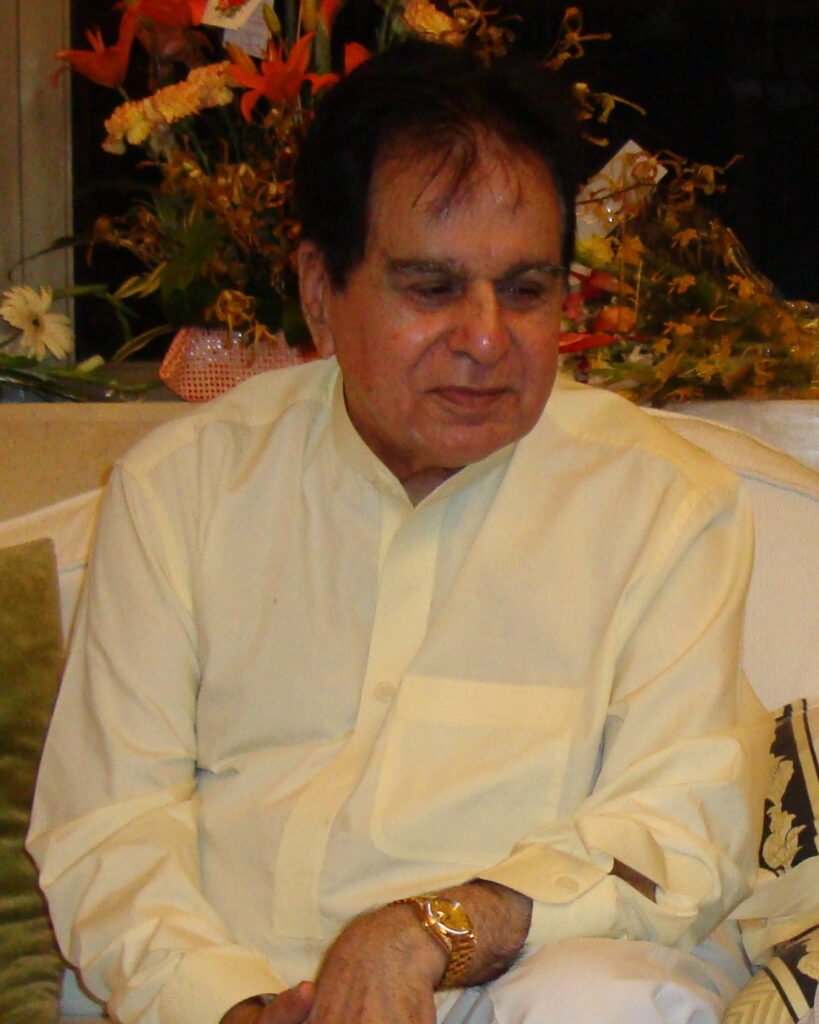
He also served in public life. He was nominated to the Rajya Sabha, the upper house of India’s Parliament, and served as a member from 2000 to 2006, representing Maharashtra. It was a quieter chapter than his film career, but it fitted the same pattern: a public figure who took institutions seriously.
His final years were marked by frequent hospital visits for age-related illness. He was admitted to Mumbai’s Hinduja Hospital in late June 2021 after breathlessness, and he died there on the morning of July 7, 2021, at 98. His doctor described a prolonged illness, and contemporary reporting noted age-related issues including pleural effusion. He was buried with full state honours at Juhu Qabarastan in Mumbai that evening, with actors including Shah Rukh Khan and Dharmendra paying their respects at the family home.
Lesser-Known Facts About Dilip Kumar
- He was born Muhammad Yusuf Khan and was renamed Dilip Kumar by Devika Rani of Bombay Talkies.
- Before films, he worked at a sandwich stall in an army club in Pune for a small monthly wage.
- His first hit, Jugnu in 1947, came three years after his unsuccessful debut in Jwar Bhata.
- He was the first actor to win the Filmfare Award for Best Actor, in 1954, and went on to win it eight times.
- He is listed in Guinness World Records for winning the maximum number of awards by an Indian actor.
- He took a five-year break from films in 1976 and returned with the year’s biggest hit, Kranti, in 1981.
- He was the only Indian recipient of Pakistan’s highest civilian honour, the Nishan-e-Imtiaz.
- His Mughal-e-Azam dialogue about love never changing, even as everything else changes, is still quoted across India.
Frequently Asked Questions
How old was Dilip Kumar when he died?
Dilip Kumar was born on December 11, 1922, and died on July 7, 2021, in Mumbai, which made him 98 years old at his death. He had been ill with age-related problems for some time before he died.
Who was Dilip Kumar’s wife?
His wife was actress Saira Banu, whom he married in 1966. She was his wife for more than five decades, until his death in 2021, and she survives him.
Did Dilip Kumar have children?
No. He and Saira Banu had no children, as confirmed in contemporary obituaries. No names or details are invented here, because there are none to give.
What was Dilip Kumar’s net worth?
His net worth is most commonly estimated at around $85 million, about ₹627 crore, according to Celebrity Net Worth, as repeated in 2021 obituary coverage. No audited figure exists, so the number should be treated as an estimate.
What are Dilip Kumar’s best movies?
His defining films include Jugnu, Andaz, Aan, Devdas, Naya Daur, Madhumati, Mughal-e-Azam, Ganga Jamuna, Ram Aur Shyam, Kranti, Shakti, Karma, and Saudagar, with Qila in 1998 as his last film.
Why is Dilip Kumar called the Tragedy King?
He earned the name for his portraits of suffering lovers and doomed heroes in the 1940s and 1950s, played with a quiet, naturalistic style that became known as method acting in Indian cinema. Filmmaker Satyajit Ray called him the ultimate method actor.
Final Thoughts
Dilip Kumar’s career is unusual because it contains two full careers inside one life. The first made him the Tragedy King, the romantic lead who taught Indian acting to whisper. The second made him the elder statesman, the patriarch whose presence alone could steady a film. Both careers rest on the same gift: the belief that feeling, played honestly, needs no decoration.
At his death at 98, he left no children, but he left something larger. His films are still watched, his acting method is still taught, and his marriage to Saira Banu is still remembered as one of Indian cinema’s great love stories. The Tragedy King is gone. The standard he set has not moved.


