


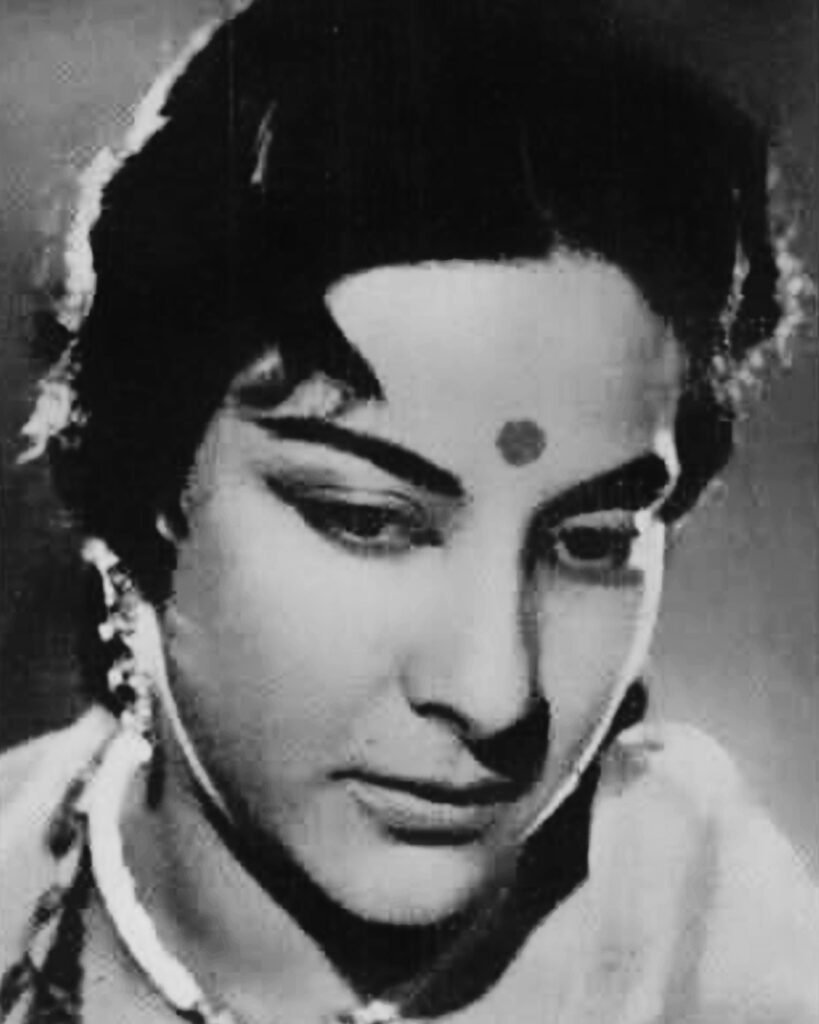
Few names in Hindi cinema carry the weight that Nargis does. She was not simply a popular leading lady of the 1940s and 1950s. She became a symbol of strength, dignity, and emotional honesty on screen.
Her most famous role, Radha in Mother India, still shapes how Indian audiences think about motherhood and sacrifice. Yet her career was much wider than that one film. She moved with ease between romance, comedy, tragedy, and social drama.
This profile looks at her life and work in full. It covers her childhood in a film family, her rise to stardom, her marriage to Sunil Dutt, her children, and the public service that defined her final years.

Quick Facts
| Fact | Detail |
|---|---|
| Full name | Nargis Dutt, born Fatima Rashid |
| Also known as | Nirmala Dutt |
| Born | 1 June 1929, Calcutta, British India |
| Died | 3 May 1981, Bombay, India, aged 51 |
| Occupation | Actress and politician |
| Years active | 1935–1936 and 1942–1968 |
| Spouse | Sunil Dutt, married 1958 |
| Children | Sanjay Dutt, Namrata Dutt, and Priya Dutt |
| Breakthrough films | Andaz and Barsaat, both 1949 |
| Best-known film | Mother India (1957) |
| Major awards | Filmfare Award for Best Actress, National Film Award for Best Actress, Padma Shri |
| Cause of death | Pancreatic cancer |
A Childhood Shaped by Music and Film
Nargis was born Fatima Rashid on 1 June 1929 in Calcutta, then part of British India. Her father was Abdul Rashid, and her mother was Jaddanbai, a Hindustani classical singer who became one of the early pioneers of Indian cinema.
Growing up in that world meant film sets, music, and performance were never distant ideas. They were part of everyday family life. Her mother had moved from Allahabad to Calcutta, and later helped introduce young Nargis to the growing film culture of India.
Her maternal half-brother, Anwar Hussain, also became a film actor. Her first screen appearance came when she was only six years old. She appeared in Talash-E-Haq in 1935 and was credited as Baby Nargis. The name Nargis comes from a Persian word for the narcissus flower, and it stayed with her for life.
Finding Her Footing as a Young Leading Lady
Nargis did not move straight from child roles into stardom. Her adult acting career is generally dated to Tamanna in 1942. Her first leading role followed in Taqdeer in 1943, opposite Motilal, and the film was a box office success.
Those early years were a period of learning. She worked in a range of films, including the period drama Humayun in 1945, and built experience in both serious and popular material. Not every film was a hit, but the work gave her range.
In 1948, she made her first film with Raj Kapoor, the drama Aag. The film did only average business at the box office. It mattered for a different reason, because it began one of the most celebrated screen partnerships in Hindi cinema.
The Breakthrough Year of 1949
Nargis became a major star in 1949, and two films did the work. The first was Mehboob Khan’s Andaz, a drama in which she played Neena, a woman caught between her husband and a close friend. The story turned on suspicion, loyalty, and misunderstanding, and Nargis held the emotional center of it.
The film started slowly at the box office. Word of mouth then carried it to major commercial success, and it became a breakthrough for Nargis as well as for her co-stars. It showed that she could carry a serious adult drama without losing warmth or charm.
The second film was Barsaat, directed by Raj Kapoor. Nargis played a village woman, and Kapoor played a poet. The film became the highest-grossing film of 1949 and broke the record set by Andaz.
A Screen Partnership That Defined an Era
The pairing of Nargis and Raj Kapoor ran through more than a dozen films. It included Awaara in 1951, Shree 420 in 1955, and Chori Chori in 1956. Each film used their partnership in a different way.
Awaara gave her one of her most striking roles. She played a lawyer who understood a painful family secret and who spoke plainly about how society treated women. In an era when many heroines were written as passive figures, her character argued, challenged, and stood her ground.
The film was a major critical and commercial success in India. It also found audiences overseas, including in countries such as Greece and the United States. That international reach helped make Nargis and Kapoor familiar names far beyond Indian cinemas.
Mother India and the Role of a Lifetime
In 1957, Nargis reached the peak of her career with Mehboob Khan’s Mother India. She played Radha, a poor village woman who endures drought, debt, loss, and impossible moral choices while raising her sons alone.
The role demanded everything from her. Radha ages across the story, suffers deeply, and refuses to surrender her principles even when survival itself is at stake. Nargis played her without sentimentality, and that restraint is part of why the performance still feels powerful.
The film was the highest-grossing Indian film at that point in its history. It was also nominated for the Academy Award for Best Foreign Language Film. Filmindia critic Baburao Patel called Mother India the greatest picture produced in India and wrote that no other actress could have performed the role as well as Nargis.
For her performance, Nargis won the Filmfare Award for Best Actress in 1958. She also became the first Indian to win Best Actress at the Karlovy Vary International Film Festival. In the same year, the Government of India honored her with the Padma Shri for her contribution to the arts.
That combination of popular success, critical praise, and national recognition is rare. It is why Mother India is still described as her defining performance, even though her earlier work was already strong.
The Wider Filmography Beyond One Classic
It would be a mistake to remember Nargis only for Mother India. Her filmography shows a performer who kept testing herself across genres and moods.
In the early 1950s, she took on the psychological drama Anhonee in 1952, playing a dual role that drew critical praise. The two characters were sharply different, and the film gave her room to show control and contrast.
Her later work included Adalat and Lajwanti, both released in 1958. Those films arrived as she was moving toward a major life change. After her marriage, she largely stepped away from full-time acting to focus on her family.
She returned for Raat Aur Din in 1967, and it won her the inaugural National Film Award for Best Actress.
Marriage to Sunil Dutt and Family Life
Nargis married her Mother India co-star Sunil Dutt in 1958. In the film, Dutt had played one of Radha’s sons, a casting detail that has often surprised later viewers. Their marriage marked the start of a new chapter, and she largely left the film industry after her remaining films were released.

The couple had three children: Sanjay Dutt, Namrata Dutt, and Priya Dutt. Sanjay went on to become a successful film actor in his own right. Priya later entered politics and served as a Member of Parliament.
Namrata married actor Kumar Gaurav, whose father Rajendra Kumar had appeared alongside Nargis and Sunil Dutt in Mother India. That connection is a reminder of how closely linked the families of that era were, both on screen and off.
Together with her husband, Nargis formed the Ajanta Arts Cultural Troupe. The troupe brought leading actors and singers to border areas to entertain soldiers. It was also the first troupe to perform in Dhaka after the liberation war of Bangladesh in 1971.
That work showed a different side of her public life. She was not only a former star lending her name to a cause. She was an organizer who helped bring live performance to audiences who rarely saw it.
Public Service and the Rajya Sabha
In the early 1970s, Nargis became the first patron of the Spastics Society of India. Her work for children with disabilities brought her recognition as a social worker. It also reflected a serious, sustained commitment rather than a brief public appearance.
Her service was formally recognized in 1980, when she was nominated to the Rajya Sabha, the upper house of India’s Parliament. She served in the nominated arts category from 3 April 1980 until her death on 3 May 1981.
That final year was marked by illness. She fell ill during a session of the Rajya Sabha in August 1980 and was later diagnosed with pancreatic cancer. She died in Bombay at the age of 51, only three days before her son Sanjay made his Hindi film debut in Rocky.
Her husband later established the Nargis Dutt Memorial Cancer Foundation in her memory in 1982. The foundation became part of her legacy, linking her name to cancer care and support for patients and families.
What Was Nargis’s Net Worth
For a star who died in 1981, a modern net worth figure would be misleading without a reliable source behind it. No reputable financial publication or major news outlet has published a verified estimate of Nargis’s wealth at the time of her death.
That absence is important to state plainly. She was among the highest-paid actresses of the 1950s and 1960s, and her films were major commercial successes. Those facts are well documented, but they do not translate into a trustworthy personal fortune figure.
Some low-authority celebrity biography sites publish a number for her, but they do not explain how it was calculated or cite a credible source. This article does not repeat such a figure, because repeating it would turn a guess into a fact.
What can be said with confidence is where her professional value lay. It lay in her status as a top actress, her long run of successful films, and her later public service. Any site that gives a precise dollar amount for Nargis should be treated with caution unless it names a verifiable source.
Why Her Legacy Still Matters
Nargis is often described as one of the greatest actresses in the history of Hindi cinema. That judgment rests on more than nostalgia. It rests on the range of her work and the way her characters pushed against the limits of their time.
She played independent, outspoken women in films that reached mass audiences. She played mothers without reducing them to saints, and lovers without reducing them to decoration. Her performances gave emotional weight to stories that might otherwise have felt conventional.
Her legacy is also visible in public honors. Streets in Bandra in Mumbai and Model Colony in Pune are named Nargis Dutt Road in her memory. India Post issued a postage stamp in her honor on 30 December 1993.
In 2015, Google marked her 86th birthday with a doodle and noted her portrayal of strong women protagonists. The National Film Awards also created the Nargis Dutt Award for Best Feature Film on National Integration in her honor, although her name was removed from that award in 2024 for reasons that were not publicly explained.
Like the classic Hollywood stars of the same golden era, her work rewards a second look. Fans of Humphrey Bogart will recognize a similar kind of screen authority, the sense that a performer could carry a scene through presence as much as through dialogue. Nargis had that same quality, even though she worked in a very different film industry.
Her career also invites comparison with Cary Grant, whose screwball comedies and romantic films helped define Hollywood charm in the same period. Nargis moved between screwball comedy and literary drama with a similar ease, shifting tone without losing her characters.
And like Clark Gable, who became a defining leading man of Hollywood’s studio era, Nargis became a defining star of Hindi cinema’s studio era. Both careers show how a strong screen persona could shape popular taste for a generation.
Lesser-Known Facts About Nargis
- She made her screen debut at six years old, credited as Baby Nargis, more than a decade before her breakthrough as a leading lady.
- Her birth name was Fatima Rashid, and she later also used the name Nirmala Dutt.
- Her mother, Jaddanbai, was a classical singer and an early pioneer of Indian cinema.
- She was the first Indian to win Best Actress at the Karlovy Vary International Film Festival.
- She was the first film actress to receive the Padma Shri, in 1958.
- Her final film, Raat Aur Din, won her the first-ever National Film Award for Best Actress.
- She became the first patron of the Spastics Society of India in the early 1970s.
- A biography of her life, The Life and Times of Nargis by T. J. S. George, was published in 1994.
Frequently Asked Questions
How old was Nargis when she died?
Nargis was 51 years old when she died on 3 May 1981. She had been born on 1 June 1929, so she died just weeks before what would have been her 52nd birthday.
Who was Nargis’s husband?
Nargis’s husband was actor Sunil Dutt. They married in 1958 after working together on Mother India, in which Dutt played one of her character’s sons.
How many children did Nargis have?
Nargis had three children: Sanjay Dutt, Namrata Dutt, and Priya Dutt. Sanjay became a film actor, while Priya later became a politician and Member of Parliament.
What was Nargis’s most famous movie?
Her most famous movie was Mother India from 1957. She played Radha, a village mother who endures hardship while holding firmly to her principles, and the performance won her the Filmfare Award for Best Actress.
What awards did Nargis win?
Nargis won the Filmfare Award for Best Actress for Mother India and the National Film Award for Best Actress for Raat Aur Din. She also received the Padma Shri in 1958 and Best Actress at the Karlovy Vary International Film Festival.
What was Nargis’s net worth?
No reliable, well-sourced estimate of Nargis’s net worth exists in reputable publications. She was among the highest-paid actresses of her era, but this article does not publish an invented figure in place of a verified one.
Conclusion
Nargis built a career that moved from child roles to stardom, from romance to tragedy, and from cinema to public service. Her best work combined emotional directness with discipline, and her most famous role still sets a standard for screen motherhood.
She left films at the height of her fame to build a family life, then returned to public work with the same seriousness she had brought to acting. That second act, in charity and in Parliament, is part of why she is remembered as more than a film star.
For new viewers, Mother India remains the best starting point. For those who stay with her filmography, the comedies, dramas, and late return in Raat Aur Din reveal an actress of unusual range. More than four decades after her death, that range is still her legacy.