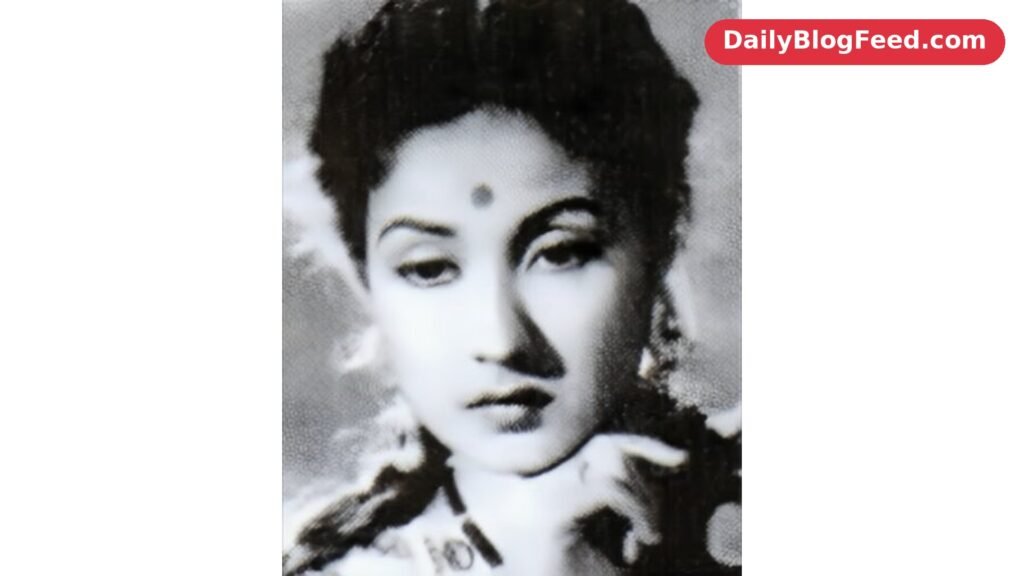

Meena Kumari remains one of the most haunting names in Hindi cinema. Decades after her death, her films still play, her songs still circulate, and new viewers still discover the actress audiences called the Tragedy Queen.
She was not famous for glamour alone. She was famous for the way she carried sorrow on screen without turning it into melodrama for its own sake. Her eyes did much of the acting, and her restraint made her characters feel like real women rather than symbols.
This guide answers the questions readers most often ask about her. It covers her age, her husband, whether she had children, her net worth, and the movies that define her career. It also separates well documented facts from the speculation that has grown up around her short life.
Quick Facts
| Detail | Information |
|---|---|
| Full name | Meena Kumari |
| Birth name | Mahjabeen Bano |
| Born | 1 August 1933, Bombay, British India |
| Died | 31 March 1972, Bombay, India, aged 38 |
| Occupation | Actress, poet, singer, costume designer |
| Years active | 1939–1972 |
| Films | More than 90 |
| Spouse | Kamal Amrohi, married 1952, separated 1964 |
| Children | None |
| Known as | The Tragedy Queen |
| Pen name | Naaz |
| Major awards | Four Filmfare Best Actress awards |
A Childhood That Began at Work
Meena Kumari was born Mahjabeen Bano in Bombay on 1 August 1933. Her father, Ali Bakhsh, worked in theatre and music, and her mother, Iqbal Begum, had been a stage actress and dancer. The family lived with financial pressure, and that pressure shaped the course of her childhood in a decisive way.
She entered films as a child artist at a very young age. Her first film is generally listed as Farzand-e-Watan, released in 1939 and also known as Leatherface. Director Vijay Bhatt gave her the screen name Baby Meena, and the name stayed with her as she grew up in front of the camera.
A child who works to support a family rarely gets an ordinary education or adolescence. Meena Kumari later became known as a serious reader and writer, but her formal schooling was limited by studio life.
From Child Artist to Leading Lady
The 1940s kept her busy, but they did not yet make her a star in adult roles. She appeared in mythological films and fantasy stories, the kinds of pictures that gave young performers steady work and broad exposure. Films such as Veer Ghatotkach and Aladdin and the Wonderful Lamp belong to this phase of her career.
These early adult roles mattered because they taught her camera discipline. She learned how to hold a scene, how to work with music, and how to move between dialogue and song without losing the thread of a character. By the early 1950s, she was ready for material that asked more of her than spectacle or charm.
The Breakthrough That Changed Everything
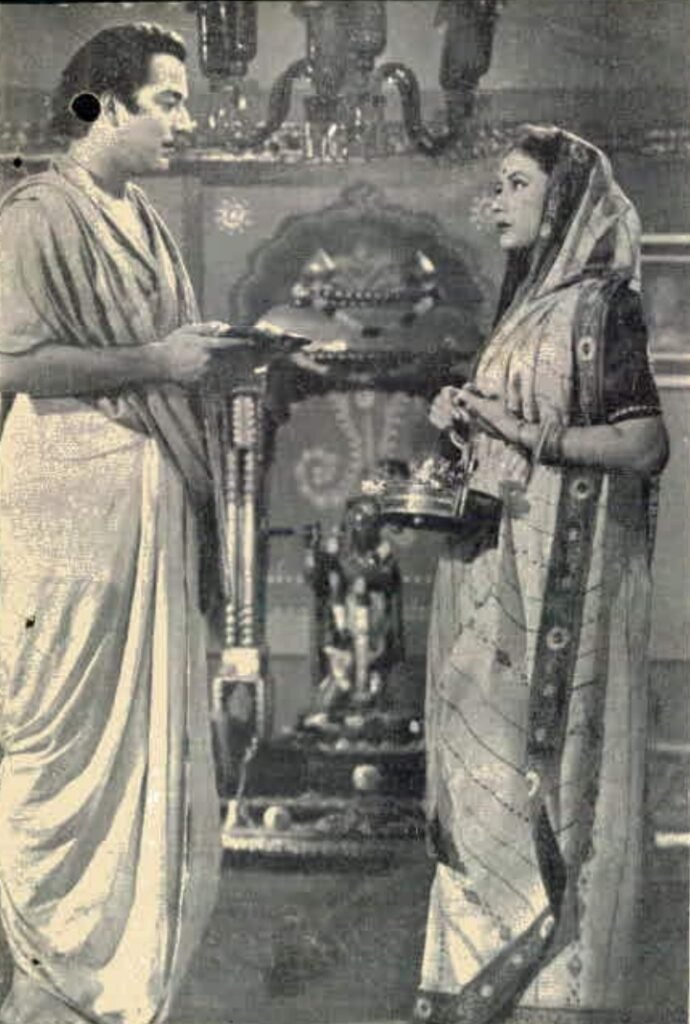
Baiju Bawra, released in 1952, changed Meena Kumari’s career completely. She played Gauri, a boatman’s daughter who loves Baiju, a young singer played by Bharat Bhushan. The film combined music, romance, and revenge in a story set in the court of Akbar, and its songs became enormously popular.
Her performance won the first Filmfare Best Actress award, presented in 1954 for the film. That detail matters because it places her at the very start of Filmfare’s acting honours. She was not simply a successful actress of her era, but one of the first performers the new awards system chose to recognise.
Baiju Bawra also established the quality that would define her stardom. She could play devotion without making it seem naive, and she could play grief without losing dignity. Audiences trusted her in emotional scenes, and directors began writing or choosing roles that relied on that trust.
A Tragedienne Who Could Also Make Audiences Laugh
The Tragedy Queen label stuck, and for good reason. Films such as Parineeta in 1953, Daera in 1953, and Dil Apna Aur Preet Parai in 1960 showed her gift for playing women caught between love, duty, and social expectation. She won her second Filmfare Best Actress award for Parineeta, in which she played Lalita with quiet steadiness.
Yet the label only tells part of the story. Meena Kumari also worked successfully in lighter films, including Azaad in 1955, Miss Mary in 1957, Shararat in 1959, and Kohinoor in 1960. These comedies and romances proved that she was not limited to sorrow, even if sorrow was what audiences remembered most vividly.
Her peak years overlapped with Hollywood’s golden age, when screen acting on both sides of the world was defined by stars who could hold a close-up without forcing an emotion. In that sense, her reputation invites comparison with Humphrey Bogart, whose weary, world-wise screen presence likewise made restraint feel more powerful than shouting. The comparison is about era and screen craft, not about shared films or a shared industry.
Sahib Bibi Aur Ghulam and a Filmfare Record
Sahib Bibi Aur Ghulam, released in 1962, is often named as Meena Kumari’s finest performance. She played Chhoti Bahu, a neglected wife in a declining feudal household who longs for her husband’s love and attention. The role asked her to show loneliness, longing, and slow decline without reducing the character to a victim alone.
At the 10th Filmfare Awards in 1963, she received all three nominations in the Best Actress category. The nominations were for Aarti, Main Chup Rahungi, and Sahib Bibi Aur Ghulam, and she won for Sahib Bibi Aur Ghulam. That feat has not been matched by another actress in the history of the awards, which gives a clear measure of how dominant she was in that year.
The film also has a complicated place in her biography. Critics have noted parallels between Chhoti Bahu’s drinking and loneliness and Meena Kumari’s own struggles, but a performance is not a confession, and those parallels should be handled carefully.
Dil Ek Mandir in 1963 and Kaajal in 1965 kept her at the top of Hindi cinema through the mid-1960s. She won her fourth Filmfare Best Actress award for Kaajal, playing Madhvi. Phool Aur Patthar in 1966, opposite Dharmendra, was another major success and showed that she could still anchor a popular film late in her peak period.
Pakeezah: Fourteen Years in the Making
No account of Meena Kumari is complete without Pakeezah. The film was conceived by director Kamal Amrohi in the mid-1950s as a showcase for his wife, and filming began in 1956. It then endured years of delay, changing plans, and personal upheaval before it finally reached audiences.
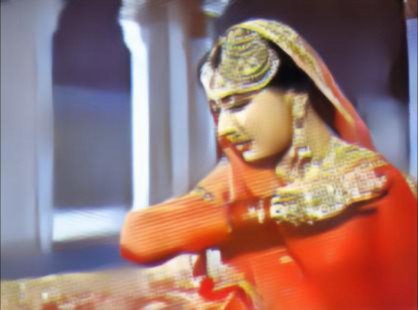
Work on the film stalled completely in 1964, when Amrohi and Meena Kumari separated. For years, Pakeezah looked like a project that might never be finished. It was revived in the late 1960s after actors Sunil Dutt and Nargis saw existing footage and encouraged Meena Kumari, who was already ill, to complete it.
Pakeezah finally opened in February 1972, with Meena Kumari in the dual role of Nargis and her daughter Sahibjaan, a courtesan seeking love and respectability. She also designed the costumes for the film, a credit that reflects how personally involved she was in its look and atmosphere. The early response was lukewarm, but after her death weeks later, the film became a major success and a landmark of Hindi cinema.
Her final years also included Mere Apne in 1971, Gulzar’s directorial debut, in which she played an elderly woman caught between two gangs of young men. The role showed a different authority from her earlier romantic leads, even as her health declined.
Personal Life: Marriage, Separation, and Family
Meena Kumari married filmmaker Kamal Amrohi in 1952. Amrohi was already married, and their marriage became one of the most discussed relationships in Hindi cinema. The couple separated in 1964, and they never reconciled as husband and wife, although they did return to finish Pakeezah together.
She had no children. That fact is stated plainly here because readers often ask about it, and because unreliable profiles sometimes add children who never existed. Her family by birth included her sisters Khurshid Jr. and Madhu, the latter a former child artist who married actor Mehmood.
Her later health problems are part of the public record, and they should be described without sensational detail. She developed liver cirrhosis, associated with alcohol dependence, and her health declined through the late 1960s. She sought treatment abroad, returned to complete Pakeezah, and died in Bombay on 31 March 1972 at the age of 38.
The Poet Known as Naaz
Away from the camera, Meena Kumari wrote Urdu poetry under the pen name Naaz. Her poems often explored loneliness, love, longing, and the feeling of being misunderstood, themes that readers naturally connect with her screen roles. Yet the poetry stands on its own as the work of a serious and sensitive writer, not merely as a footnote to her films.
She recorded some of her poems for the album I Write, I Recite, released in 1971 with music by Khayyam. Hearing her speak her own words gives a different, more intimate impression than watching her act someone else’s script.
After her death, Gulzar compiled her poems in the collection Tanha Chand. Later translators and scholars, including Noorul Hasan, brought more of her work to English readers. For anyone who wants to understand her beyond the Tragedy Queen label, the poetry is the best place to start.
Like James Stewart, whose long Hollywood career showed how a performer could move from light comedy to darker, more troubled roles without losing the audience’s trust, Meena Kumari kept finding new shades within a public image that might have trapped a lesser actor. The parallel lies in that range and longevity, since both careers spanned decades and survived major changes in their industries.
Meena Kumari Net Worth
There is no reliable, well sourced estimate of Meena Kumari’s net worth. That answer may disappoint readers who expect a single number, but inventing one would be misleading. She died in 1972, long before the modern celebrity wealth industry began publishing annual estimates, and no reputable financial source has produced an audited figure for her estate.
Some low quality websites do publish numbers for her, but those figures conflict sharply with one another and cite no credible source. Because they cannot be verified, they are not repeated here. A responsible profile should say plainly when a number does not exist, rather than dressing up a guess as a fact.
What can be said with confidence is that she was one of the most regarded and busiest leading actresses of her time. She worked steadily for more than three decades and left behind work that still earns through screenings, restorations, and music. Her lasting value lies in that cultural legacy, not in a fabricated dollar figure.
Legacy and Recognition
Meena Kumari’s legacy rests on a rare combination of popular success and critical respect. She won four Filmfare Best Actress awards, from Baiju Bawra, Parineeta, Sahib Bibi Aur Ghulam, and Kaajal, and she received twelve nominations in the category in total. Her posthumous nomination for Pakeezah in 1973 remains a notable part of Filmfare history.
Beyond awards, her influence shows in how later actresses talk about screen acting. She proved that a Hindi film heroine could be quiet and still dominate a scene, and that suffering on screen could be played with intelligence rather than excess. India issued a postage stamp featuring her in 2011, and restored versions of Pakeezah have introduced the film to new audiences in recent years.
Her story also belongs to a wider golden age of screen acting, and Marlon Brando offers a useful point of comparison because both performers were celebrated for emotional intensity that felt startlingly natural for their time. They worked in different industries and different languages, but both changed what audiences expected from a leading performance in the 1950s.
Lesser-Known Facts
- She began acting as a child artist at about age six or seven, and director Vijay Bhatt gave her the screen name Baby Meena.
- She wrote Urdu poetry throughout her adult life under the pen name Naaz, keeping that creative life largely separate from her film image.
- She sang in some of her early films and later recorded her own poems for the album I Write, I Recite in 1971.
- She designed the costumes for Pakeezah, showing a hands-on interest in the visual world of the film.
- She received all three Filmfare Best Actress nominations in 1963, a record that still stands unmatched.
- She was nominated posthumously for Pakeezah at the Filmfare Awards in 1973, another rare distinction.
- India honoured her with a postage stamp in 2011, nearly four decades after her death.
- Her poetry collection Tanha Chand was compiled by Gulzar and published after her death.
Frequently Asked Questions
How old was Meena Kumari when she died?
She was 38 years old when she died on 31 March 1972. She had been born on 1 August 1933, so she died several months before what would have been her 39th birthday.
Who was Meena Kumari’s husband?
Her husband was filmmaker Kamal Amrohi, whom she married in 1952. The couple separated in 1964, although they later worked together again to complete Pakeezah.
Did Meena Kumari have children?
No, Meena Kumari had no children. Some unreliable profiles list children for her, but no credible biography supports those claims, and they should not be repeated.
What was Meena Kumari’s net worth?
No reliable estimate of her net worth exists. She died in 1972, before modern celebrity wealth reporting began, and the conflicting figures found on low quality websites cite no credible source and are not used here.
What are Meena Kumari’s most famous movies?
Her most famous movies include Baiju Bawra, Parineeta, Sahib Bibi Aur Ghulam, Kaajal, Phool Aur Patthar, Mere Apne, and Pakeezah. Together, they show her range from musical romance and comedy to the tragic roles for which she is best remembered.
Why was Meena Kumari called the Tragedy Queen?
She earned the title because of her powerful performances as suffering, emotionally complex women in films such as Sahib Bibi Aur Ghulam and Pakeezah. The name also reflected, fairly or not, the sadness that marked much of her private life.
Conclusion
Meena Kumari’s career lasted 33 years, from a child artist in 1939 to the release of Pakeezah in 1972. In that time, she made more than 90 films, won four Filmfare Best Actress awards, and created performances that still set a standard for screen acting in Hindi cinema.
Her life was short and often painful, and honesty requires saying so. Yet the work itself is the reason she is still remembered. Watch Sahib Bibi Aur Ghulam for her restraint, Baiju Bawra for her breakthrough, and Pakeezah for the project she refused to abandon. Then read her poetry as Naaz, and a fuller portrait emerges: not only a Tragedy Queen, but a working artist with a private voice of her own.