
Israeli Prime Minister Benjamin Netanyahu ordered the closure of the West Bank on Friday after two Palestinian gunmen opened fire at an Israeli military checkpoint near the city of Hebron, killing two soldiers and wounding at least three others before being shot dead. The attack, which lasted about 20 minutes according to Israel’s military, comes just days before Israelis vote in a national election on Tuesday.
Netanyahu convened his security cabinet within hours of the shooting and announced a sweeping response: Hebron would be sealed off, a large-scale operation would begin in the surrounding area, and preparations were under way for a full closure of the occupied West Bank. Visiting the scene later in the day wearing a bulletproof vest, he said he and Defence Minister Israel Katz were considering a military campaign on a scale not seen since the 1967 war, though he added that the timing had yet to be set.

The shooting at Farsh al-Hawa
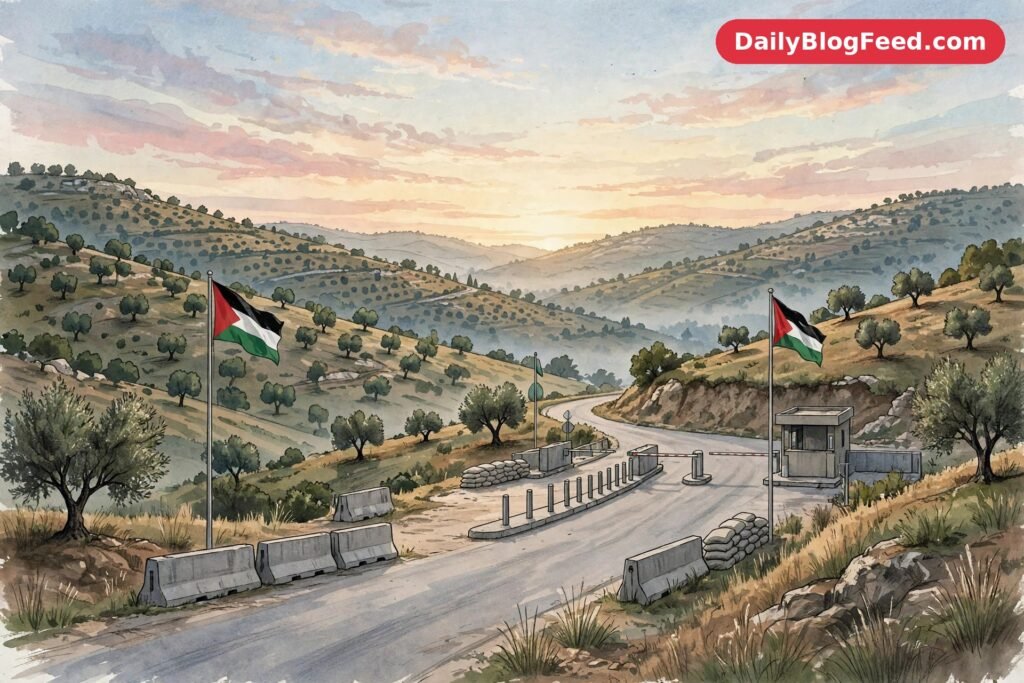
According to the Israel Defense Forces, the violence began on Friday morning when two Palestinian men armed with a handgun and an automatic rifle exited a vehicle at the Farsh al-Hawa checkpoint outside Hebron and opened fire on soldiers. A gun battle followed that, according to a preliminary military investigation reported by multiple outlets, lasted around 20 minutes before both attackers were killed.
The army said two of its soldiers “fell in combat in the Judea Junction” area near Hebron, with three others wounded. Rescue services had initially reported five wounded, two of them seriously — early, shifting casualty reporting typical of a developing attack.
The military said it recovered the vehicle used by the gunmen, which it said was filled with “a large quantity” of ammunition. IDF Chief of Staff Lt. Gen. Eyal Zamir said the rapid action of the soldiers had prevented an even more serious attack, adding that the ammunition suggested a larger assault had been planned.
An AFP photographer who happened to be heading to another assignment witnessed the exchange of fire, later reporting seeing the two armed men engaging soldiers before Israeli forces shot them dead.
A swift and sweeping military response
Netanyahu’s response was immediate. In a statement from his office, he said the assailants appeared to be Hamas operatives planning “a major attack aimed at murdering innocent civilians.” Hamas praised the shooting in a statement as a “heroic operation” and called on supporters to carry out more attacks, though it did not directly claim responsibility.
The IDF said it was imposing “a full siege” on the city of Hebron, while Netanyahu said he had ordered a full closure of the West Bank starting Friday. Hours later, he appeared to scale back the scope of the closure, saying he would consider “a cordon” around the cities of Hebron and Halhul that could extend to other areas, according to CNN.
Israeli authorities also announced a multi-day counterterrorism operation in the Hebron area. In a joint statement, the military and the Israel Security Agency said forces had begun “precise, targeted and thorough searches throughout the area to locate and dismantle terrorist infrastructure and weapons, while questioning suspects,” adding that residents could leave through three designated exit points subject to screening.

By Friday afternoon, demolitions were already under way. Netanyahu said the military would forcibly evacuate the neighborhood from which the attackers came, go house to house, and “destroy all terrorist infrastructure” — a model, he said, used in the Jenin, Tulkarm, Nur Shams and Al-Far’a refugee camps in the northern West Bank in early 2025, operations that displaced thousands of Palestinians. In video obtained by CNN, an Israeli soldier was heard telling residents of a Hebron housing complex: “You have five minutes to evacuate.”
Israeli human rights organization B’Tselem condemned the plan to “forcibly displace Palestinian residents” from the Hebron neighborhood. “Netanyahu and (Defence Minister) Katz have declared their intention to empty a Palestinian neighborhood in Hebron and repeat the mass displacement and destruction inflicted on the northern West Bank refugee camps,” the group’s executive director Yuli Novak said.
The United Nations said on Friday it was “extremely alarmed” by the escalating violence. UN spokesperson Stéphane Dujarric said Secretary-General António Guterres was deeply concerned by the closures and by reports of home demolitions and possible displacement, noting that they “severely restrict Palestinians’ freedom of movement, access to basic services and livelihoods.”
Election timing adds political pressure
The attack landed just four days before Israel holds a national election — the first since the Hamas-led attacks of October 7, 2023 — and is likely to intensify the campaign’s focus on security. Netanyahu, who is trailing in most polls according to the Wall Street Journal, has made security a central theme of his re-election effort.
His main challenger, retired general Gadi Eisenkot, has criticized the prime minister over the security failures surrounding the 2023 attacks. After Friday’s shooting, however, Eisenkot praised the troops’ response and said he was praying “for the complete and quick recovery of the injured.”
Hardline members of Netanyahu’s camp quickly seized on the attack. Finance Minister Bezalel Smotrich called for a comprehensive military campaign in the West Bank “exactly like in Gaza,” including dismantling the Palestinian Authority. National Security Minister Itamar Ben Gvir likewise called for the Ramallah-based Palestinian Authority to be “dismantled and demilitarised.” SCMP noted there is no evidence the Palestinian Authority was connected to Friday’s attack.
A volatile West Bank backdrop
The shooting is the latest in a prolonged period of violence in the occupied West Bank. According to an Agence France-Presse tally based on data from the Palestinian health ministry, Israeli forces and settlers have killed 1,113 Palestinians in the territory since the start of the Gaza war in October 2023. Israeli figures show at least 49 Israelis, including civilians and security personnel, have been killed in Palestinian attacks or during Israeli military operations during the same period.

Tensions have also been rising around attacks by extremist Israeli settlers against Palestinian olive harvesters, and the UN said Friday it was “extremely alarmed” by record levels of settler violence against Palestinians in 2026. Friday’s lockdown is the fourth time in a month that Israel has imposed restrictions across the territory, according to the UN.
What happens next
The situation remains developing. Israeli authorities say the Hebron operation will last several days, with house-to-house searches, roadblocks, and further arrests of suspects expected, alongside the threatened demolitions. Netanyahu has said a far larger West Bank operation is being considered and that “the IDF is ready to execute it and we will set the timing, but it is on the way.”
The immediate questions — how far the closure extends, how long it lasts, and whether the promised evacuations in Hebron go ahead — will shape daily life for hundreds of thousands of Palestinians in the coming days. With the election on Tuesday, the political fallout is also likely to unfold quickly. This story will be updated as confirmed details emerge.