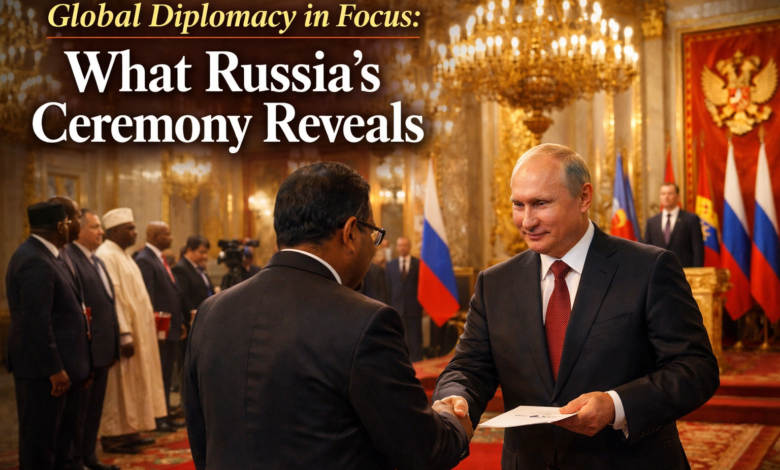
Global Diplomacy in Focus: What Russia’s Ceremony Reveals. On the 15th of January 2026, Russian President Vladimir Putin hosted a very meaningful and representative diplomatic gathering in Moscow. Namely the accreditation ceremony during which 34 foreign ambassadors presented their letters of credence at the Grand Kremlin Palace. At first glance, this can be considered just an act of tradition and protocol that has taken place for many years. However, the meaning and implications of this gathering extend very far beyond the outlined boundaries of this act.
Within this blogging site, we will attempt to understand its relevance, its implications for global diplomacy in the year 2026 and finally, its implications for Russian foreign policies.
A Diplomatic Tradition with Modern Significance
Every sovereign state invites newly appointed foreign ambassadors to present their credentials to its head of state. This ritual often staged with ceremonial flourish marks the ambassador’s official start of duty and is a foundational step in formal bilateral ties. For Russia, this ceremony remains a key instrument of diplomatic engagement.
But 2026’s ceremony was notable for several reasons:
- It included ambassadors from countries traditionally seen as “unfriendly” by Moscow such as France, Norway, Sweden and Italy.
- It featured key envoys from Africa, Asia the Middle East and Latin America.
- It underscored Russia’s evolving approach to global partnerships, even with states where relations are complex or tense.
In short, what might seem like a routine diplomatic rite carries political, strategic and communicative weight in today’s global environment.
Signal 1: Russia Is Reasserting a Multipolar World Vision
A core message from President Putin during the ceremony was Russia’s commitment to a multipolar world order , where no single power dominates global decision making. Putin explicitly stated that Russia remains committed to this vision and to maintaining open, balanced relations with all countries ready to cooperate.
This concept of a multipolar world has been at the heart of Russia’s foreign policy discourse for years, but it gains renewed relevance in 2026 amid:
- Ongoing tensions between major powers including the United States, European Union and China.
- Shifting alliances and regional power plays in Asia, Africa and the Middle East.
- Global debates about the effectiveness and equity of international institutions like the United Nations.
Putin’s emphasis isn’t just rhetorical by welcoming ambassadors from diverse regions, Russia signals its intent to be seen as a central player in a world where influence is not monopolized by the West alone.
Signal 2: Engagement With Europe and Regional Actors Is Still on the Agenda
In his remarks, President Putin also stressed that Russia is ready to restore relations with Europe, aiming to bring diplomatic ties closer to their pre‑2022 war levels.
This statement is particularly significant because:
- Relations between Russia and many European states have been strained since Moscow’s full scale invasion of Ukraine in 2022.
- Quiet diplomatic channels have continued even during confrontations, but public commitments to restoration are rare.
- The symbolic presence of ambassadors from European countries at the accreditation ceremony shows that formal diplomatic engagement has not been wholly severed.
Restoring ties with Europe would help Russia rebuild economic, cultural, and political links that have been damaged in recent years, without necessarily implying full agreement on contentious issues.
Signal 3: South Korea, Africa, and New Geopolitical Chapters
One of the most intriguing developments from the ceremony was Putin’s publicly stated hope of restoring relations with South Korea. He acknowledged that productive cooperation in trade and business had been “squandered” in the past but expressed optimism about renewing it.
This matters for global diplomacy because:
- South Korea is a key economic and technological power in East Asia.
- Russia’s desire to reset relations reflects wider strategic priorities in balancing influence between Western and Asian blocs.
- It hints at Moscow’s openness to pragmatically pursue economic partnerships, even as geopolitical fault lines persist elsewhere.
In addition, the presence of African ambassadors from Algeria, Ghana, Egypt, Namibia, and Somalia highlights Russia’s active engagement with the African continent.
It reflects Moscow’s growing focus on Africa’s diplomatic importance.
During the ceremony, President Putin emphasized ongoing commitments to partnership, support and cooperation with African nations. These commitments are partly rooted in historical ties dating back to the Soviet era. These gestures go beyond a formal ceremony. They represent efforts to deepen political trust between Russia and its partners. They also aim to expand economic cooperation across key regions. At the same time, Russia seeks to strengthen its geopolitical influence.
Such regions are becoming increasingly important in shaping 21st-century global diplomacy.
Signal 4: The United Nations and Global Governance
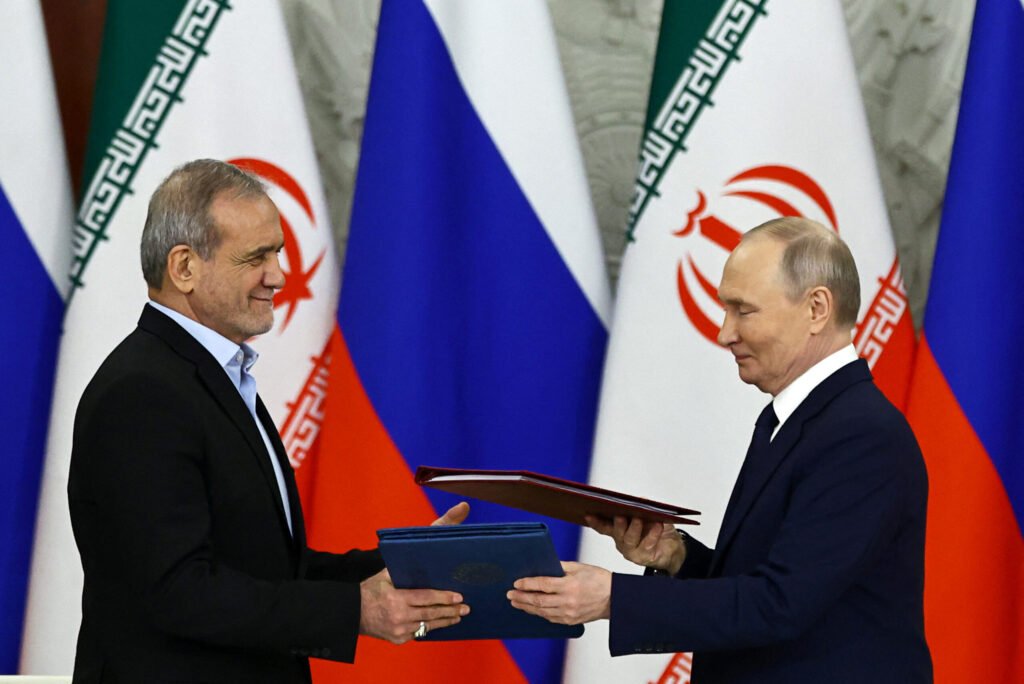
Another key theme at the ceremony was Russia’s call for a strengthened role for the United Nations as the central platform for global governance. Putin criticized what he described as a decline in multilateral diplomacy, where unilateral actions have increasingly driven international conflicts.
Emphasizing the UN’s centrality serves multiple strategic functions for Russia:
- It positions Moscow as a defender of international law and collective decision‑making.
- It challenges narratives that Western powers dominate global governance.
- It gives Russia a platform to promote its preferred frameworks for addressing global challenges like security, arms control and economic cooperation.
This stress on multilateralism even if framed through a national lens speaks to Russia’s recognition of global institutions as essential stages for power projection and diplomatic negotiation.
Signal 5: Pakistan and Other Bilateral Priorities
From a regional standpoint, the accreditation of Pakistan’s ambassador to Russia, Faisal Niaz Tirmizi, is a noteworthy element of the broader diplomatic picture. Ambassador Tirmizi’s credentials were formally presented at the ceremony and Putin described Pakistan as a “close partner” emphasizing expanding cooperation in trade, energy, commerce, education, IT and more.
This reflects Russia’s desire to:
- Diversify its global partnerships beyond traditional geopolitical alignments.
- Engage with key players from South Asia, a region of significant strategic importance.
- Build cooperative channels that span economic, cultural and technological sectors.
Pakistan’s inclusion highlights how Russia is approaching diplomacy not only through grand strategic narratives but also through concrete bilateral relationships that yield mutual benefits on the ground.
What It All Means for 2026 Global Diplomacy
The 2026 ambassador accreditation ceremony in Moscow reveals several important patterns in the current international system:
1. Diplomacy Is Alive Even in Strained Times
Despite tensions especially with the West Russia continues to engage formally with a wide range of countries through channels like ambassador accreditation. Ceremonies like this demonstrate that diplomatic engagement remains indispensable even when geopolitical rivalries are pronounced.
2. Multipolar World Order Is a Central Narrative
Russia’s public commitment to a multipolar world reflects broader global debates about power distribution, alliances and the future of international cooperation. Whether or not this vision is fully realized, it has become a rallying concept for many nations seeking alternatives to Western dominance in global affairs.
3. Regional and Bilateral Focus Matters
From Europe to South Korea to Pakistan and African nations, Russia’s partnerships showcase a multi‑layered diplomatic strategy. Moscow is balancing traditional alliances and economic interests with efforts to open new dialogues across continents.
4. Global Institutions Still Matter
By advocating for a stronger United Nations, Russia affirms that global governance structures remain crucial arenas for diplomacy despite criticisms and challenges. How these institutions adapt in an era of rising tensions will shape much of the geopolitical landscape beyond 2026.
Conclusion: More Than a Ceremony
What could be dismissed as a routine protocol event the presenting of credentials is actually a window into the strategic currents shaping international relations today. The 2026 ceremony highlights Russia’s complex diplomatic posture a mix of tradition, strategic messaging, bilateral partnership and global ambition.
As the world navigates conflict, cooperation and competition in equal measure, ceremonies like this remind us that diplomacy formal and informal continues to be both a tool and a stage for the unfolding story of global politics.