
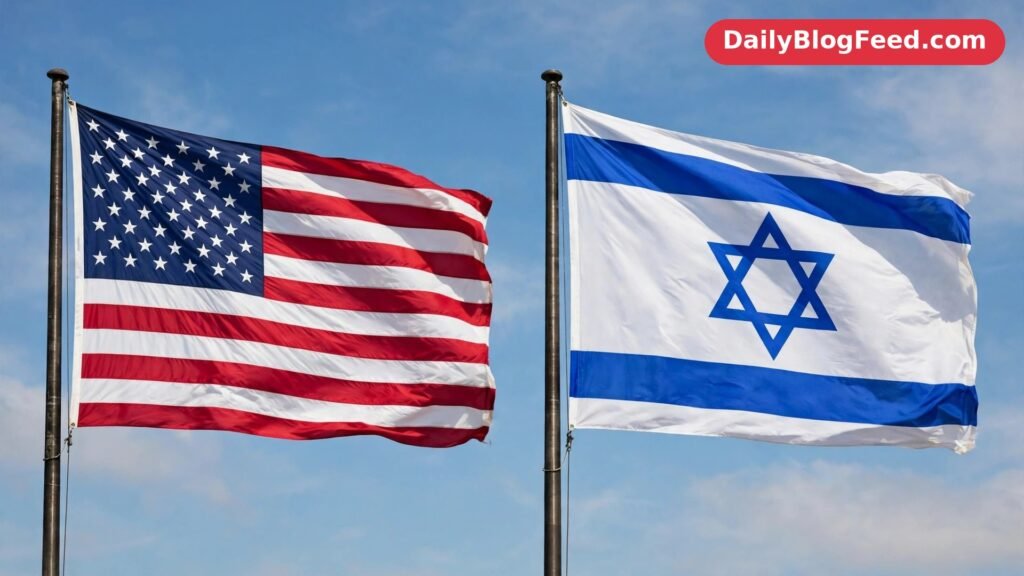

President Donald Trump has said the United States will stop providing roughly $4 billion in annual military aid to Israel by the end of 2026, announcing what he described as an agreement with Israeli Prime Minister Benjamin Netanyahu. The announcement was made on Tuesday, November 3, 2026 — US midterm election day — during a telephone interview with Fox News’ Fox & Friends programme, and it was reported by the BBC, Reuters and several other outlets.
“We’ve already agreed that by the end of this year we won’t be paying Israel,” Mr Trump said, according to the BBC’s account of the interview. “Now we’ll help Israel if they need it.” He added that Mr Netanyahu had approached him about ending the assistance, arguing that Israel’s economy was strong enough to finance its own defence and could buy American weapons instead of receiving direct funding.
The announcement is significant because Israel has been the largest recipient of American foreign assistance since the Second World War, and the annual aid package has been a cornerstone of the US-Israel relationship for decades. But it also leaves major questions unanswered, including how the funding would be ended early under an existing agreement that runs until 2028.
What the current agreement actually provides
The main framework for regular American assistance to Israel is a memorandum of understanding signed in 2016 under former President Barack Obama. It commits $38 billion in military aid over ten fiscal years, from 2019 through 2028 — about $3.8 billion a year, which Mr Trump rounded to $4 billion in his interview. The agreement is therefore due to run for almost two more years after the end-of-2026 date Mr Trump mentioned.
That gap is the central puzzle in the announcement. According to Reuters’ reporting, cited by SFG Media, neither the White House nor Mr Netanyahu’s office had responded to requests for details of the agreement at the time of publication. Mr Trump did not explain the mechanism by which the payments would be brought to an early end, and he did not say whether the cutoff would cover all forms of assistance or only part of it.
Analysts quoted in the coverage noted an important distinction: the memorandum is a political commitment rather than a legally binding international treaty ratified by the Senate. That may give a president more room to change course than a formal treaty would, but it does not by itself explain how an agreed ten-year framework would be wound down two years early, or what would happen to funding already appropriated by Congress.
Mr Trump was clear on one point, however: American weapons sales to Israel would continue. Israel would still be able to purchase US military equipment, he said, even if direct financial assistance ends. That distinction matters, because it means the announcement is about the funding mechanism rather than a halt to the military relationship itself.
Why the announcement came now
The timing of the announcement, on the day Americans voted in the midterm elections, was widely noted. Opposition to American military assistance to Israel has grown in the United States, particularly among Democratic voters, and the issue featured in several midterm campaigns. Mr Trump himself noted that Democratic candidates had used US military support for Israel against Republicans, according to ABP News’ account of the interview.
Polling cited by the BBC points to a long shift in public opinion. A September Quinnipiac University poll found that 48 percent of voters believed the United States was too supportive of Israel, compared with 16 percent in 2017, according to the BBC figures reported by the Palestine Chronicle. That change has been driven in part by the war in Gaza and by broader questions about the cost of overseas commitments at a time when many Americans say they are struggling with living costs at home.
The announcement also came in a week of major political change in Washington. Democrats won control of both chambers of Congress in the midterm elections, a result Mr Trump acknowledged was partly driven by voter anger over the war with Iran. Against that backdrop, the Israel aid announcement can be read as both a policy shift and a political signal: an attempt to reposition the administration on an issue where public opinion has moved.

What is confirmed and what is not
It is important to separate what Mr Trump actually said from what remains unclear. What is confirmed, on the basis of the BBC and Reuters reporting, is that Mr Trump said on November 3 that he and Mr Netanyahu had agreed months earlier to end the annual payments by the end of 2026, and that weapons sales would continue. What is not confirmed is whether Mr Netanyahu has publicly endorsed that account, how the existing agreement would be altered, or whether Congress — which appropriates the funding — would go along.
Some coverage has also noted that the $4 billion figure is approximate. The memorandum provides about $3.8 billion a year, and additional supplemental assistance has been provided at various points, so the exact sum affected by any cutoff depends on which funding streams are included. Until the White House publishes details, the precise scope of the announcement remains open to interpretation.
Israel’s government has not, in the reporting so far, issued its own detailed statement on the arrangement. That silence leaves room for different readings: the announcement could reflect a genuine mutual agreement, as Mr Trump described it, or it could be a unilateral American statement that Israel has yet to confirm in its own terms. Readers should treat the claim of agreement as Mr Trump’s account unless and until it is confirmed by the Israeli government.
What happens next
In the short term, attention will turn to three things: whether the White House or the Israeli government provides written details of the arrangement, whether Congress moves to change the funding in its appropriations for the coming year, and whether the announcement affects the broader US-Israel relationship beyond the aid question itself.
If the cutoff goes ahead, it would mark a historic change in a relationship that has involved tens of billions of dollars in American assistance over decades. A congressional report cited by the BBC put cumulative US assistance to Israel at $174 billion, without adjusting for inflation. Ending the annual payments would not end the military relationship, given continued arms sales, but it would change its financial basis in a fundamental way.
For now, the safest summary is the one the reporting supports: the president has announced an end to annual military aid by the end of 2026, has said Mr Netanyahu agreed, and has left the details — and the mechanism — unexplained. What happens next will depend on the details that have not yet been published.
Sources: BBC News, as reported by multiple outlets; Reuters, as reported by SFG Media; ABP News; The Daily Pioneer; Tipp Insights.