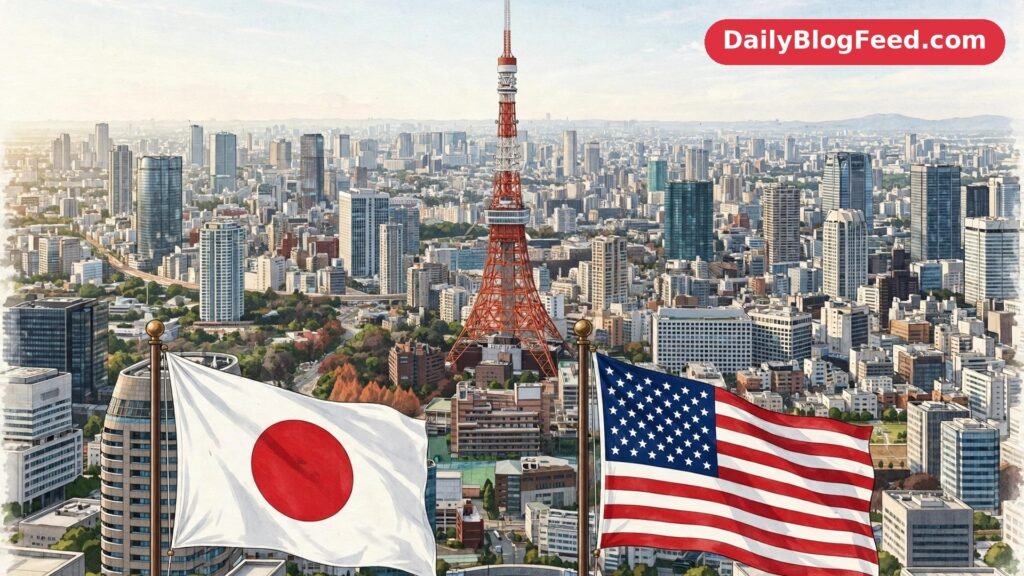

US President Donald Trump has met Japan’s new Prime Minister Sanae Takaichi in Tokyo, in a summit that reaffirmed the alliance between the two countries and the framework of a $550 billion Japanese investment package in the United States. The meeting, held during Trump’s tour of Asia, was a high-stakes test for Takaichi, who became Japan’s first female prime minister earlier this month.
Trump said the two leaders had solidified the framework for approximately $550 billion in Japanese investment in the United States, and that Toyota had conveyed its intention to invest $10 billion in American plants. The visit also included a meeting with Emperor Naruhito at the Imperial Palace, a signing ceremony and a planned tour of the USS George Washington, a nuclear-powered aircraft carrier, at the Yokosuka naval base south of Tokyo.
Takaichi, who leads a Liberal Democratic Party still recovering from a slush-fund scandal that prompted the resignation of two prime ministers, told Trump that strengthening the alliance was her top priority. “Both Japan and the United States have developed the greatest alliance in the world, and together with you, Japan is ready to contribute towards world peace and stability,” she said. “As leader, I will do everything in my power to make Japan a great national power.”
What was agreed, and what remains vague
The $550 billion figure was first agreed earlier in the year as part of a tariff deal struck under Takaichi’s predecessor, Shigeru Ishiba, and the Tokyo summit was in part an exercise in reaffirming it under new leadership. Trump has previously cast the money as capital his administration could invest as it liked, with 90 percent of the profits going to the United States. Japanese officials have described it differently, as a combination of investments, loans and loan guarantees designed to back Japanese firms’ projects in America, funded through methods including loans from the foreign exchange special account.
That difference in characterisation matters. Japan’s deal already sets a maximum 15 percent tariff on most of the country’s exports to the United States, including automobiles and parts, and includes a safety clause intended to ensure Japan is not treated worse than any other nation on future sectoral tariffs for semiconductors and pharmaceuticals. For Takaichi, who faces a debt pinch at home and pressure to accelerate defence spending, there is an incentive to keep elements of the deal loosely defined while still demonstrating to Washington that Tokyo is pulling its weight.
Projects worth around a quarter of the pledged total have already been announced, according to reports, and the two sides discussed further areas for investment, including power grids, during meetings between Commerce Secretary Howard Lutnick and his Japanese counterpart Ryosei Akazawa. Takaichi was also reported to be preparing further offers, including purchases of American pickup trucks, soybeans and gas, and an agreement on shipbuilding, as part of her effort to impress Trump.
Security and symbolism
The summit also had a security dimension. Trump met families of Japanese citizens believed to have been abducted by North Korea in the 1970s and 1980s, reaffirming American solidarity on an issue of deep emotional importance in Japan, and reiterated his openness to a meeting with North Korean leader Kim Jong Un, while noting that no scheduling had materialised.
A new leader under pressure
For Takaichi, the visit was about more than trade. Elected Japan’s first female prime minister earlier this month, she is navigating the implementation of a trade deal she inherited, a party rebuilding after scandal, and a regional security environment in which Japan’s relations with China have deteriorated considerably following her comments on Taiwan early in her tenure. Few analysts expect a detente with Beijing soon, given her hawkish stance and what they see as little incentive for China to re-engage.
Trump, for his part, praised his host warmly. He said he had a lot of respect for her, described her as a close ally of his late friend and golfing partner, former Prime Minister Shinzo Abe, and added: “I think she’s going to be great.” The personal rapport was on display in symbolic exchanges, with Takaichi presenting Trump with a golf bag signed by Masters winner Hideki Matsuyama, and Trump offering signed caps declaring “Japan is back.”
The visit was not without tension in the background. Thousands of police guarded Tokyo after a knife-wielding man was arrested outside the US embassy, and an anti-Trump protest was planned in central Shinjuku. But the official programme proceeded smoothly, with Trump greeted by a night tour of Tokyo in which several towers were lit in the red, white and blue of the American flag.

What happens next
The immediate question is how the $550 billion framework is turned into concrete projects, and whether the differing American and Japanese descriptions of the money can be reconciled in practice. Investors and officials will watch for new project announcements and for evidence that financing is being mobilised through institutions such as the Japan Bank for International Cooperation, rather than slowing after the summit’s headlines fade.
Takaichi’s broader challenge is to build what analysts have called a “Plan B” beyond the American alliance, deepening relationships with partners including Australia, South Korea, the Philippines, the United Kingdom and Southeast Asian nations, even as she keeps Washington close. Her mentor Abe held office for nearly eight years, but few analysts expect her to match that longevity, and her ability to deliver on defence spending, economic reform and party renewal will be tested in the months ahead.
For the alliance itself, the summit appears to have achieved its central purpose: a public reaffirmation of partnership under new Japanese leadership, with the trade framework intact and the security relationship visibly on display at Yokosuka. Whether that display translates into lasting economic and strategic gains will depend on the detailed work that follows, much of it far from the cameras.