
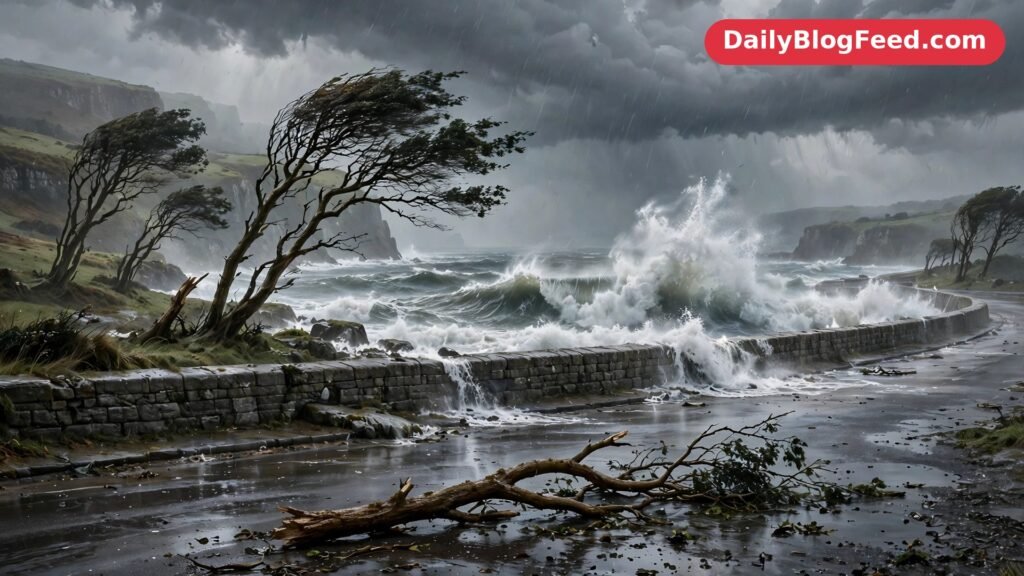

Two men have died and around 90,000 properties have been left without power after Storm Boelo swept across the United Kingdom, bringing winds of up to 85 mph, widespread flooding and severe travel disruption. A clean-up operation is under way across the worst-affected areas, while forecasters have warned of further strong winds in the days ahead.
The two deaths, both caused by falling trees on Sunday, 25 October, were reported in Scotland and in north London. Police Scotland said a 60-year-old man died after being struck by a falling tree on a minor road at Mid Kelton, near Castle Douglas in Dumfries and Galloway, at around 10:30 am. Hours later, a man in his 20s died in north London after a tree fell onto the car he was driving on Dollis Road in Finchley. Two women were also taken to hospital after being struck by another fallen tree in Aberfeldy, Perth and Kinross.
Scotland’s First Minister John Swinney offered condolences on social media on Monday. “My deepest condolences to the families and loved ones of the two people who have tragically lost their lives as a result of Storm Boelo,” he said. “My thoughts are with all those affected by the damage, and I thank the emergency services working through the night to keep people safe.”
Power cuts on a huge scale
The Energy Networks Association said around 90,000 properties were still without power as of Monday, with engineers working to restore supplies in difficult conditions. Scottish and Southern Electricity Networks said 38,000 of its customers were still without power on Sunday evening, after restoring service to more than 54,000, and reported gusts of up to 85 mph in northern Scotland, with fallen trees, flooding and damaged equipment hampering repairs.
Two storms, one weekend
The scale of the disruption becomes clearer when Storm Boelo is combined with Storm Austen, which hit on Friday, 23 October. Across the two storms, approximately 838,700 properties experienced power cuts, according to the Energy Networks Association. Leo Slade, the association’s chief executive, said it had been “a tough weekend,” with sustained winds of 50 to 85 mph across Scotland and northern England hampering efforts to reconnect homes.
“Until that weather system passes, we can’t safely get engineers out to replace poles, to get wires back up, so today is going to be a hive of activity in getting engineers out into the field,” Slade told BBC Radio 4’s Today programme. He said the UK’s power network was resilient, but that a debate was needed over how much more investment was required to cope with further storms linked to climate change.
Businesses and households felt the impact directly. Marcus Reed, operations director at the home fragrance manufacturer Wax Lyrical, said his factory and shop in Lyndal, Cumbria, would be without power until Tuesday evening, forcing him to turn away staff and customers during what he called the busiest time of the year before Christmas. “To lose two days manufacturing and distribution is going to be really disruptive,” he said.
Travel and flooding disruption
Travel was disrupted across the country. In Scotland, Network Rail said the Crianlarich to Oban and Inverness to Wick and Thurso lines remained closed, while some schools shut due to lost power, heating or water. Ferries were cancelled and flights to and from Belfast, Glasgow, Aberdeen and Dublin were affected, while roads across Scotland were flooded or blocked by fallen trees and debris.
Flooding also caused damage to homes and businesses. In Dumbarton, part of the A82 at Dumbuck Quarry flooded, and a mobile phone shop owned by Muhammad Zubair Ashraf was flooded overnight, with damage estimated at between 5,000 and 10,000 pounds. High rainfall totals were recorded in the Scottish Highlands, peaking at 130 mm at Cluanie Inn. In Ballantrae, flooding led 15 guests to leave a caravan park.
Wind gusts peaked on Sunday morning at 85 mph in Machrihanish, Argyll and Bute, with 84 mph recorded in Stornoway in the Outer Hebrides and in Capel Curig, north Wales. An amber wind warning covered Scotland and parts of northern England until 9 pm on Sunday, while a yellow warning extended across other northern cities, the Midlands and north Wales. The Met Office urged people to stay indoors and avoid sheltering near buildings and trees during the worst of the weather.

What happens next
The Met Office has issued further yellow warnings for strong winds, with one covering much of Scotland, northern England and Northern Ireland from early Tuesday to late Tuesday, and another covering the west coast of England, Wales, Scotland and eastern Northern Ireland from Monday evening to early Tuesday. Engineers hope to restore power to most remaining customers by Monday, though some could remain without service until Tuesday, according to Scottish and Southern Electricity Networks.
The clean-up will take longer. Fallen trees must be cleared from roads and railways, flood damage assessed, and the electricity network inspected for damage that could not be reached while conditions were dangerous. For the families of the two men who died, and for the communities still without power, the storm’s effects will linger well beyond the warnings’ expiry.
Storm Boelo is the second named storm to hit parts of the UK in recent days, and forecasters say the unsettled pattern is set to continue. The debate raised by network operators over investment in resilience, and by householders over how quickly supplies can be restored after extreme weather, is likely to continue as the clean-up proceeds and the next weather system approaches.