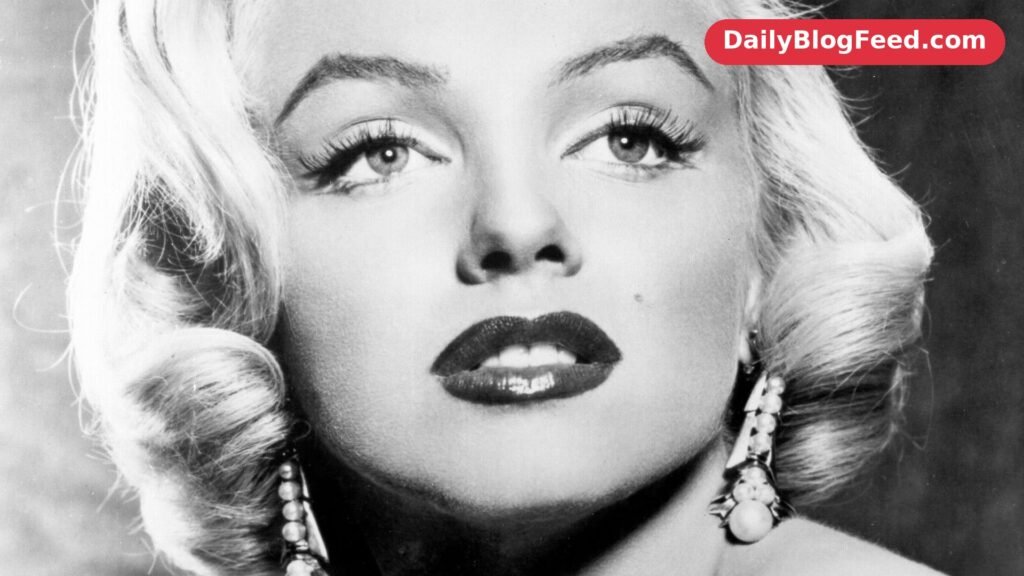

More than sixty years after her death, Marilyn Monroe is still the first face that comes to mind when people picture old Hollywood. The white dress billowing over a subway grate. The breathy voice singing “Diamonds Are a Girl’s Best Friend.” The smile that could fill a movie screen all by itself.
Yet the woman behind that image was far more complicated than the image itself. Born Norma Jeane Mortenson, raised in foster homes and an orphanage, she fought her way into the most powerful studio in the world, then fought the studio itself for better roles and fairer pay. She was, by turns, a pin-up model, a comic genius, a serious actress, a producer, and a deeply unhappy person who never quite escaped the pressures of fame.
People still search for her age, her husbands, her children, her fortune, and her best films. This article answers those questions from documented sources, and it is careful about the parts of her story where the record is disputed.
Quick Facts
| Fact | Detail |
|---|---|
| Full Name | Norma Jeane Mortenson (later Norma Jeane Baker; legally Marilyn Monroe from 1956) |
| Born | June 1, 1926, Los Angeles, California, USA |
| Died | August 4, 1962, Los Angeles, California, USA (aged 36) |
| Height | About 5 feet 5.5 inches (1.66 m) |
| Nationality | American |
| Occupation | Actress, model, producer |
| Years Active | 1945–1962 |
| Husbands | James Dougherty (1942–1946), Joe DiMaggio (1954–1955), Arthur Miller (1956–1961) |
| Children | None |
| Best Known For | Gentlemen Prefer Blondes, The Seven Year Itch, Some Like It Hot, The Misfits |
| Major Awards | Golden Globe for Best Actress (Some Like It Hot); BAFTA nomination (The Prince and the Showgirl) |
| Net Worth | No official figure; estate described as modest at her death (see Net Worth section) |
From Norma Jeane to Marilyn
Marilyn Monroe was born Norma Jeane Mortenson on June 1, 1926, at Los Angeles General Hospital. Her mother, Gladys Pearl Baker, worked as a film negative cutter. The name on the birth certificate, Mortenson, came from Gladys’s second husband, though biographers agree he was almost certainly not the father. In 2022, DNA comparison appeared to confirm that her biological father was Charles Stanley Gifford, Gladys’s supervisor at an RKO film editing company.
Gladys was mentally and financially unprepared for a child. Norma Jeane spent her early years with foster parents Albert and Ida Bolender in Hawthorne, California, and after Gladys suffered a mental breakdown in 1934 and was committed to a state hospital, the girl became a ward of the state. She lived with a series of families and, from September 1935, in the Los Angeles Orphans Home. She later said she escaped into the movies, sitting in dark theatres all day, dreaming of the life on screen.
In 1942, when she was sixteen, she married her neighbor James Dougherty, a factory worker, largely to avoid returning to the orphanage after her guardians moved out of state. Dougherty joined the Merchant Marine, and Norma Jeane took a job at the Radioplane munitions factory in Van Nuys. There, in late 1944, an Army photographer named David Conover spotted her while shooting morale-boosting pictures of female workers. She quit the factory in January 1945, signed with the Blue Book Model Agency, and within a year had appeared on dozens of magazine covers.
In August 1946 she signed a six-month contract with 20th Century Fox. She and studio executive Ben Lyon chose her new name together: Marilyn, after Broadway star Marilyn Miller, and Monroe, her mother’s maiden name.
She divorced Dougherty the following month. Her first film parts were tiny, Fox dropped her contract in 1947, and she went back to modeling. But she kept studying acting, and she kept showing up.
The Climb: Small Parts, Then a Star Is Born
The turning point came in 1950. A small, uncredited role as Angela Phinlay in John Huston’s crime drama The Asphalt Jungle drew a flood of fan mail, and a walk-on part in All About Eve (1950) won her a new contract with Fox. Over the next two years she worked constantly: As Young as You Feel, Love Nest, Clash by Night, Don’t Bother to Knock, and Monkey Business.
Monkey Business (1952) paired her with a master of screen comedy, and it is worth pausing on that pairing. Cary Grant was already a legend when he played opposite the rising Monroe, and the film showed she could hold her own against the smoothest leading man in Hollywood.
In 1953 she became one of the most marketable stars in the world. Niagara cast her as a scheming wife in a film noir that leaned openly on her appeal. Gentlemen Prefer Blondes made her Lorelei Lee, the gold-digging showgirl who sang “Diamonds Are a Girl’s Best Friend” and stole the picture from under everyone. How to Marry a Millionaire completed the trio, and all three were hits.
The same year, her nude photographs from before fame were used as the centerfold of the first issue of Playboy. The revelation could have ended her career in 1953’s Hollywood. Instead, handled with unusual frankness, it increased interest in her films. Monroe had a gift for turning scandal into sympathy, and the public, by and large, stayed on her side.
Taking Control: Her Own Company, Her Own Terms
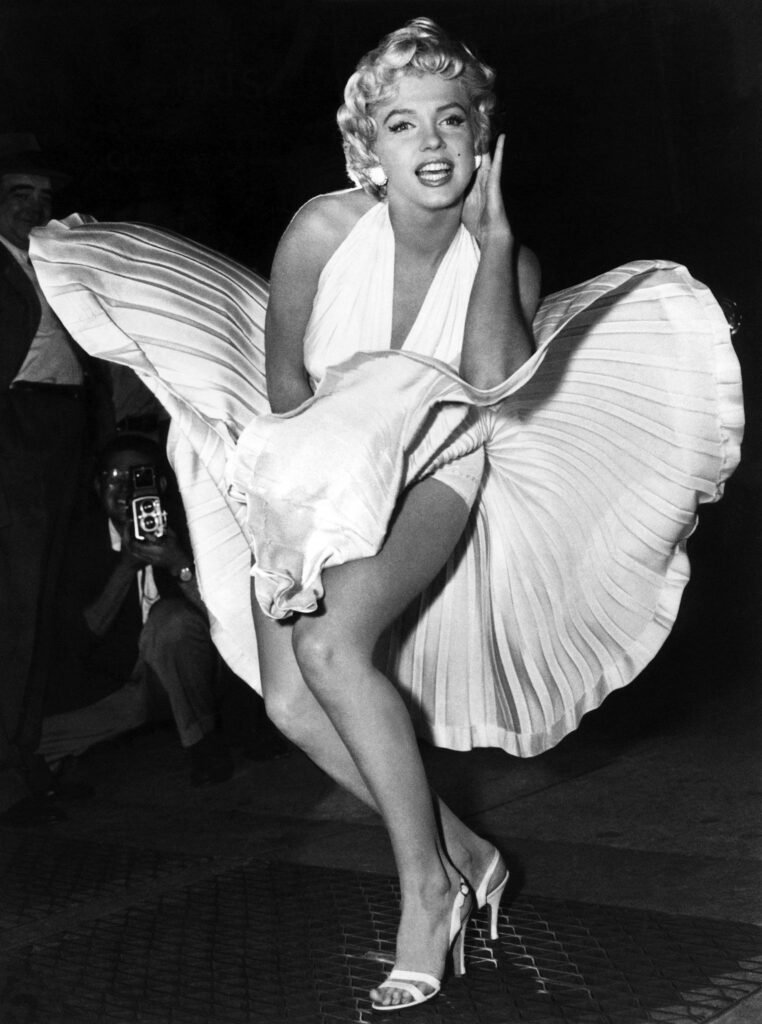
By 1954, Monroe was fed up with being typecast and underpaid. She was briefly suspended by Fox for refusing a project, then returned to star in The Seven Year Itch (1955), which became one of the biggest box office successes of her career. The film gave the world its most famous image of her: standing over a subway grate in a white dress, laughing as the air rushes up.
But the fight with the studio was not over. In late 1954 she had founded her own production company, Marilyn Monroe Productions, with photographer friend Milton Greene. She spent much of 1955 in New York, studying method acting under Lee Strasberg at the Actors Studio. Fox eventually gave her a new contract with more control and a much larger salary.
The work that followed proved the gamble right. Bus Stop (1956) earned her some of the best reviews of her career as Chérie, a saloon singer with dreams bigger than her talent.
The Prince and the Showgirl (1957), her company’s first production, co-starred Laurence Olivier and brought her a BAFTA nomination. She was no longer just playing the blonde. She was acting, and critics were beginning to say so.
The Comedies That Made Her Immortal
If one film settles the argument about Monroe’s talent, it is Some Like It Hot (1959). Billy Wilder’s comedy cast her as Sugar Kane, a ukulele player in an all-girl band, opposite Jack Lemmon and Tony Curtis. The film is routinely ranked among the greatest comedies ever made, and Monroe won the Golden Globe for Best Actress in a comedy or musical for it. Her timing is precise, and she is the emotional center of a very funny film.
Her last completed film was The Misfits (1961), written for her by her then-husband Arthur Miller and directed by John Huston. It co-starred Clark Gable in his final role, alongside Montgomery Clift.
The film itself is a sad, beautiful elegy for people the modern West has left behind. It underperformed on release and has grown in reputation ever since. Gable died of a heart attack days after filming ended, and Monroe would be gone within two years.
Three Marriages and No Children
Monroe married three times, and each marriage was a public event. Her first, to James Dougherty, lasted from 1942 to 1946 and ended as her modeling career took off. Her second, to baseball star Joe DiMaggio, began in January 1954 and ended in divorce less than a year later. DiMaggio, famously private, struggled with the glare of her fame, though he remained devoted to her after the split and arranged her funeral.
Her third marriage, to playwright Arthur Miller, lasted from 1956 to 1961. Miller wrote The Misfits for her, but the marriage disintegrated during production, and they divorced in January 1961.
After Miller, Monroe’s private life was the subject of endless speculation. This article does not repeat unconfirmed claims about her relationships as fact: rumored affairs, including those alleged with John F. Kennedy and Robert F. Kennedy, have never been proven, and the evidence for them remains contested.
Monroe had no children. According to Britannica, she wanted children and was pregnant several times during her marriage to Miller, but two pregnancies ended in miscarriage and another was an ectopic pregnancy. She was also diagnosed with endometriosis, which affected her ability to carry a pregnancy.
The Last Year and an Unfinished Film
In 1962 Monroe began filming the comedy Something’s Got to Give for Fox. She was frequently absent from the set because of illness, and in May she traveled to New York to sing “Happy Birthday” to President John F. Kennedy at a Madison Square Garden gala, a performance that became instantly famous.
In June, Fox fired her from the film. She was later rehired, but work never resumed.
On August 4, 1962, Monroe died at her home in Brentwood, Los Angeles, at the age of 36. She was found the following morning. The coroner ruled her death a probable suicide caused by a barbiturate overdose, a finding supported by her history of drug use and previous suicide attempts.
Conspiracy theories about her death have persisted for decades, including claims involving the Kennedy family, but as Britannica notes, there has been insufficient evidence to support them. This article reports the official ruling and treats the theories as unproven.
She was buried at Westwood Village Memorial Park Cemetery. DiMaggio took charge of the funeral arrangements, keeping the service small and private.
What Was Marilyn Monroe’s Net Worth?
There is no official, agreed figure for Marilyn Monroe’s fortune at her death, and this article will not invent one. Published accounts generally describe her estate as modest at the time she died, despite her being one of the highest-paid stars of her era. Studio-era contracts, taxes, and her spending all limited what she kept.
What is documented is the shape of her will. She left the bulk of her estate, 75 percent, to her acting coach Lee Strasberg, with the remainder going to her psychiatrist Dr. Marianne Kris and others, including provisions for her mother’s care.
The commercial value of her image, by contrast, grew enormously after her death. Her films had already grossed about $200 million by 1962, and her likeness has since become one of the most licensed in the world. The gap between what she earned in life and what her image earned after death is itself part of her story: the industry profited from Marilyn Monroe far more than Norma Jeane ever did.
Why She Still Matters
The American Film Institute ranked Monroe the sixth-greatest female screen legend of Hollywood’s golden age. That ranking rests on more than beauty. She was a comic actress of genuine skill, a singer with real warmth, and a performer who understood her own image better than the studios that tried to own it.
She also matters because of what she fought for. Founding her own production company in 1954, when few actresses had that kind of leverage, and studying seriously at the Actors Studio while the studio wanted her to stay a pin-up, were acts of professional courage. Later generations of actresses who demanded control over their careers were walking a road Monroe helped clear.
Her vulnerability is part of the legacy too, and it should be handled with respect. The foster homes, the failed marriages, the miscarriages, the addiction, and the early death are not gossip. They are the human cost of a fame machine that wanted the image and had little interest in the person. Remembering both halves, the joy on screen and the pain off it, is the honest way to remember her.
Things You Might Not Know About Marilyn Monroe
- She was born a brunette. Her naturally curly brown hair was chemically straightened and dyed blonde on her modeling agency’s advice.
- She was named partly after actress Norma Talmadge. Her mother chose “Norma” in homage to the silent-era star.
- She appeared on 33 magazine covers by early 1946, before she had ever acted in a film.
- She legally changed her name to Marilyn Monroe in 1956, a decade after she first used it professionally.
- Her famous “Happy Birthday, Mr. President” performance took place in May 1962, less than three months before her death.
- Her last completed film, The Misfits, was also the last completed film of her co-star Clark Gable.
- In their first runs, her 23 films grossed more than $200 million, an enormous sum for the era.
Frequently Asked Questions
How old was Marilyn Monroe when she died?
Marilyn Monroe was 36 years old. She was born on June 1, 1926, and died on August 4, 1962, at her home in Los Angeles.
Who was Marilyn Monroe’s husband?
Marilyn Monroe was married three times: to James Dougherty (1942–1946), to baseball star Joe DiMaggio (1954–1955), and to playwright Arthur Miller (1956–1961). All three marriages ended in divorce.
Did Marilyn Monroe have children?
No. Marilyn Monroe had no children. During her marriage to Arthur Miller she was pregnant several times, but the pregnancies ended in miscarriage or ectopic pregnancy, and she had been diagnosed with endometriosis.
What was Marilyn Monroe’s net worth?
There is no official figure. Her estate was modest at her death by the standards of her fame, and published estimates vary and are not authoritative. She left the bulk of her estate to her acting coach Lee Strasberg.
What are Marilyn Monroe’s best movies?
Start with Gentlemen Prefer Blondes (1953) and How to Marry a Millionaire (1953) for the star-making comedies, The Seven Year Itch (1955) for the iconic image, Bus Stop (1956) for her dramatic breakthrough, Some Like It Hot (1959) for her finest comic performance, and The Misfits (1961) for her haunting final role.
How did Marilyn Monroe die?
Her death was officially ruled a probable suicide caused by a barbiturate overdose. Conspiracy theories about her death have circulated for decades, but there is insufficient evidence to support them.
Conclusion
Marilyn Monroe’s life is often told as a tragedy, and the tragic parts are real. But that telling misses the ambition, the humor, and the fight. A girl from foster homes and an orphanage became the most famous woman in the world, then risked that fame to demand better work and fairer treatment. She made comedies that still make audiences laugh, and a final drama that still makes them ache.
At 36, she left behind 23 films, a voice, a laugh, and an image the world has never stopped reproducing. Norma Jeane wanted to be loved, and Marilyn Monroe wanted to be taken seriously. More than sixty years on, she deserves both.