
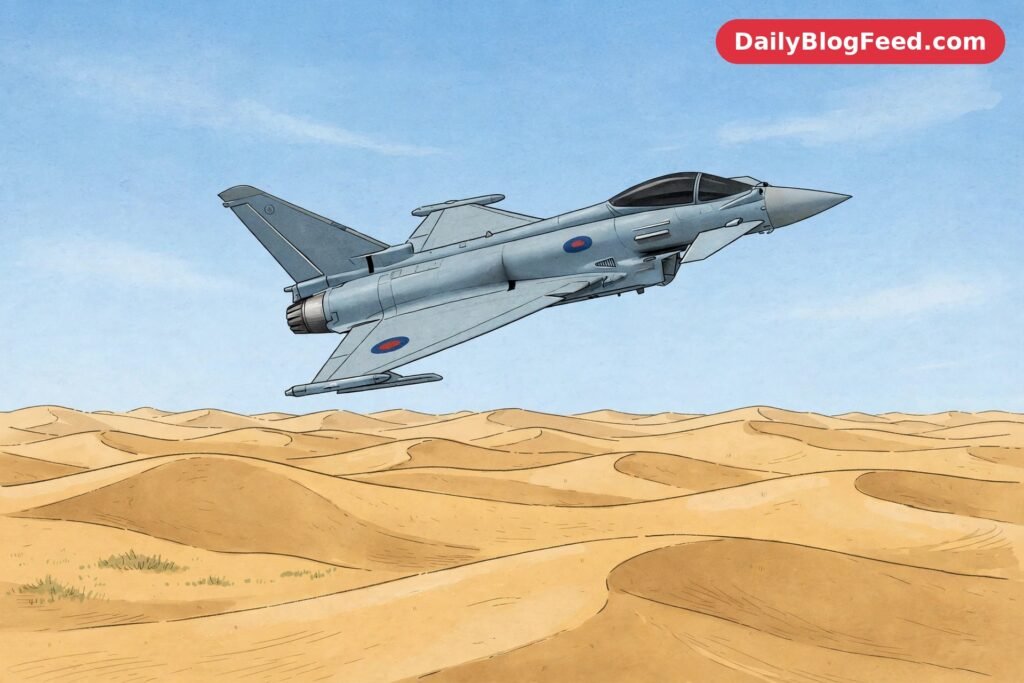

LONDON — Britain will deploy Royal Air Force Typhoon fighter jets to fly defensive air missions over Saudi Arabia to help protect the kingdom’s cities and critical infrastructure from escalating Houthi missile and drone attacks, the Ministry of Defence announced on Tuesday, October 20.
The deployment, authorised by Prime Minister Andy Burnham, marks a significant expansion of Britain’s military support to Riyadh. According to Reuters, the Ministry of Defence said the Typhoons would carry out “defensive counter air missions” in support of Saudi defences, with an explicit guarantee that the aircraft will not conduct offensive strikes against Houthi targets.

The announcement was made by Defence Secretary Wes Streeting in a written statement to Parliament. The decision, he said, followed a direct request from the Saudi government for additional defensive assistance — a request Burnham had said earlier this month that Britain was prepared to consider.
A strictly defensive role
Britain has been careful to frame the mission in strictly defensive terms. The Typhoons will be tasked with helping to intercept incoming aerial threats — drones and missiles — over Saudi airspace, rather than targeting Houthi positions inside Yemen.
“These aircraft will operate in a defensive role and will not conduct offensive strikes against the Houthis,” Streeting said in his statement, a formulation carried by both Reuters and the BBC.
Streeting described the recent Houthi attacks as “absolutely despicable,” singling out the strikes on Riyadh’s King Khalid International Airport. “The targeting of the airport in Riyadh in particular shows the lengths the Houthis are going to escalate the situation in the region,” he said. “That’s why today I have approved further UK military support. RAF Typhoons will fly defensive air missions to help protect Saudi airspace from drones and missiles.”
The package announced alongside the fighter jets includes an Atlas A400M military transport aircraft to move defence equipment within Saudi Arabia, British military advisers to support Saudi staff officers, and an extension of existing air-to-air refuelling support for Saudi defensive operations by a further 90 days. Britain has already been providing Saudi Arabia with air-defence equipment and aerial refuelling assistance; this announcement adds fighter jets to that support for the first time, with the exception of refuelling aircraft previously deployed.
Why now: an escalation of attacks
The announcement comes amid a sharp intensification of Houthi strikes on Saudi territory in recent weeks, as the conflict in Yemen has escalated. According to the BBC, the Houthis said they were behind two strikes on Riyadh’s King Khalid International Airport on October 10 and 11 — the first of which killed 13 people and injured 308 others, Saudi authorities said.
Reuters reported that Saudi Arabia’s international airport has been targeted repeatedly since the start of October, and that Houthi attacks against Saudi oil facilities and other infrastructure have intensified in recent weeks.
The Houthis, who are aligned with Iran according to Western governments, declared a naval blockade of Saudi Arabia in July and have since widened their campaign to hit Saudi cities, ports and energy infrastructure. The BBC reported that Houthi military spokesman Brig Gen Yahya Saree earlier this month vowed to continue what he called “escalating operations deep inside Saudi Arabia.”
Inside Yemen, the violence has also surged. Reuters reported that a Houthi strike on Monday against a training camp for Saudi-backed government security forces killed 58 people, illustrating how quickly the fighting has reignited on both sides of the border.
Background: Yemen’s fragile truce collapses
Yemen’s civil war began when the Houthi movement seized control of the capital Sanaa in 2014, forcing the internationally recognised government into exile. Since 2015, Saudi Arabia has led a military coalition backing that government against the Houthis.
A years-long informal truce had kept large-scale fighting largely frozen, but it collapsed in September, according to multiple reports, and the conflict has reignited. Saudi Arabia has since launched air operations in support of Yemeni government forces, while the Houthis have retaliated with missile and drone strikes deep inside Saudi territory.
The Houthi campaign has wider economic stakes. Britain’s defence ministry warned that the attacks threaten regional stability and risk disrupting energy supplies and trade routes. Streeting also pointed to the violence in the Gulf increasing energy costs for families and businesses, a concern echoed in British reporting on the deployment.
The decision also reflects the depth of the UK-Saudi defence relationship. Britain has long been a major supplier of military equipment to the kingdom, and British personnel have been involved in supporting Saudi air defences against earlier waves of Houthi attacks. The Guardian described this mission as the most significant military operation signed off by Burnham since he became prime minister.

What happens next
The Ministry of Defence has not said how many Typhoons will be deployed or when they will arrive, and the announcement remains a developing story. Officials have emphasised that the mission’s scope is bounded: the jets will operate over Saudi Arabia in a defensive posture, and the government has drawn a clear line against offensive strikes.
Questions are likely to be raised in Parliament about the rules of engagement for RAF crews, the cost of the deployment, and how long the mission will last. Streeting’s statement indicated that the Typhoons would join a broader British presence already supporting Saudi defences, suggesting the deployment will be integrated into existing structures rather than built from scratch.
For now, the confirmed facts are those set out by the government and corroborated by international news organisations: RAF Typhoons will fly defensive missions to help protect Saudi airspace from Houthi drones and missiles, alongside a transport aircraft, military advisers and extended refuelling support — and no offensive operations.