
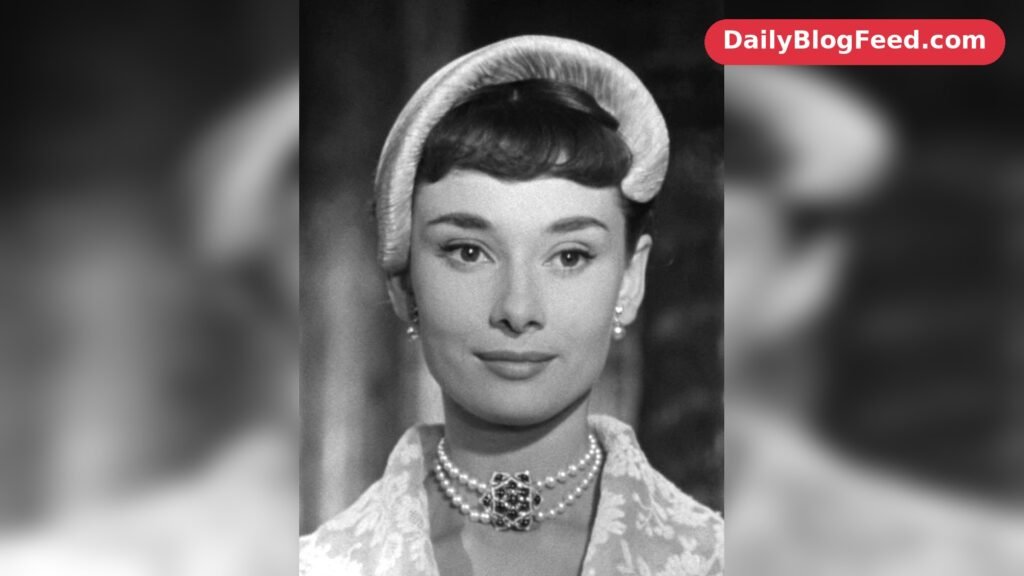

There is a particular kind of fame that does not fade when the films stop. Audrey Hepburn has it. More than thirty years after her death, her face still sells posters, her little black dress still defines an idea of elegance, and new generations still discover her the same way: one rainy afternoon, one old film, one unforgettable entrance.
People search for her for the same mix of reasons. They want the facts of a life that sounds almost invented: a wartime childhood in occupied Holland, an Oscar on her very first Hollywood film, a second career saving children’s lives. They also want the personal details, the husbands, the children, the fortune. This article gives you all of it, and it is careful
Quick Facts
| Fact | Detail |
|---|---|
| Full Name | Audrey Kathleen Ruston (later Hepburn-Ruston) |
| Born | May 4, 1929, Ixelles, Brussels, Belgium |
| Died | January 20, 1993, Tolochenaz, Switzerland, aged 63 |
| Nationality | British |
| Height | About 5 feet 7 inches |
| Occupation | Actress, humanitarian |
| Years Active | 1948–1993 |
| Husbands | Mel Ferrer (1954–1968), Andrea Dotti (1969–1982) |
| Partner | Robert Wolders (1980–1993) |
| Children | 2 sons — Sean Hepburn Ferrer (born 1960) and Luca Dotti (born 1970) |
| Best Known For | Roman Holiday, Sabrina, Breakfast at Tiffany’s, My Fair Lady, Charade |
| Major Awards | Academy Award, Tony Award, Emmy Award, Grammy Award, Presidential Medal of Freedom |
| Net Worth | About $55 million at death, per Celebrity Net Worth estimates |
The Girl Who Danced Through a War
Audrey Kathleen Ruston was born in Ixelles, a district of Brussels, on May 4, 1929. Her father, Joseph Victor Anthony Ruston, was a British subject of Austrian descent who worked in business. Her mother, Baroness Ella van Heemstra, was a Dutch aristocrat.
She spent her early childhood moving between Belgium, England, and the Netherlands, attending schools in England and Holland. Her parents divorced in the mid-1930s, and her father left the family, a loss she felt for the rest of her life. By 1939, she was living with her mother in Arnhem, in the Netherlands, just as Europe slid into war.
The German occupation of the Netherlands shaped her more than any acting school ever could. Food grew desperately scarce, and during the Dutch famine winter of 1944–45 she suffered malnutrition, anemia, and respiratory problems. She later said she survived on tulip bulbs and nettles, and that the hunger never fully left her.
It also gave her the cause of her later life. Decades later, when she travelled for UNICEF and saw starving children, she said she recognized what she was looking at because she had lived it. The girl who had once danced secretly to raise money for the Dutch resistance became the woman who would spend her final years begging the world to feed other people’s children.
From Ballet to Broadway, by Way of London
After the war, Hepburn moved to Amsterdam and then to London, where she studied ballet under Marie Rambert. She was talented and disciplined, but the war had cost her: she was taller than most ballerinas, and the years of malnutrition had limited her strength. Teachers told her, gently, that she would not become a prima ballerina.
So she did what practical young performers do. She modelled, she danced in West End chorus lines, and she took small film parts, including an uncredited appearance in the Dutch film Nederlands in 7 lessen in 1948. A London stage role in the musical Sauce Piquante caught the eye of a visiting French novelist, Colette, who insisted the unknown girl play the title role in the Broadway stage version of her novella Gigi.
Gigi opened on Broadway in 1951, and Hepburn won a Theatre World Award for it. More importantly, Hollywood noticed. During the run, she was screen-tested for a film about a princess who runs away in Rome. She got the part, and nothing in her life was ever small again.
Roman Holiday: An Oscar on the First Try
Roman Holiday, released in 1953, cast Hepburn as Princess Ann, a sheltered royal who escapes her duties for a day in Rome with an American reporter played by Gregory Peck. Peck was already a major star, and he did something generous that the film’s history always remembers: he insisted Hepburn receive equal billing with him, although she was a complete unknown.
The gamble worked for everyone. Hepburn won the Academy Award for Best Actress, the first of her five Oscar nominations, and the only competitive win of her career. She was 24, and she had arrived fully formed: the elfin face, the long neck, the voice that could be regal and girlish in the same sentence.
The film also set the template for her screen persona. Hepburn’s heroines were never just beautiful. They were curious, funny, and quietly stubborn, women who wanted more from life than the world was offering them. That quality, more than any dress, is why the performance still works.
Sabrina, Funny Face, and the Givenchy Years
What followed was a run of films that built her into a fashion icon as much as an actress. In Sabrina (1954), she played a chauffeur’s daughter transformed by two years in Paris, opposite Humphrey Bogart and William Holden. The film’s costumes, designed by the young Hubert de Givenchy, began one of the great partnerships in fashion history.
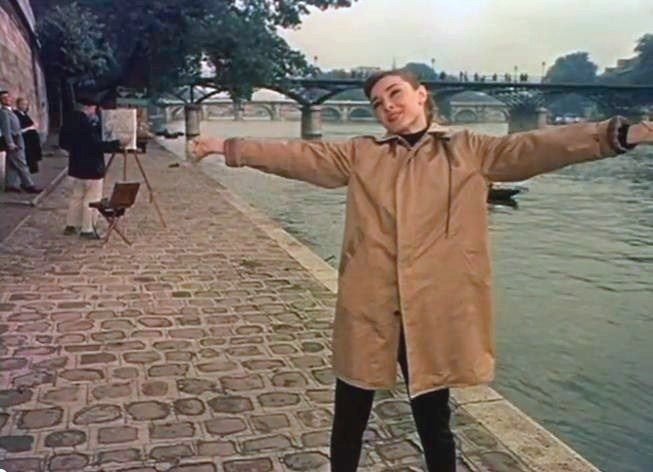
Givenchy dressed her on screen and off for the next four decades. He designed the clothes for Funny Face (1957), in which she played a bookshop clerk turned model opposite Fred Astaire, and for Love in the Afternoon (1957), opposite Gary Cooper. The look was unmistakable: simple lines, dark colours, ballet flats, and a poise that made simplicity feel luxurious.
The Nun’s Story (1959) proved she could carry a serious drama, earning her a second Oscar nomination as a nun questioning her vocation in the Belgian Congo. Then came the role that fixed her in popular culture forever.
Breakfast at Tiffany’s and the Little Black Dress
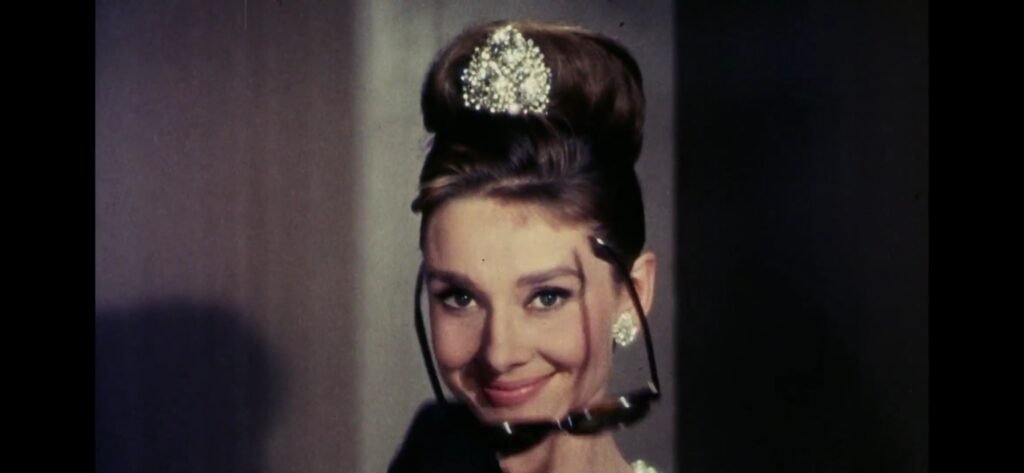
In Breakfast at Tiffany’s (1961), Hepburn played Holly Golightly, Truman Capote’s free-spirited New York heroine, in a performance that earned her a fourth Oscar nomination. The opening image, Holly in a black Givenchy dress eating a pastry outside Tiffany’s at dawn, is one of the most reproduced shots in film history.
It is worth saying plainly that the film softened Capote’s character considerably, and that Hepburn herself worried she was wrong for the part. She was not. She gave Holly a loneliness underneath the sparkle, and that is why the character survived the decades when so many other 1960s heroines did not.
The film also gave her a signature song. “Moon River,” sung by Hepburn herself in a simple, untrained voice, won the Academy Award for Best Original Song and became inseparable from her image. She sang it sitting on a fire escape with a guitar, and the scene still stops people cold.
Charade, My Fair Lady, and the Voice Question
Two of her most beloved films followed in quick succession. In Charade (1963), a sparkling thriller-comedy, she played Regina Lampert, a widow chased across Paris by men hunting her husband’s fortune, opposite Cary Grant. Grant, who was 25 years older than her, reportedly worried about the age gap and insisted the script make her the pursuer, a detail that gives the film its modern charm.
Then came My Fair Lady (1964), in which she played Eliza Doolittle, the Cockney flower girl transformed into a lady, opposite Rex Harrison. The film won eight Academy Awards, including Best Picture, but it carried a controversy that still follows it: Hepburn’s singing voice was largely dubbed by Marni Nixon, because the studio doubted her voice could carry the score.
Hepburn was hurt by the decision, and she said so. She had trained hard for the songs, and her own voice can be heard in parts of the film. The dubbing did not hurt the film’s success, but it did cost her an Oscar nomination that many felt she deserved, and it remains the one sour note in her happiest decade.
Stepping Back: Family, and Then a Second Career
By the late 1960s, Hepburn was pulling away from Hollywood. Her last major film of the decade was Wait Until Dark (1967), a thriller in which she played a blind woman terrorized in her own apartment, earning her fifth Oscar nomination. After that, she largely stopped acting to raise her sons.
She returned occasionally: Robin and Marian (1976) opposite Sean Connery, and a final screen appearance as an angel in Steven Spielberg’s Always (1989). But the work that mattered most to her in her last years had nothing to do with film.
In 1989, she became a Goodwill Ambassador for UNICEF. She travelled to Ethiopia, Bangladesh, Vietnam, and Somalia, visiting feeding centres and refugee camps and using her fame to force cameras to look at children the world was ignoring. Her final mission, to Somalia in late 1992, left her exhausted and ill. She died of appendiceal cancer on January 20, 1993, at her home in Tolochenaz, Switzerland, aged 63.
The honours that followed were the kind she would have valued most. She received the Presidential Medal of Freedom posthumously in December 1993, and the Academy’s Jean Hersholt Humanitarian Award. With her posthumous Emmy and Grammy wins, she also became one of the few performers to have won an Emmy, a Grammy, an Oscar, and a Tony, the achievement known as the EGOT.
Husbands, Sons, and a Private Life
Hepburn married twice. Her first husband was the actor and director Mel Ferrer, whom she married in 1954. They had one son, Sean Hepburn Ferrer, born in 1960, and they divorced in 1968.
Her second husband was the Italian psychiatrist Andrea Dotti, whom she married in 1969. They had one son, Luca Dotti, born in 1970, and they divorced in 1982.
From 1980 until her death, her partner was the Dutch actor Robert Wolders, who stayed with her through her UNICEF years and her final illness. She never married a third time, and those close to her described the relationship with Wolders as a happy and settled one.
Both of her sons have guarded her legacy carefully. Sean became an author and film producer, and Luca a graphic designer, and together they have overseen exhibitions and charitable work in her name, including the Audrey Hepburn Children’s Fund. Reports of later disagreements between the brothers over memorabilia and auction items have been covered in the press, but the brothers have also continued to appear together at events honouring their mother.
What Was Audrey Hepburn’s Net Worth?
Celebrity Net Worth estimates that Audrey Hepburn was worth about $55 million at the time of her death in 1993. That figure is widely repeated by other outlets, and it would be worth roughly $100 million in today’s money. It should still be read as an estimate, not an official valuation: no audited account of her estate has been published.
The fortune came from a long career at the top of Hollywood, where she commanded some of the largest salaries of her era. She reportedly received $1 million for My Fair Lady in 1964, an enormous sum at the time, and her films continued to earn royalties long after her death. She also owned property in Switzerland, where she lived for her final decades.
Her will, by most accounts, left the bulk of her estate to her two sons, with jewellery and personal items going to family and close friends. The exact division of memorabilia later became the subject of press coverage, but the broad picture is not in doubt: she died wealthy, and her sons inherited the estate.
Things You Might Not Know About Audrey Hepburn
- She spoke five languages: English, French, Dutch, Italian, and Spanish, with some German.
- During the war, she danced in secret performances to raise money for the Dutch resistance.
- She turned down the role of Anne Frank on stage and screen, saying the memories of the war were too painful and too close.
- She was offered the part of Maria in The Sound of Music, which went to Julie Andrews.
- Her favourite food, by her own account, was pasta, and she ate it with enthusiasm all her life.
- She kept a small vegetable garden at her Swiss home and did much of the gardening herself.
- The little black dress from Breakfast at Tiffany’s sold at auction in 2006 for nearly £467,000, then one of the highest prices ever paid for a film costume.
Frequently Asked Questions
How old was Audrey Hepburn when she died?
Audrey Hepburn was 63 when she died on January 20, 1993, at her home in Tolochenaz, Switzerland. She had been born on May 4, 1929, in Ixelles, Brussels, Belgium.
Who was Audrey Hepburn’s husband?
Audrey Hepburn was married twice: to actor Mel Ferrer from 1954 to 1968, and to psychiatrist Andrea Dotti from 1969 to 1982. Her partner from 1980 until her death was Dutch actor Robert Wolders.
Did Audrey Hepburn have children?
Yes, she had two sons: Sean Hepburn Ferrer, born in 1960 to her first husband Mel Ferrer, and Luca Dotti, born in 1970 to her second husband Andrea Dotti.
What was Audrey Hepburn’s net worth?
Celebrity Net Worth estimates her net worth at about $55 million at the time of her death in 1993, roughly $100 million in today’s money. No official estate valuation has been published, so the figure is an attributed estimate.
What are Audrey Hepburn’s best movies?
Start with Roman Holiday (1953) for the Oscar-winning breakthrough, Sabrina (1954) and Funny Face (1957) for the Givenchy years, Breakfast at Tiffany’s (1961) for the icon, Charade (1963) for pure charm, and My Fair Lady (1964) for the spectacle.
What did Audrey Hepburn do for UNICEF?
She served as a UNICEF Goodwill Ambassador from 1989 until her death, travelling to Ethiopia, Bangladesh, Vietnam, and Somalia to draw attention to malnourished and displaced children, and she received the Presidential Medal of Freedom posthumously for that work.
Conclusion
Audrey Hepburn’s life divides neatly into two acts, and both of them matter. The first made her a star: the war-scarred girl who became Hollywood’s most elegant leading lady, the Oscar winner, the fashion icon. The second made her something rarer: a famous woman who spent her final years using that fame for children nobody else was looking at.
That is why she endures when other stars of her era have faded into trivia questions. The dresses are beautiful, and the films are wonderful, but the thing people remember is the decency. She survived hunger as a child, and she spent her life making sure other children did not have to.