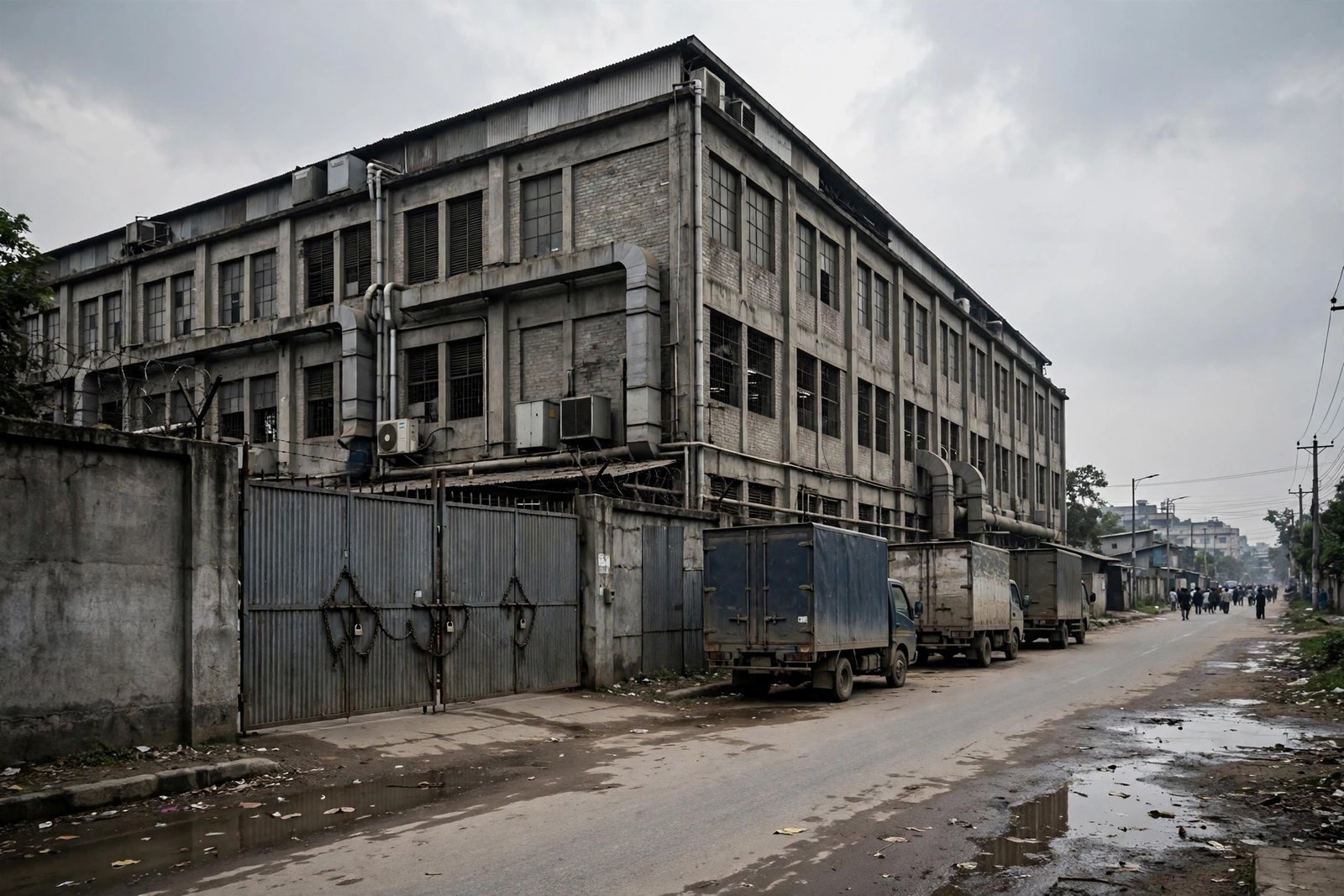

Bangladesh’s garment factories briefly resumed operations on Monday, November 2, 2026, after a widespread shutdown the previous day, but fresh clashes between workers and police forced hundreds of plants to suspend production again, deepening a wage dispute that has disrupted one of the world’s largest clothing industries.
Workers are demanding a minimum monthly wage of 30,000 taka, about 245 US dollars, more than double the current minimum of 12,500 taka. They say rising costs for food, housing, transport and healthcare have sharply eroded their purchasing power, and they have blocked roads, staged demonstrations in Dhaka, Gazipur and Ashulia, and clashed with police, who have used tear gas and water cannon to disperse crowds.
According to industry figures reported by Reuters, 529 garment factories had shut down by Sunday, leaving 987,190 workers out of work across the country’s main industrial hubs. By Monday, after fresh unrest, the number of factories halting production rose to 679, according to Reuters, raising concerns about shipment delays and buyer confidence at a critical point in the production cycle for spring and summer export orders.
A wage board, but protests continue
In an attempt to defuse the crisis, the government announced on Sunday, November 1, that it had formed a six-member wage board to review garment workers’ pay. Labour and Employment Minister Ariful Haque Choudhury said the board was formed after discussions with workers’ representatives and industry leaders, and he urged workers to return to work.
The board comprises two representatives each from workers and employers, along with a government representative and a neutral member, and is headed by Senior District and Sessions Judge Sheikh Ashfaqur Rahman, according to reports. Workers’ representatives on the board include Babul Akhter, general secretary of the Bangladesh Garment and Industrial Workers Federation.
Despite the announcement, thousands of garment workers staged demonstrations on Sunday, blocking roads in Dhaka and Gazipur, outside the capital, and disrupting transport across key industrial areas. Police used tear gas and water cannon after demonstrators threw bricks at officers, and a police vehicle and a police box were set on fire in separate incidents, according to Reuters.
Prime Minister Tarique Rahman called an emergency meeting with senior ministers and advisers, directing the authorities to ensure workers’ safety and keep factories running, according to reports. The government has stressed that the wage board is the proper route for reviewing pay, but many workers have said they want faster action, and protests continued into a second day in several areas.
The unrest began in Ashulia, a major garment manufacturing hub on the outskirts of Dhaka, where dozens of factories suspended operations on Saturday after workers staged protests demanding higher pay. From there, demonstrations spread to Mirpur in Dhaka, Savar, Gazipur and other industrial zones, with workers blocking major roads and highways and bringing traffic to a standstill in several places.
Scale of the disruption
Bangladesh’s garment industry employs about 4 million workers, generates more than 80 percent of the country’s export earnings, and supplies clothing to many leading Western brands, including H&M, Zara, Walmart and Primark, according to Reuters. That scale explains why a shutdown of hundreds of factories has drawn attention far beyond Bangladesh.
According to the Bangladesh Garment Manufacturers and Exporters Association (BGMEA), Gazipur and Mymensingh accounted for the largest disruption, with 276 factories and 645,360 workers affected. In Savar, Ashulia and Jirani, 185 factories were affected, involving 290,205 workers, while another 68 factories in Dhaka’s Mirpur area reported disruption, affecting 51,625 workers.
The Daily Star reported that on Sunday, readymade garment workers blocked major roads in Mirpur, Ashulia and Gazipur’s Kaliakoir, demanding a monthly minimum wage of 30,000 taka. In Mirpur, several hundred workers took to the streets in the morning, bringing traffic to a standstill in the Mirpur-10, Mirpur-11 and Mirpur-12 areas and around the Proshika intersection, according to police quoted by the newspaper. Nearly all factories in the greater Mirpur area closed for the day after the protests began.
BGMEA president Mahmud Hasan Khan said around 20 to 25 factories were vandalised during the unrest and the office of a leather goods factory was also attacked, according to Reuters. Police and industry officials said protesters set fire to a police vehicle and vandalised a number of factories, while workers reported injuries on both sides in clashes in Ashulia and Kaliakoir.
Why wages are at the centre
The current minimum wage of 12,500 taka was introduced in December 2023. Under amendments to the Bangladesh Labour Act, wages across sectors are to be reviewed every three years to account for inflation, and the garment sector’s wage structure is due for review in December 2026, according to reports. Workers argue that the existing level no longer covers basic living costs, and they have demanded 30,000 taka as a new minimum.
The dispute comes during a critical period for the industry. November to February is a peak order-placement season, when Bangladesh’s garment manufacturers typically secure around 40 percent of their annual export orders, according to local media reports. A prolonged shutdown therefore risks not only immediate production losses but also longer-term damage to buyer confidence, if brands worry about reliability of supply.
For factory owners, the calculation is different. They face their own cost pressures, including energy prices and competition from other manufacturing countries, and they have argued that a sudden doubling of the minimum wage would be difficult to absorb. The wage board is intended to balance those competing pressures, taking evidence from workers, employers and the government before making a recommendation.
Trade union representatives have said the board must move quickly and deliver a meaningful increase, rather than using the review process to delay a decision. The government has urged workers to resume work while the review takes place, but the fact that reopened factories were forced to close again suggests many workers are not prepared to wait without further assurances.
What happens next
The immediate question is whether the wage board can produce a timetable and a proposal that workers accept, and whether protests ease in the coming days. If unrest continues, more factories could suspend operations, and the disruption to export orders could grow, particularly if the peak order season is affected.
For now, the dispute remains unresolved. The wage board exists, but its work has only just begun, and the protests that prompted its creation have not stopped. The coming days will show whether the board’s formation is enough to bring workers back to the factories, or whether the demand for 30,000 taka will continue to be pressed on the streets of Dhaka, Gazipur and Ashulia.
Sources: Reuters (via SRN News and Business Standard); The Daily Star; Business Standard.