
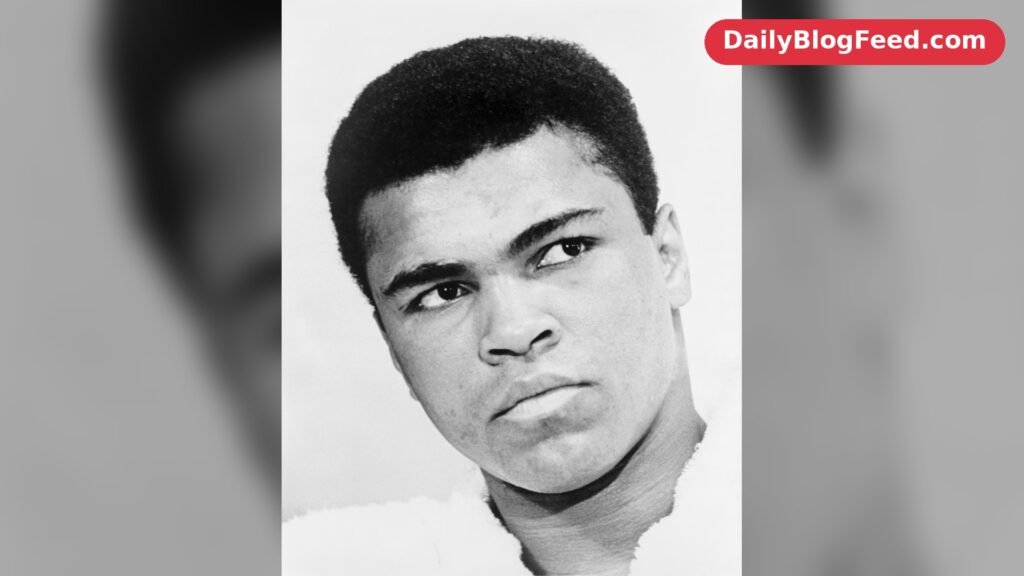

Muhammad Ali was more than a boxer, although boxing alone would have made him famous. He was a showman, a poet of self-promotion, a political figure, and later a symbol of dignity in illness. People who never watched a full fight knew his name, his face, and his voice. That kind of fame is rare, and it lasted long after his last bout.
He was born Cassius Clay in Louisville, Kentucky, and he changed his name after joining the Nation of Islam. He won the heavyweight title three times, lost it, and won it back in ways that still shape how boxing history is told. He also paid a heavy price for refusing to be drafted during the Vietnam War, losing the prime years of his career for a stand he refused to soften.
This article looks at Ali’s life in full: the early years, the championship reigns, the exile, the comebacks, the family life, and the final decades when his public presence said as much as his words once had.
Quick Facts
| Fact | Detail |
|---|---|
| Full name | Muhammad Ali (born Cassius Marcellus Clay Jr.) |
| Born | 17 January 1942, Louisville, Kentucky, USA |
| Died | 3 June 2016, aged 74 |
| Wives | Sonji Roi; Belinda Boyd (Khalilah Ali); Veronica Porché; Yolanda Williams |
| Children | Nine, including Laila Ali and Muhammad Ali Jr. |
| Sport | Boxing, heavyweight division |
| Titles | Three-time world heavyweight champion |
| Famous fights | Rumble in the Jungle (1974); Thrilla in Manila (1975) |
| Olympic gold | Rome 1960, light heavyweight |
Louisville Beginnings and the Making of Cassius Clay
Cassius Marcellus Clay Jr. was born on 17 January 1942 in Louisville, Kentucky. His father painted billboards and signs, and his mother worked as a household domestic.
Louisville in the 1940s and 1950s was segregated, and young Cassius grew up with a clear sense of racial injustice. That awareness stayed with him for the rest of his life.
Boxing entered his life almost by chance. When he was twelve, his bicycle was stolen, and he told a police officer, Joe Martin, that he wanted to beat up the thief. Martin, who also ran a boxing gym, suggested he learn to fight first.
Clay took up the sport and quickly showed unusual speed for a tall young boxer. He won amateur titles and built a reputation for fast hands, quick feet, and constant talk.
In 1960, at the age of eighteen, Clay won the light heavyweight gold medal at the Rome Olympics. He returned to Louisville as a national figure, but professional boxing was still a difficult world to enter. He turned professional later that year and began a run of victories that made him a contender. His style was already distinctive: he moved like a smaller man, kept his hands low, and talked through fights in rhymes and predictions.
By 1964, he was ready to challenge Sonny Liston for the heavyweight title. Liston was feared as one of the hardest punchers in the sport, and most experts expected Clay to lose. Instead, Clay dominated the fight, and Liston did not come out for the seventh round. At twenty-two, Cassius Clay was heavyweight champion of the world.
A New Name and a New Public Identity
Shortly after beating Liston, Clay announced that he had joined the Nation of Islam and would be known as Muhammad Ali. The name change shocked many Americans, and it cost him support in parts of the press and public. Ali did not retreat. He said his old name had been a slave name, and he insisted on being called by his new name.
The change was not just personal. It placed Ali inside a larger story about Black identity, religion, and independence in 1960s America. In that sense, his public journey ran alongside other era-defining figures.
Like Marlon Brando, who became an era-defining icon of the 1960s and 1970s through a commanding public presence, Ali became a figure people discussed far beyond his own profession. The comparison is about cultural reach, not about acting or boxing.
Ali defended his title successfully through the mid-1960s, beating Liston again, Floyd Patterson, and other contenders. His confidence grew with each win, and so did his audience. He was funny, fast, and unwilling to be modest in the way champions were expected to be. For many young fans, especially Black Americans, that confidence itself felt like a statement.
The Stand That Cost Him Everything
In 1967, Ali refused induction into the U.S. Army during the Vietnam War. He cited his religious beliefs and his opposition to the war, famously saying that he had no quarrel with the Viet Cong. The decision had immediate consequences.
Boxing authorities stripped him of his titles and his licence, and he was convicted of draft evasion. He faced a possible prison sentence and was barred from boxing during what should have been his athletic peak.
Ali spent nearly four years out of the ring, from 1967 to 1970. He spoke at colleges, appeared on television, and defended his position in public debates. Some audiences booed him, while others admired his willingness to lose money and fame for a principle.
The case eventually reached the U.S. Supreme Court, which in 1971 overturned his conviction on procedural grounds. He was free to box again, but the years away could never be returned.
The exile changed how history judges him. Boxers are usually judged by wins and losses, but Ali is also judged by what he gave up and why. His stand became one of the most discussed acts of conscience by an athlete in American history. It also meant that his later comebacks carried extra meaning: he was not just trying to win titles, but trying to recover time that had been taken from him.
During the same period, other Black public figures were also breaking barriers and changing expectations. Sidney Poitier broke barriers for Black Americans in the public eye in the 1960s, becoming a leading man in Hollywood at a time when such roles were rare. Ali’s barrier-breaking was different in form, but it shared that sense of a public figure expanding what was possible for Black Americans in mainstream American life.
The Comeback: Rumble and Thrilla
Ali returned to boxing in 1970 and lost to Joe Frazier in 1971 in a fight billed as the Fight of the Century. It was his first professional defeat, and it showed that the years away had taken something from him. He was still fast and clever, but he was no longer quite the untouchable mover of his youth. He rebuilt his career with wins over top contenders and earned another title shot.
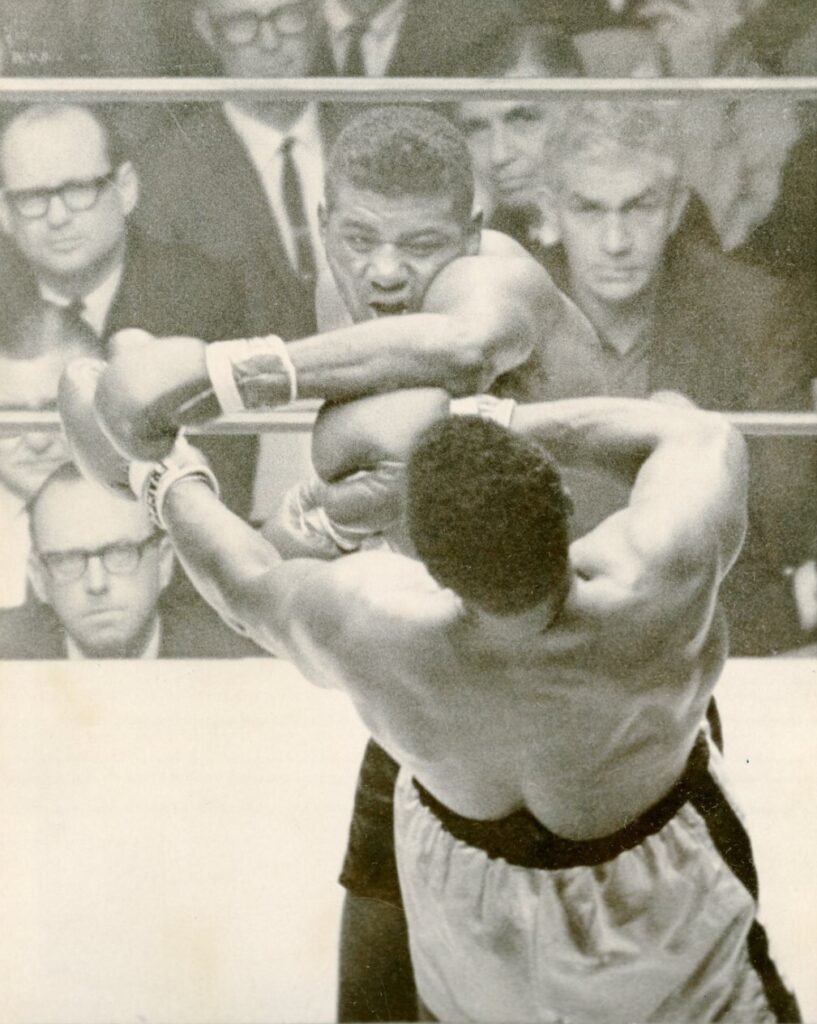
That shot came in 1974 against George Foreman in Kinshasa, Zaire, in a fight known as the Rumble in the Jungle. Foreman was younger, stronger, and heavily favoured. Ali used a tactic later called rope-a-dope, leaning on the ropes, absorbing punches, and letting Foreman tire himself out.
In the eighth round, Ali knocked Foreman out and regained the heavyweight title. At thirty-two, he was champion again.
The following year brought an even harder test. In Manila in 1975, Ali faced Frazier for a third time in the Thrilla in Manila. The fight, held in intense heat, lasted fourteen brutal rounds before Frazier’s corner stopped the contest.
Ali kept his title, but both men were badly hurt by the effort. Ali later described the fight as the closest he had come to dying in the ring, a remark that showed how much the bout had cost him.
Those two fights secured his legend. The Rumble showed his intelligence and courage, while the Thrilla showed his endurance. Together, they made his second championship reign more celebrated than his first, because it had been won against greater odds and after a longer struggle.
Beyond the Ring: Faith, Activism and Global Voice
Ali’s fame travelled far beyond the United States. He fought in Africa, Asia, and Europe, and he was welcomed as a hero in many countries where American athletes were not always popular. His opposition to the Vietnam War, his conversion to Islam, and his outspoken views on race made him a global figure in debates about justice and identity.
In later years, his religious views evolved, and he became known for a message of peace and respect across faiths. He travelled on humanitarian missions, met world leaders, and used his fame to draw attention to causes ranging from hunger to Parkinson’s research. His 1996 appearance at the Atlanta Olympics, where he lit the Olympic cauldron, became one of the most memorable moments in Olympic history.
His cultural reach in the 1960s and 1970s also placed him alongside the most charismatic public figures of the time. Like Steve McQueen, a charismatic 1960s and 1970s icon whose screen presence defined an era, Ali had a style and confidence that audiences recognised instantly. Both men became symbols of cool self-assurance, even though their crafts were entirely different.
Ali’s way with language mattered too. His rhymes, predictions, and interviews changed how athletes spoke to the media. Before Ali, most boxers gave short, cautious answers.
After Ali, showmanship became part of the job. Later generations of athletes, in boxing and beyond, borrowed from a playbook he helped write.
Family Life and Later Years
Ali married four times. His first wife was Sonji Roi, whom he married in 1964. His second wife was Belinda Boyd, later known as Khalilah Ali.
His third wife was Veronica Porché, and his fourth wife was Yolanda Williams, whom he married in 1986 and who remained his wife until his death. He had nine children, including Laila Ali, who became a successful professional boxer herself, and Muhammad Ali Jr.
Family life was complicated by fame, travel, and the demands of a long career. Ali’s children have spoken publicly about both the pride and the difficulty of growing up in his shadow. Laila Ali’s own boxing career drew natural comparisons to her father, but she built a separate reputation as an undefeated champion in women’s boxing.
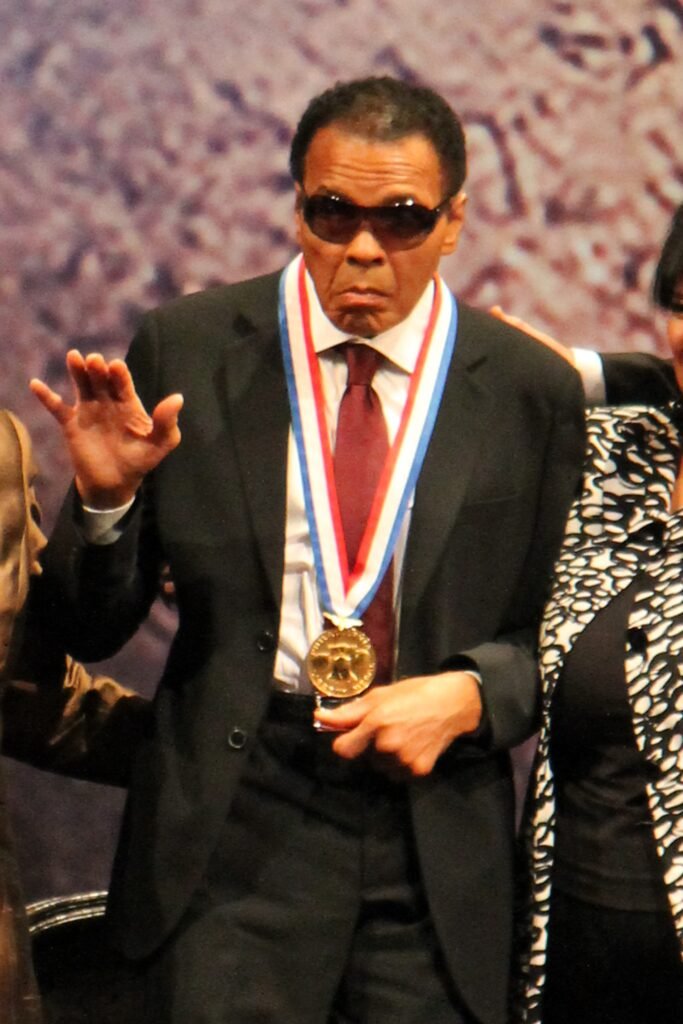
After retiring from boxing in 1981, Ali lived increasingly in Michigan with Yolanda. He remained a public figure, attending events, signing autographs, and supporting charitable work. As Parkinson’s disease progressed, his speech and movement became slower, but his public appearances still drew large crowds. Many fans described those appearances as moving precisely because they showed a man who had once been famous for words now communicating through presence alone.
Ali died on 3 June 2016, aged 74, after living with Parkinson’s disease for many years. His funeral in Louisville drew mourners from around the world and included tributes from political leaders, fellow athletes, and religious figures. The city that had shaped him became the place where his life was celebrated in full.
Net Worth and Legacy Earnings
At the time of his death, Celebrity Net Worth estimated Muhammad Ali’s net worth at around $50 million, though other outlets have offered different estimates depending on how they counted assets, earnings, and estate matters. As with all such figures, the total should be treated as an estimate, not an audited account. What is clear is that Ali earned tens of millions of dollars across his career, an extraordinary sum for a boxer of his era.
His biggest paydays came late in his career, including the Rumble in the Jungle and the Thrilla in Manila, which earned him millions at a time when boxing purses were smaller than they are today. He also earned money from endorsements, appearances, books, and licensing after retirement. Financial troubles during parts of his career have been widely reported, including disputes over management and spending, which makes precise lifetime totals difficult to pin down.
His estate has continued to earn from licensing his name and image. That ongoing value reflects how durable his fame remained after his death. Ali is not only remembered as a great boxer, but as a brand and cultural symbol whose image still appears in advertising, documentaries, and public tributes around the world.
Lesser-Known Facts
- Ali won the Olympic gold medal in Rome in 1960, but he later said he threw the medal into the Ohio River after being refused service in a Louisville restaurant, although historians have debated the details of that story.
- He worked as a young man with trainer Angelo Dundee, who remained in his corner for most of his career and helped shape his fighting style.
- Ali appeared on Broadway and recorded spoken-word albums, showing an interest in performance that went beyond boxing promotion.
- He was an accomplished amateur boxer before turning professional, winning the National Golden Gloves title and building a strong amateur record.
- Despite his famous trash talk, Ali often showed respect for opponents after fights, and he maintained friendships with several rivals later in life.
- The Muhammad Ali Center in Louisville, opened in 2005, preserves his legacy through exhibits on his boxing career, his activism, and his humanitarian work.
Frequently Asked Questions
How old was Muhammad Ali when he died?
Muhammad Ali died on 3 June 2016, aged 74. He had lived with Parkinson’s disease for many years before his death.
Who were Muhammad Ali’s wives?
Muhammad Ali married four times: Sonji Roi, Belinda Boyd (later Khalilah Ali), Veronica Porché, and Yolanda Williams. Yolanda Williams was his wife from 1986 until his death in 2016.
How many children did Muhammad Ali have?
Muhammad Ali had nine children, including Laila Ali and Muhammad Ali Jr. Laila Ali went on to become a successful professional boxer in her own right.
How many times was Muhammad Ali heavyweight champion?
Muhammad Ali was a three-time world heavyweight champion. He first won the title in 1964, regained it in 1974, and won it a third time in 1978.
What were the Rumble in the Jungle and the Thrilla in Manila?
The Rumble in the Jungle was Ali’s 1974 fight against George Foreman in Kinshasa, Zaire, which Ali won by knockout. The Thrilla in Manila was his 1975 fight against Joe Frazier in the Philippines, which Ali won when Frazier’s corner stopped the contest after fourteen rounds.
What was Muhammad Ali’s net worth?
Celebrity Net Worth estimated Muhammad Ali’s net worth at around $50 million at the time of his death, though estimates vary. The figure reflects career earnings, endorsements, and licensing, and should be read as an estimate.
The Greatest, in Full
It is easy to repeat Ali’s own nickname for himself, but his career gives the phrase real weight. He was not the greatest simply because he said so. He was great because he won titles across three decades, because he risked his career for a principle, and because he came back from exile to win again. He was also great because his influence reached people who never cared about boxing.
Ali’s life also shows the costs of greatness. He lost prime years to exile, took enormous punishment in later fights, and lived for decades with Parkinson’s disease. His story is not only about triumph, but about endurance and dignity after the spotlight faded. That fuller picture is why he remains, for many, the most important athlete of the twentieth century.