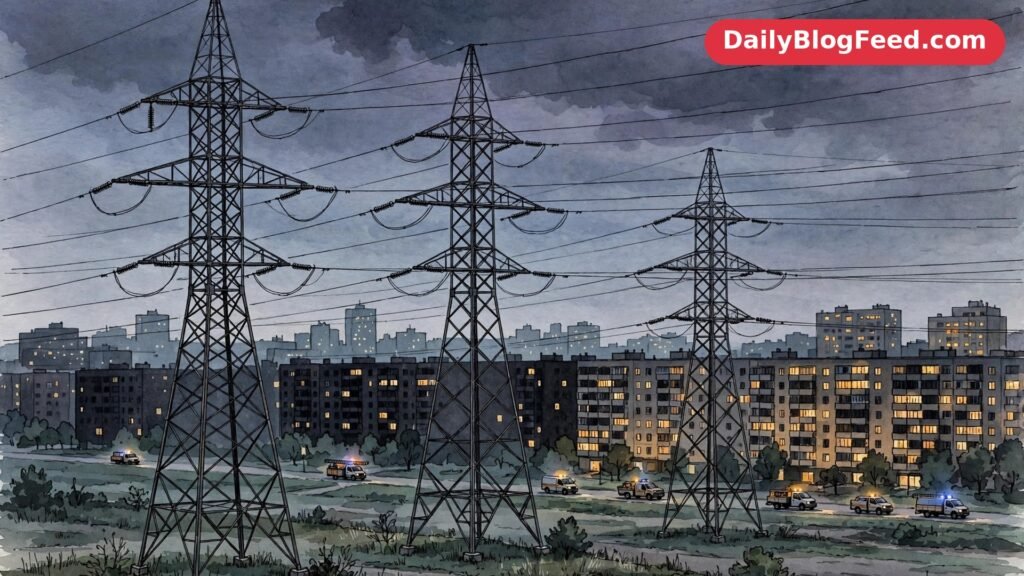

Russian strikes on energy infrastructure overnight left about 280,000 households without electricity in Ukraine, President Volodymyr Zelensky said on Saturday, October 31, 2026, as emergency crews worked to repair damaged power lines and substations ahead of winter.
According to Ukrainian officials, about 200,000 households in the city of Dnipro and the surrounding Dnipropetrovsk region were left without power, along with more than 80,000 households in the Kyiv region. The strikes formed part of a wider overnight attack in which, according to Ukraine’s air force, Russia launched 134 drones, including Shahed-type attack drones, Gerbera drones and decoys. Ukrainian air defences said they shot down or suppressed 105 of them, while strikes were recorded at 20 locations.
The regional power company in Dnipropetrovsk said the grid operator had ordered emergency power cuts across Dnipro city, adjacent districts and parts of the Pavlograd district after equipment in the region was seriously damaged. Dnipropetrovsk Governor Oleksandr Ganzha said on Telegram that power engineers had restored electricity to most customers who had been cut off, but that more than 200,000 subscribers remained without power.
In Kyiv, officials said a combined heat and power plant was hit by drones on the evening of October 30, while in Dnipropetrovsk region four electrical substations were struck overnight. Early on October 31, a drone also attacked a combined heat and power plant in Shostka, in the Sumy region, according to reports of Zelensky’s statement. Rail infrastructure in Dnipro and Kharkiv came under attack, and a gas distribution facility in Dnipropetrovsk region was also hit, officials said.
A campaign against the grid before winter
The overnight strikes are the latest in a sustained campaign against Ukraine’s energy system that has intensified as winter approaches. Ukrainian officials and energy companies have reported repeated attacks on power plants, substations and transmission lines in recent weeks, and Zelensky said Russia had hit key parts of the grid more than 30 times in the last two weeks of October alone.
Energy company DTEK, which operates sites in the Dnipropetrovsk region, said two of its facilities were seriously damaged in the latest strikes. Repair teams worked through the night, according to the regional power company, and were still working to restore power to critical infrastructure on Friday and Saturday.
The timing matters because Ukraine is entering its fifth winter since Russia’s full-scale invasion began in February 2022. The UN refugee agency has warned that temperatures in Ukraine could fall to minus 20 degrees Celsius this winter, while strikes on civilian infrastructure threaten further electricity outages and interruptions to heating. Ukrainian officials have repeatedly described the energy attacks as an attempt to wear down civilian resistance, a characterisation Moscow rejects; Russia’s defence ministry said its air defence systems had overnight shot down more than 1,000 Ukrainian drones across Russian regions, and it has previously described its strikes as aimed at military-linked targets.
The power outages in Dnipro came a day after a separate strike on a railway station in the city. According to Ukrainian officials, a Russian drone struck a busy railway platform in Dnipro on Thursday, October 29, killing at least 14 people and wounding more than a dozen others. Zelensky described that attack as horrific. Ukrainian authorities also reported civilian deaths and injuries in Zaporizhzhia and Kharkiv over the past day, according to regional officials cited in coverage of the fighting.
Fighting continues on several fronts
The overnight air attacks coincided with heavy fighting on the ground. Ukraine’s General Staff said there were 173 combat engagements over the past day, with intense fighting reported around Kostyantynivka and Pokrovsk in the Donetsk region. Ukrainian forces said they had also struck targets inside Russia, including a plant producing fuel for multiple-launch rocket systems in the Rostov region, according to Ukraine’s military. Russian officials had not commented on that claim at the time of reporting, and it could not be independently verified.
Diplomatically, the picture remained uncertain. Speaking at a meeting of G20 foreign ministers on October 31, United States Secretary of State Marco Rubio expressed uncertainty about whether a negotiated peace deal between Ukraine and Russia was possible, according to reports of the meeting. Earlier, the United States and Ukraine had agreed an Oleshky ceasefire framework, and trilateral talks had been floated, but no settlement has followed.
Meanwhile, the United States State Department approved a possible sale of 500 PAC-3 MSE Patriot interceptors worth $2.1 billion on October 30, to be paid for by Canada, Germany and Norway through a joint programme and by Ukraine with European Union loan funds, according to reports. NATO’s top military commander said deliveries of American-made weapons purchased by European allies were continuing without delays.
What happens next
In the short term, the priority for Ukrainian authorities is restoration. Power engineers in Dnipropetrovsk said they had already reconnected most customers, and work continued through Saturday to bring the remaining households back onto the grid. But officials cautioned that repeated strikes on the same facilities make lasting repairs difficult, and emergency power cuts may remain in place in affected districts while the grid is stabilised.
Looking further ahead, Ukraine’s government and its partners face the same challenge as in previous winters: keeping heating and electricity running for millions of people while the energy system remains a target. A separate United Nations winter plan for Ukraine is seeking $358.4 million to assist 2.1 million vulnerable people across the country, and the UN refugee agency launched its own $50 million winter appeal on October 30 covering Ukraine and three other war-affected countries.
For residents of Dnipro and Kyiv region, the immediate question is simpler: how quickly the lights come back on, and how long they stay on. With temperatures falling and the grid under repeated attack, Ukrainian officials have urged households to prepare for further outages, and energy workers remain on standby for the next round of repairs.
Sources: Dawn (AFP); Ukrainska Pravda; Kyiv Independent; Anadolu Agency.